Kathleen Spivack - Unspeakable Things
Здесь есть возможность читать онлайн «Kathleen Spivack - Unspeakable Things» весь текст электронной книги совершенно бесплатно (целиком полную версию без сокращений). В некоторых случаях можно слушать аудио, скачать через торрент в формате fb2 и присутствует краткое содержание. Год выпуска: 2016, Издательство: Knopf, Жанр: Современная проза, на английском языке. Описание произведения, (предисловие) а так же отзывы посетителей доступны на портале библиотеки ЛибКат.
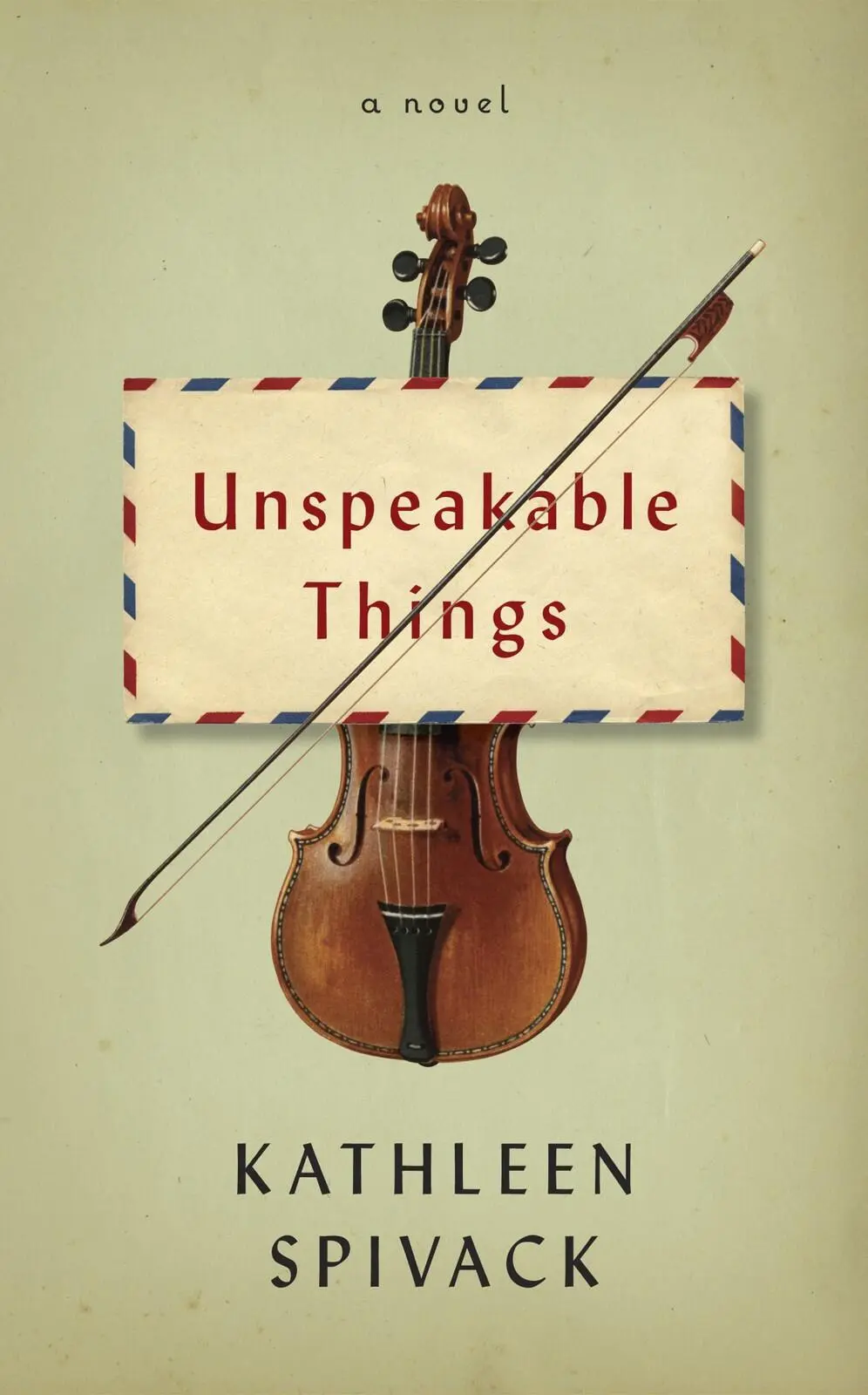
- Название:Unspeakable Things
- Автор:
- Издательство:Knopf
- Жанр:
- Год:2016
- ISBN:нет данных
- Рейтинг книги:4 / 5. Голосов: 1
-
Избранное:Добавить в избранное
- Отзывы:
-
Ваша оценка:
Unspeakable Things: краткое содержание, описание и аннотация
Предлагаем к чтению аннотацию, описание, краткое содержание или предисловие (зависит от того, что написал сам автор книги «Unspeakable Things»). Если вы не нашли необходимую информацию о книге — напишите в комментариях, мы постараемся отыскать её.
and
. A strange, haunting novel about survival and love in all its forms; about sexual awakenings and dark secrets; about European refugee intellectuals who have fled Hitler’s armies with their dreams intact and who have come to an elusive new (American) “can do, will do” world they cannot seem to find. A novel steeped in surreal storytelling and beautiful music that transports its half-broken souls — and us — to another realm of the senses.
The setting: the early 1940s, New York — city of refuge, city of hope, with the specter of a red-hot Europe at war.
At the novel’s center: Anna (known as the Rat), an exotic Hungarian countess with the face of an angel, beautiful eyes, and a seraphic smile, with a passionate intelligence, an exquisite ugliness, and the power to enchant. . Her second cousin Herbert, a former minor Austrian civil servant who believes in Esperanto and the international rights of man, wheeling and dealing in New York, powerful in the social sphere yet under the thumb of his wife, Adeline. . Michael, their missing homosexual son. . Felix, a German pediatrician who dabbles in genetic engineering, practicing from his Upper East Side office with his little dachshund, Schatzie, by his side. . The Tolstoi String Quartet, four men and their instruments, who for twenty years lived as one, playing the great concert halls of Europe, escaping to New York with their money sewn into the silk linings of their instrument cases. .
And watching them all: Herbert’s eight-year-old granddaughter, Maria, who understands from the furtive fear of her mother, and the huddled penury of their lives, and the sense of being in hiding, even in New York, that life is a test of courage and silence, Maria witnessing the family’s strange comings and goings, being regaled at night, when most are asleep, with the intoxicating, thrilling stories of their secret pasts. . of lives lived in Saint Petersburg. . of husbands being sent to the front and large, dangerous debts owed to the Tsar of imperial Russia, of late-night visits by coach to the palace of the Romanovs to beg for mercy and avoid execution. . and at the heart of the stories, told through the long nights with no dawn in sight, the strange, electrifying tale of a pact made in desperation with the private adviser to the Tsar and Tsarina — the mystic faith healer Grigory Rasputin (Russian for “debauched one”), a pact of “companionship” between Anna (the Rat) and the scheming Siberian peasant — turned — holy man, called the Devil by some, the self-proclaimed “only true Christ,” meeting night after night in Rasputin’s apartments, and the spellbinding, unspeakable things done there in the name of penance and pleasure. .
Unspeakable Things — читать онлайн бесплатно полную книгу (весь текст) целиком
Ниже представлен текст книги, разбитый по страницам. Система сохранения места последней прочитанной страницы, позволяет с удобством читать онлайн бесплатно книгу «Unspeakable Things», без необходимости каждый раз заново искать на чём Вы остановились. Поставьте закладку, и сможете в любой момент перейти на страницу, на которой закончили чтение.
Интервал:
Закладка:
“Furthermore,” added the wives, “I hate your music!”
The men did not respond to these provocations, but their enjoyment of their instruments at night was slightly curtailed. No longer did the instruments sing out with joy; they sang in furtive whispers now.
“I want to sleep in the bed,” the wives whined all night long. The men could hear them turning over on the floor restlessly. “I want the bed! Listen to me,” they complained. Where before the men went to sleep listening to the strains of the Brahms or Schubert they had just finished playing, now their concentration was disturbed.
“Ach, there is dust here under the bed.” The wives thrashed. “Why did I never see it before? Why must I lie here on the floor looking at dust while she — the musical instrument — gets to sleep on the pillow? On my mother’s sheets. Does she think I am just her maid, hmm?”
The violins, viola, and violoncello said nothing to this unfair attack as the men pressed their cheeks to the smooth necks of the instruments and curled their fingers around them. But the next morning, at the rehearsal, it was hard to feel their customary joy.
Somewhere in the recesses of the first violinist’s flat, four discontented women threw pots around the kitchen, and the sounds of quarrels and complicity filled the air.
“Again,” commanded the first violinist in rehearsal. He had been distracted. “The first movement again.”
“But why?” The second violinist questioned.
“Silence.”
All four men laid their instruments aside. Never in the history of the Tolstoi Quartet had the authority and decision of the first violinist been questioned. “Because…,” the chief finally stuttered. “Because…” He could find no reason. Silently, he took off his glasses and wiped them, laying them on the music stand. All the men looked at one another. “My friends…,” began the first violinist with difficulty. “Oh, my friends…”
“Oh mein Gott!” the second violinist cried aloud in an agony of remorse and shame. “Forgive me! Forgive me,” “Shh,” said the cellist, laying a restraining hand on his knee. “It is normal,” added the viola player soothingly. “We begin again.”
And then, as if the interruption had never happened, the four men took up their instruments and played the first movement from the top. But the heart had gone out of them, and the instruments sounded dispirited.
“My friends…” The first violinist sighed as the four men put down their bows, and before they could turn the page and essay the second movement. “Nothing is normal,” muttered the cellist. He looked at his watch. It was almost time for lunch, that savory mixture of soups, dumplings, breads, and apple strudel that sustained the men through long rehearsals. “Maybe we should stop for the day.” The four men took out their cloths of red velvet and rubbed down their instruments, which lay inert and silent as little children. For they, too, were depressed at their rendition of the first movement. “It is nothing. We will play it again after lunch,” the men promised one another. But the instruments did not gleam with their usual luster, not even after their rubdowns.
Laying the instruments in their cases, the men did not shut the lids, but left everything as it was, the bows on the music stands, the pages of musical notes still gesturing wildly to them, and headed for the kitchen, where, as usual, they would sit down and eat amid the cheerfulness of scented steam.
As they trooped in single file, the men rubbed their hands in anticipation. “Here we are, my darlings!” sang out the first violinist, as he had every lunchtime for fifteen years. But silence greeted them. The kitchen was tidy and cold. No pots bubbling merrily on the stove. And the enamel kitchen table was unadorned. No tablecloth, no deep white bowls awaiting soup and gratitude. Nothing. The kitchen stood bare and clean and cheerless. Bewildered, the four men looked at one another. What was this? What was this terrible void?
“Where are you, my little dumplings?” the men sang out, as if playing a little game of hide-and-seek. They tiptoed around the room, into the pantry. “Where are you, our little mice? Our dearest ones? Our little strudels? Our sweet little legs of lamb?”
But there was no answer. Clasping their hands in front of them, the men coaxed. “Come out, come out, little darlings. Are you hiding from us, silly ones? Oh, come here our succulent pork chops, our sugar buns.”
Again, nothing but cold silence greeted them. “Now, my dearest ones, be reasonable,” said the first violinist, trying a sterner note. “You know it is lunchtime. And we must eat. This is enough of joking.” Still no answer. The men looked at one another. Their eyes widened and they began to feel frightened. “Come now, our Lebkuchen, this has gone on long enough.” The cold kitchen gave no answer, and the instruments, waiting in the parlor, were silent also. A vacancy filled the house.
Chapter 11 WHAT IS MISSING?
Soon all of Vienna knew the wives had gone. But where? That was a mystery. The men continued to practice as before, to give their concerts, and to travel together, sharing rooms. They could be seen walking together as a single body, each carrying an instrument, as if nothing had happened. Only — at night — some joy had gone from their sleeping. Although they lay freely now with their instruments, although beautiful music resounded at full voice from the bedrooms, there was something missing. It did not have the same sweetness, perhaps, as the piano sobs in the muffled nights attended by their wives.
And yet they would have said, if asked, that they were now happy. They could play music freely; they could rehearse until the small hours of the night — no one to complain or shout “I hate music!” at embarrassing intervals.
Only, there was the problem of food. Musicians, like everyone else, must eat. Or maybe they must eat even more. “For after all,” as the violist used to remind his wife at mealtimes, “I must eat for two.” Although some of the good women of Vienna, the same women who swooned over the men and their music in the grand concert hall, left casseroles at the violinist’s door, and although sometimes there would be found a large tureen of good chicken soup, there were many times when the men were obliged to live only on Sacher-Torte and Apfelstrudel purchased from the Café Mozart or the Hotel Sacher or one of the establishments that produced good strong coffee and cake. “Man does not live by cake alone,” reminded the cellist jokingly. The men grew nervous and thin.
“Gentlemen, something is missing,” the cellist announced gravely as, after a nearly spirited rendition of the third movement of a Brahms quartet during rehearsal, the men sat back for a moment and returned their instruments to their cases. Without music, the apartment was suspiciously quiet, and each man sighed, remembering the good meals that had awaited them so often at moments like this in the past. “Ach, how I miss Gudrun,” said the second violinist. “And Inge,” said the first violinist. “And I, too, my sweet little Ludi,” added the violist. “And Olga,” the cellist said. The men sighed, and their instruments shifted restlessly, twanging a bit awkwardly as they did so.
“Yes.” The violist sighed. “We must face this. Gentlemen”—he leaned forward portentously—“we are getting stale.”
“We are getting old,” whispered the second violinist. “Old!” Could it be true? Startled, the four men looked at one another in wonder. Yes, these dear faces were now lined. They all wore spectacles now to read the music. Hair, formerly tumultuous and passionate, was now almost white, thinning, and in the case of the cellist, it had gone completely. Their kindly faces were wrinkled, especially at the smile lines. How had this happened? Four ardent young men had, in the course of years, grown old.
Читать дальшеИнтервал:
Закладка:
Похожие книги на «Unspeakable Things»
Представляем Вашему вниманию похожие книги на «Unspeakable Things» списком для выбора. Мы отобрали схожую по названию и смыслу литературу в надежде предоставить читателям больше вариантов отыскать новые, интересные, ещё непрочитанные произведения.










Обсуждение, отзывы о книге «Unspeakable Things» и просто собственные мнения читателей. Оставьте ваши комментарии, напишите, что Вы думаете о произведении, его смысле или главных героях. Укажите что конкретно понравилось, а что нет, и почему Вы так считаете.