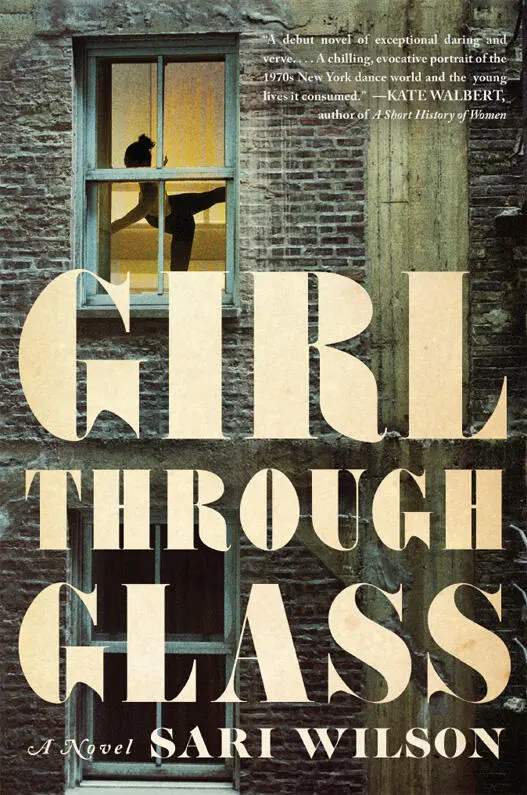
Sari Wilson - Girl Through Glass
Здесь есть возможность читать онлайн «Sari Wilson - Girl Through Glass» весь текст электронной книги совершенно бесплатно (целиком полную версию без сокращений). В некоторых случаях можно слушать аудио, скачать через торрент в формате fb2 и присутствует краткое содержание. Год выпуска: 2016, Издательство: HarperCollins, Жанр: Современная проза, на английском языке. Описание произведения, (предисловие) а так же отзывы посетителей доступны на портале библиотеки ЛибКат.
- Название:Girl Through Glass
- Автор:
- Издательство:HarperCollins
- Жанр:
- Год:2016
- ISBN:нет данных
- Рейтинг книги:3 / 5. Голосов: 1
-
Избранное:Добавить в избранное
- Отзывы:
-
Ваша оценка:
Girl Through Glass: краткое содержание, описание и аннотация
Предлагаем к чтению аннотацию, описание, краткое содержание или предисловие (зависит от того, что написал сам автор книги «Girl Through Glass»). Если вы не нашли необходимую информацию о книге — напишите в комментариях, мы постараемся отыскать её.
In the roiling summer of 1977, eleven-year-old Mira is an aspiring ballerina in the romantic, highly competitive world of New York City ballet. Enduring the mess of her parent’s divorce, she finds escape in dance — the rigorous hours of practice, the exquisite beauty, the precision of movement, the obsessive perfectionism. Ballet offers her control, power, and the promise of glory. It also introduces her to forty-seven-year-old Maurice DuPont, a reclusive, charismatic balletomane who becomes her mentor.
Over the course of three years, Mira is accepted into the prestigious School of American Ballet run by the legendary George Balanchine, and eventually becomes one of “Mr. B’s girls”—a dancer of rare talent chosen for greatness. As she ascends higher in the ballet world, her relationship with Maurice intensifies, touching dark places within herself and sparking unexpected desires that will upend both their lives.
In the present day, Kate, a professor of dance at a Midwestern college, embarks on a risky affair with a student that threatens to obliterate her career and capsizes the new life she has painstakingly created for her reinvented self. When she receives a letter from a man she’s long thought dead, Kate is hurled back into the dramas of a past she thought she had left behind.
Told in interweaving narratives that move between past and present,
illuminates the costs of ambition, secrets, and the desire for beauty, and reveals how the sacrifices we make for an ideal can destroy — or save — us.
Girl Through Glass — читать онлайн бесплатно полную книгу (весь текст) целиком
Ниже представлен текст книги, разбитый по страницам. Система сохранения места последней прочитанной страницы, позволяет с удобством читать онлайн бесплатно книгу «Girl Through Glass», без необходимости каждый раз заново искать на чём Вы остановились. Поставьте закладку, и сможете в любой момент перейти на страницу, на которой закончили чтение.
Интервал:
Закладка:
I remember Maurice’s eyes burning into me, as if he owned me. I remember the inside of his car, its plush silence, like the inside of a theater before a show. My broken wrist, his broken legs. Two broken things. But I had wanted that too, to be owned by him.
I turn around and head away from the park, back toward Felicia’s apartment.
CHAPTER 28 FALL 1978
The smell from the dank hallways seeps into the classroom. A rainstorm has moved overhead. Steady rain pounds on the high studio windows. Outside, the sky is green. A leak has begun near the window and has made a small puddle. An industrial rubber bucket has appeared. Every twenty minutes or so, Danilova carries the bucket herself to the doorway, where it is carried away by one of the male scholarship students, all the while calling out instructions to their class. For the minute she is gone, the water leaks onto the floor.
They are in the middle of Variations with Danilova. “Remind me of days of Russian Revolution,” Danilova says in her accented singsong voice. “No bread, no toilets, no heat! Ah, we are so lucky here to only have some small, silly leaks.” Her English is much better than Tumkovsky’s. Her body is still recognizable as a dancer’s. Even in her ballroom shoes — an American affectation they all forgive her for because she is Danilova — her high arches pop. Her legs are still long, muscled — a dancer’s. She wears dark eyeliner. Her hair is dyed blond, short and swept back. Along with her trademark brightly colored scarf — she favors blues and greens — Danilova gives the impression that she is on a yacht in the middle of a high wind. She holds her nose up high. Her chin quivers with dignity.
“Tondue finish, girls. Now ronde de jambe . Yes, girls,” Danilova is saying. “Make the body sing.”
Mira can feel the shift in the room. The air pressure drops. She turns. Mr. B is teetering into the room on the arm of Karin von Aroldingen. They all turn to stare, then try to pretend they are not staring. She hadn’t even heard he was out of the hospital. But here he is now. His turtle-like head is tilted at a strange angle, but he doesn’t look sick. Though he is not a tall man, he does not seem short either. He is taller than Maurice.
“Hello, dears,” he says. “Hello!”
Mr. B lets go of Karin’s arm and cocks his head to take each of them in. He walks over and looks in the bucket.
He says something to Danilova in Russian and they laugh. “Girls,” he says. “If the sky is falling, make it beautiful.”
Then he turns to the pianist. “Play nothing,” he says softly. “I want to hear them.” Since she saw him last at the Russian Tea Room his face has grown longer and his skin more papery. Maurice looks like a boy compared to him. But she recognizes the eyes that touch on each of them brightly, merrily. She remembers the question he asked Maurice: Is she one of mine? What had Maurice said? “No. No,” he had said. She widens her second position. Danilova has them line up in a row in back of the room. They will do their across-the-floor for Mr. B. They will parade one at a time.
He wants to hear them, he wants to see them. They do not meet one another’s eyes as they unwrap their chiffon skirts and hang them from the barre. Now they stand in just their white tights and pink leotards.
“Just walk,” Mr. B says. “Just walk.” Just walk? The great Mr. B wants them to walk across the room?
“Like waiter at Russian Tea Room. Just walk, carrying tray. You want to do Plisetskaya head-kick? First you must be waiter.”
What Mr. B is asking from her is something no one has asked from her before in all her years of ballet. Why couldn’t they do an arabesque, a million-dollar pose, flash a smile? Why couldn’t she show him how she could be beautiful — how nicely she danced — how well she had learned? I know how to walk. I want to learn how to be a ballerina. She imagines saying it, the words dropping out of her mouth like heavy drops into a bucket. Would they shock everyone? No, all the girls must feel as she does.
But she does not say this. No one does. They are dancers — they do not talk, they move. Of course they do what Mr. B asks. They walk past him. One by one, Mr. B stops them as they walk across the room to correct them. He watches Felicia go, head held high, her arms in first position. “No, no,” he says. “Too pretty.” Then Bryce goes, walking too fast, skittering like a mouse, slipping on the little puddle by the bucket and, arms flailing, catching herself before she hits the ground. “Yes.” He gives a dry giggle. “Better.”
It’s her turn. She feels something: cold, shivery, then hot. Her skin prickles. She feels a wildness growing in her, something like a panther about to spring. How has a walk, just a walk, set this free in her?
“Yes,” Mr. B says. He is pointing at her. “Fast, no thinking. Don’t think. Do.”
He stops Mira in the center of the room. He stands before her. “ Bourrées. Same feeling. Very simple step, right? But very difficult. Must feel wind at back. Very fast. Never catch up to yourself.” The music has started again. She is moving, now running, her bourrées are too rushed but he doesn’t chide her like Ms. Clement would. “Yes,” he says. Then she has forgotten him. She is moving across the floor and over the floor and cannot see him watching; she is just moving and feeling. The music has stopped but she has kept going, her eyelids at half-mast. When she finally stops, breathing hard and looking around, she sees that he is gone and everyone is looking at her, their eyes burning with hatred, and she knows without anyone telling her that she is a Mr. B girl.

After class, she rushes out to the fountain to meet Maurice. He’s there, his shimmering white lawn of hair, his black cape. Wearing a top hat, the gentleman from the storybooks — her prince — waiting for her in the lamplights outside by the fountain, like Drosselmeyer in The Nutcracker , holding out something to her, this thing, a gift — the nutcracker! — but in this case the gift is his hungry, adoring eyes that alight on her, burn her into being, and now she is here: a Mr. B girl.
“He came to our class today. He asked me to demonstrate.”
“Ah.” He takes her hands in his. “He chose you?”
The one thing in her tilting world, her scattered life, the one who held her to the side of the pool, told her to jump. She’d jumped. She looks at him. “Yes.” He smiles.
Back at Maurice’s house, in his living room, he has not turned on the overhead light, and the streetlight shines in from outside, illuminating the space in front of the couch like a spotlight. He stares at Mira. He takes a few awkward steps toward her. His face is whiter than ever before.
“Bella,” he says. He whispers: “Show me what Mr. B saw.” Behind his gold clocks, without his velvet, his chandelier, his exotic fish, his candelabras, he needs her.
She dances on pointe, which is hard on his carpet. She does an extension in relevé . She bourrées from one end of the room to the other, thinking about what Mr. B said, feeling the same wind at her back, the shivery hot-cold feeling.
When she is finished, she stands panting in the middle of the room. His eyes are shining.
He leans forward. “I see it,” he says. “It’s a cold wind on a winter’s night that cuts the cheek, it’s that last breath in the body that does not want to leave, it is earth and sky. I have not seen that before. How did he get that?”
Читать дальшеИнтервал:
Закладка:
Похожие книги на «Girl Through Glass»
Представляем Вашему вниманию похожие книги на «Girl Through Glass» списком для выбора. Мы отобрали схожую по названию и смыслу литературу в надежде предоставить читателям больше вариантов отыскать новые, интересные, ещё непрочитанные произведения.








Обсуждение, отзывы о книге «Girl Through Glass» и просто собственные мнения читателей. Оставьте ваши комментарии, напишите, что Вы думаете о произведении, его смысле или главных героях. Укажите что конкретно понравилось, а что нет, и почему Вы так считаете.