Chimamanda Adichie - Americanah
Здесь есть возможность читать онлайн «Chimamanda Adichie - Americanah» весь текст электронной книги совершенно бесплатно (целиком полную версию без сокращений). В некоторых случаях можно слушать аудио, скачать через торрент в формате fb2 и присутствует краткое содержание. Год выпуска: 2013, Издательство: Knopf, Жанр: Современная проза, на английском языке. Описание произведения, (предисловие) а так же отзывы посетителей доступны на портале библиотеки ЛибКат.
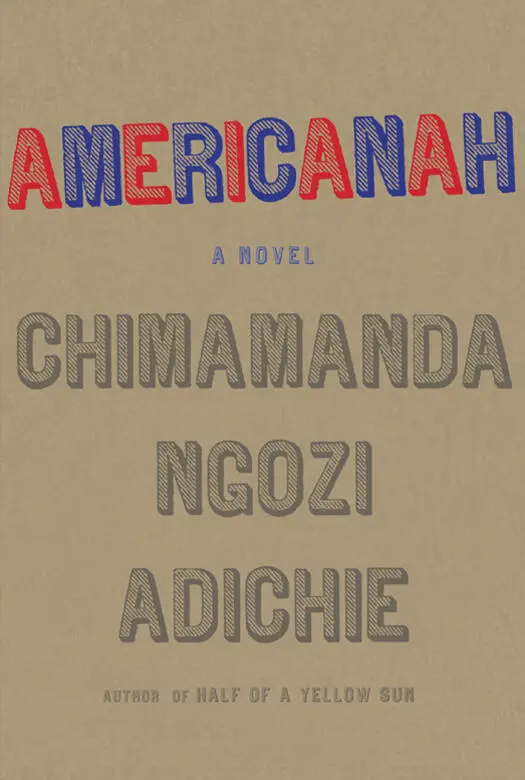
- Название:Americanah
- Автор:
- Издательство:Knopf
- Жанр:
- Год:2013
- ISBN:нет данных
- Рейтинг книги:4 / 5. Голосов: 1
-
Избранное:Добавить в избранное
- Отзывы:
-
Ваша оценка:
Americanah: краткое содержание, описание и аннотация
Предлагаем к чтению аннотацию, описание, краткое содержание или предисловие (зависит от того, что написал сам автор книги «Americanah»). Если вы не нашли необходимую информацию о книге — напишите в комментариях, мы постараемся отыскать её.
, a dazzling new novel: a story of love and race centered around a young man and woman from Nigeria who face difficult choices and challenges in the countries they come to call home.
As teenagers in a Lagos secondary school, Ifemelu and Obinze fall in love. Their Nigeria is under military dictatorship, and people are leaving the country if they can. Ifemelu — beautiful, self-assured — departs for America to study. She suffers defeats and triumphs, finds and loses relationships and friendships, all the while feeling the weight of something she never thought of back home: race. Obinze — the quiet, thoughtful son of a professor — had hoped to join her, but post-9/11 America will not let him in, and he plunges into a dangerous, undocumented life in London.
Years later, Obinze is a wealthy man in a newly democratic Nigeria, while Ifemelu has achieved success as a writer of an eye-opening blog about race in America. But when Ifemelu returns to Nigeria, and she and Obinze reignite their shared passion — for their homeland and for each other — they will face the toughest decisions of their lives.
Fearless, gripping, at once darkly funny and tender, spanning three continents and numerous lives,
is a richly told story set in today’s globalized world: Chimamanda Ngozi Adichie’s most powerful and astonishing novel yet.
Americanah — читать онлайн бесплатно полную книгу (весь текст) целиком
Ниже представлен текст книги, разбитый по страницам. Система сохранения места последней прочитанной страницы, позволяет с удобством читать онлайн бесплатно книгу «Americanah», без необходимости каждый раз заново искать на чём Вы остановились. Поставьте закладку, и сможете в любой момент перейти на страницу, на которой закончили чтение.
Интервал:
Закладка:
Obinze got his phone number from Nicholas and called him.
“The Zed! Kinsman! You did not tell me you were coming to London!” Iloba said. “How is your mother? What of your uncle, the one who married from Abagana? How is Nicholas?” Iloba sounded full of a simple happiness. There were people who were born with an inability to be tangled up in dark emotions, in complications, and Iloba was one of them. For such people, Obinze felt both admiration and boredom. When Obinze asked if Iloba might be able to help him find a National Insurance number, he would have understood a little resentment, a little churlishness — after all, he was contacting Iloba only because he needed something — but it surprised him how sincerely eager to help Iloba was.
“I would let you use mine but I am working with it and it is risky,” Iloba said.
“Where do you work?”
“In central London. Security. It’s not easy, this country is not easy, but we are managing. I like the night shifts because it gives me time to read for my course. I’m doing a master’s in management at Birkbeck College.” Iloba paused. “The Zed, don’t worry, we will put our heads together. Let me ask around and let you know.”
Iloba called back two weeks later to say he had found somebody. “His name is Vincent Obi. He is from Abia State. A friend of mine did the connection. He wants to meet you tomorrow evening.”
They met in Iloba’s flat. A claustrophobic feel pervaded the flat, the concrete neighborhood with no trees, the scarred walls of the building. Everything seemed too small, too tight.
“Nice place, Loba Jay You,” Obinze said, not because the flat was nice but because Iloba had a flat in London.
“I would have told you to come and stay with me, The Zed, but I live with two of my cousins.” Iloba placed bottles of beer and a small plate of fried chin-chin on the table. It seared a sharp homesickness in Obinze, this ritual of hospitality. He was reminded of going back to the village with his mother at Christmas, aunties offering him plates of chin-chin.
Vincent Obi was a small round man submerged in a large pair of jeans and an ungainly coat. As Obinze shook hands with him, they sized each other up. In the set of Vincent’s shoulders, in the abrasiveness of his demeanor, Obinze sensed that Vincent had learned very early on, as a matter of necessity, to solve his own problems. Obinze imagined his Nigerian life: a community secondary school full of barefoot children, a polytechnic paid for with help from a number of uncles, a family of many children and a crowd of dependents in his hometown who, whenever he visited, would expect large loaves of bread and pocket money carefully distributed to each of them. Obinze saw himself through Vincent’s eyes: a university staff child who grew up eating butter and now needed his help. At first Vincent affected a British accent, saying “innit” too many times.
“This is business, innit, but I’m helping you. You can use my NI number and pay me forty percent of what you make,” Vincent said. “It’s business, innit. If I don’t get what we agree on, I will report you.”
“My brother,” Obinze said. “That’s a little too much. You know my situation. I don’t have anything. Please try and come down.”
“Thirty-five percent is the best I can do. This is business.” He had lost his accent and now spoke Nigerian English. “Let me tell you, there are many people in your situation.”
Iloba spoke up in Igbo. “Vincent, my brother here is trying to save money and do his papers. Thirty-five is too much, o rika, biko . Please just try and help us.”
“You know that some people take half. Yes, he is in a situation but all of us are in a situation. I am helping him but this is business.” Vincent’s Igbo had a rural accent. He put the National Insurance card on the table and was already writing his bank account number on a piece of paper. Iloba’s cell phone began to ring. That evening, as dusk fell, the sky muting to a pale violet, Obinze became Vincent.
CHAPTER 26
Obinze-as-Vincent informed his agency, after his experience with the curled shit on the toilet lid, that he would not be returning to that job. He scoured the newspaper job pages, made calls, and hoped, until the agency offered him another job, cleaning wide passages in a detergent-packing warehouse. A Brazilian man, sallow and dark-haired, cleaned the building next to his. “I’m Vincent,” Obinze said, when they met in the back room.
“I’m Dee.” A pause. “No, you’re not English. You can pronounce it. My real name is Duerdinhito, but the English, they cannot pronounce, so they call me Dee.”
“Duerdinhito,” Obinze repeated.
“Yes!” A delighted smile. A small bond of foreignness. They talked, while emptying their vacuum cleaners, about the 1996 Olympics, Obinze gloating about Nigeria beating Brazil and then Argentina.
“Kanu was good, I give him that,” Duerdinhito said. “But Nigeria had luck.”
Every evening, Obinze was covered in white chemical dust. Gritty things lodged in his ears. He tried not to breathe too deeply as he cleaned, wary of dangers floating in the air, until his manager told him he was being fired because of a downsizing. The next job was a temporary replacement with a company that delivered kitchens, week after week of sitting beside white drivers who called him “laborer,” of endless construction sites full of noises and helmets, of carrying wood planks up long stairs, unaided and unsung. In the silence with which they drove, and the tone with which they said “laborer!” Obinze sensed the drivers’ dislike. Once, when he tripped and landed on his knee, a fall so heavy that he limped back to the truck, the driver told the others at the warehouse, “His knee is bad because he’s a knee-grow!” They laughed. Their hostility rankled, but only slightly; what mattered to him was that he earned four pounds an hour, more with overtime, and when he was sent to a new delivery warehouse in West Thurrock, he worried that he might not have opportunities for overtime.
The new warehouse chief looked like the Englishman archetype Obinze carried in his mind, tall and spare, sandy-haired and blue-eyed. But he was a smiling man, and in Obinze’s imagination, Englishmen were not smiling men. His name was Roy Snell. He vigorously shook Obinze’s hand.
“So, Vincent, you’re from Africa?” he asked, as he took Obinze around the warehouse, the size of a football field, much bigger than the last one, and alive with trucks being loaded, flattened cardboard boxes being folded into a deep pit, men talking.
“Yes. I was born in Birmingham and went back to Nigeria when I was six.” It was the story he and Iloba had agreed was most convincing.
“Why did you come back? How bad are things in Nigeria?”
“I just wanted to see if I could have a better life here.”
Roy Snell nodded. He seemed like a person for whom the word “jolly” would always be apt. “You’ll work with Nigel today, he’s our youngest,” he said, gesturing towards a man with a pale doughy body, spiky dark hair, and an almost cherubic face. “I think you’ll like working here, Vinny Boy!” It had taken him five minutes to go from Vincent to Vinny Boy and, in the following months, when they played table tennis during lunch break, Roy would tell the men, “I’ve got to beat Vinny Boy for once!” And they would titter and repeat “Vinny Boy.”
It amused Obinze, how keenly the men flipped through their newspapers every morning, stopping at the photo of the big-breasted woman, examining it as though it were an article of great interest, and were any different from the photo on that same page the previous day, the previous week. Their conversations, as they waited for their trucks to be loaded up, were always about cars and football and, most of all, women, each man telling stories that sounded too apocryphal and too similar to a story told the day before, the week before, and each time they mentioned knickers— the bird flashed her knickers —Obinze was even more amused, because knickers were, in Nigerian English, shorts rather than underwear, and he imagined these nubile women in ill-fitting khaki shorts, the kind he had worn as a junior student in secondary school.
Читать дальшеИнтервал:
Закладка:
Похожие книги на «Americanah»
Представляем Вашему вниманию похожие книги на «Americanah» списком для выбора. Мы отобрали схожую по названию и смыслу литературу в надежде предоставить читателям больше вариантов отыскать новые, интересные, ещё непрочитанные произведения.








Обсуждение, отзывы о книге «Americanah» и просто собственные мнения читателей. Оставьте ваши комментарии, напишите, что Вы думаете о произведении, его смысле или главных героях. Укажите что конкретно понравилось, а что нет, и почему Вы так считаете.