Chimamanda Adichie - Americanah
Здесь есть возможность читать онлайн «Chimamanda Adichie - Americanah» весь текст электронной книги совершенно бесплатно (целиком полную версию без сокращений). В некоторых случаях можно слушать аудио, скачать через торрент в формате fb2 и присутствует краткое содержание. Год выпуска: 2013, Издательство: Knopf, Жанр: Современная проза, на английском языке. Описание произведения, (предисловие) а так же отзывы посетителей доступны на портале библиотеки ЛибКат.
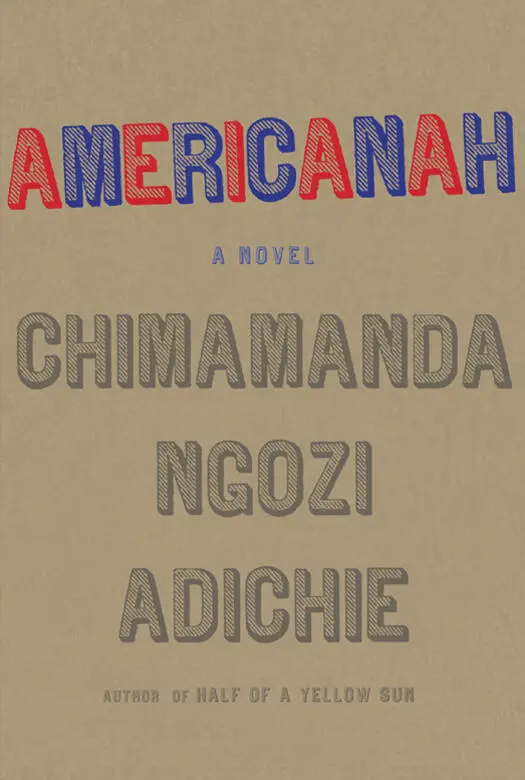
- Название:Americanah
- Автор:
- Издательство:Knopf
- Жанр:
- Год:2013
- ISBN:нет данных
- Рейтинг книги:4 / 5. Голосов: 1
-
Избранное:Добавить в избранное
- Отзывы:
-
Ваша оценка:
Americanah: краткое содержание, описание и аннотация
Предлагаем к чтению аннотацию, описание, краткое содержание или предисловие (зависит от того, что написал сам автор книги «Americanah»). Если вы не нашли необходимую информацию о книге — напишите в комментариях, мы постараемся отыскать её.
, a dazzling new novel: a story of love and race centered around a young man and woman from Nigeria who face difficult choices and challenges in the countries they come to call home.
As teenagers in a Lagos secondary school, Ifemelu and Obinze fall in love. Their Nigeria is under military dictatorship, and people are leaving the country if they can. Ifemelu — beautiful, self-assured — departs for America to study. She suffers defeats and triumphs, finds and loses relationships and friendships, all the while feeling the weight of something she never thought of back home: race. Obinze — the quiet, thoughtful son of a professor — had hoped to join her, but post-9/11 America will not let him in, and he plunges into a dangerous, undocumented life in London.
Years later, Obinze is a wealthy man in a newly democratic Nigeria, while Ifemelu has achieved success as a writer of an eye-opening blog about race in America. But when Ifemelu returns to Nigeria, and she and Obinze reignite their shared passion — for their homeland and for each other — they will face the toughest decisions of their lives.
Fearless, gripping, at once darkly funny and tender, spanning three continents and numerous lives,
is a richly told story set in today’s globalized world: Chimamanda Ngozi Adichie’s most powerful and astonishing novel yet.
Americanah — читать онлайн бесплатно полную книгу (весь текст) целиком
Ниже представлен текст книги, разбитый по страницам. Система сохранения места последней прочитанной страницы, позволяет с удобством читать онлайн бесплатно книгу «Americanah», без необходимости каждый раз заново искать на чём Вы остановились. Поставьте закладку, и сможете в любой момент перейти на страницу, на которой закончили чтение.
Интервал:
Закладка:
“London is a leveler. We are now all in London and we are now all the same, what nonsense,” Bose said.
“Maybe he should go and find a Jamaican woman,” Amara said. Her husband had left her for a Jamaican woman, with whom it turned out he had a secret four-year-old child, and she somehow managed to veer every conversation towards the subject of Jamaicans. “These West Indian women are taking our men and our men are stupid enough to follow them. Next thing, they will have a baby and they don’t want the men to marry them o, they just want child support. All they do is spend their money doing their hair and nails.”
“Yes,” Bose, Chika, and Ojiugo all agreed. A routine, automatic agreement: Amara’s emotional well-being was more important than what they actually believed.
The phone rang. Ojiugo took the call and came back to say, “This woman who just called, she is a character. Her daughter and Nne belong to the same orchestra. I met her when Nne took her first exam. She came in her Bentley, a black woman, with a driver and everything. She asked me where we lived and when I told her, I just knew what was on her mind: how can somebody in Essex be thinking of the National Children’s Orchestra? So I decided to look for trouble and I told her, My daughter goes to Brentwood, and you should have seen her face! You know people like us are not supposed to be talking about private school and music. The most we should want is a good grammar school. I just looked at the woman and I was laughing inside. Then she started telling me that music for children is very expensive. She kept telling me how expensive it is, as if she had seen my empty bank account. Imagine o! She is one of those black people who want to be the only black person in the room, so any other black person is an immediate threat to her. She just called now to tell me that she read online about an eleven-year-old girl who got grade five distinction and did not get into the National Children’s Orchestra. Why would she call just to tell me that negative story?”
“Enemy of progress!” Bose said.
“Is she a Jamaican?” Amara asked.
“She is Black British. I don’t know where her people came from.”
“It must be Jamaica,” Amara said.
CHAPTER 25
Sharp, the word everyone used to describe Emenike in secondary school. Sharp, full of the poisoned admiration they felt for him. Sharp Guy. Sharp Man. If exam questions leaked, Emenike knew how to get them. He knew, too, which girl had had an abortion, what property the parents of the wealthy students owned, which teachers were sleeping together. He always spoke quickly, pugnaciously, as though every conversation was an argument, the speed and force of his words suggesting authority and discouraging dissent. He knew, and he was full of an eagerness to know. Whenever Kayode returned from a London vacation, flush with relevance, Emenike would ask him about the latest music and films, and then examine his shoes and clothes. “Is this one designer? What is the name of this one?” Emenike would ask, his eyes feral with longing. He had told everyone that his father was the igwe of his hometown, and had sent him to Lagos to live with an uncle until he turned twenty-one, to avoid the pressures of princely life. But one day, an old man arrived at school, wearing trousers with a mended patch near the knee, his face gaunt, his body bowed with the humility that poverty had forced on him. All the boys laughed after they discovered that he was really Emenike’s father. The laughter was soon forgotten, perhaps because nobody had ever fully believed the prince story — Kayode, after all, always called Emenike Bush Boy behind his back. Or perhaps because they needed Emenike, who had information that nobody else did. This, the audacity of him, had drawn Obinze. Emenike was one of the few people for whom “to read” did not mean “to study,” and so they would spend hours talking about books, bartering knowledge for knowledge, and playing Scrabble. Their friendship grew. At university, when Emenike lived with him in the boys’ quarters of his mother’s house, people had sometimes mistaken him for a relative. “What of your brother?” people would ask Obinze. And Obinze would say, “He’s fine,” without bothering to explain that he and Emenike were not related at all. But there were many things he did not know about Emenike, things he knew not to ask about. Emenike often left school for weeks, only vaguely saying that he had “gone home,” and he spoke endlessly of people who were “making it” abroad. His was the coiled, urgent restlessness of a person who believed that fate had mistakenly allotted him a place below his true destiny. When he left for England during a strike in their second year, Obinze never knew how he got a visa. Still, he was pleased for him. Emenike was ripe, bursting, with his ambition, and Obinze thought of his visa as a mercy: that ambition would finally find a release. It seemed to, quite quickly, as Emenike sent news only of progress: his postgraduate work completed, his job at the housing authority, his marriage to an Englishwoman who was a solicitor in the city.
Emenike was the first person Obinze called after he arrived in England.
“The Zed! Good to hear from you. Let me call you back, I’m just going into a managerial meeting,” Emenike said. The second time Obinze called, Emenike sounded a little harried. “I’m at Heathrow. Georgina and I are going to Brussels for a week. I’ll call you when I get back. I can’t wait to catch up, man!” Emenike’s e-mail response to Obinze had been similar: So happy you are coming this way, man, can’t wait to see you! Obinze had imagined, foolishly, that Emenike would take him in, show him the way. He knew of the many stories of friends and relatives who, in the harsh glare of life abroad, became unreliable, even hostile, versions of their former selves. But what was it about the stubbornness of hope, the need to believe in your own exceptionality, that these things happened to other people whose friends were not like yours? He called other friends. Nosa, who had left right after graduation, picked him up at the tube station and drove him to a pub where other friends soon gathered. They shook hands and slapped backs and drank draft beer. They laughed about memories from school. They said little about the details of their present lives. When Obinze said he needed to get a National Insurance number, and asked, “Guys, how I go take do?” they all shook their heads vaguely.
“Just keep your ear to the ground, man,” Chidi said.
“The thing is to come closer to central London. You’re too far away from things, in Essex,” Wale said.
As Nosa drove him back to the station later, Obinze asked, “So where do you work, guy?”
“Underground. A serious hustle, but things will get better,” Nosa said. Although Obinze knew he meant the tube, the word “underground” made him think of doomed tunnels that fed into the earth and went on forever, ending nowhere.
“What of Mr. Sharp Guy Emenike?” Nosa asked, his tone alive with malice. “He’s doing very well and he lives in Islington, with his oyinbo wife who is old enough to be his mother. He has become posh o. He doesn’t talk to ordinary people anymore. He can help sort you out.”
“He’s been traveling a lot, we haven’t yet seen,” Obinze said, hearing too clearly the limpness of his own words.
“How is your cousin Iloba?” Nosa asked. “I saw him last year at Emeka’s brother’s wedding.”
Obinze had not even remembered that Iloba now lived in London; he had last seen him days before graduation. Iloba was merely from his mother’s hometown, but he had been so enthusiastic about their kinship that everyone on campus assumed they were cousins. Iloba would often pull up a chair, smiling and uninvited, and join Obinze and his friends at a roadside bar, or appear at Obinze’s door on Sunday afternoons when Obinze was tired from the languor of Sunday afternoons. Once, Iloba had stopped Obinze at the General Studies quad, cheerfully calling out “Kinsman!” and then giving him a rundown of marriages and deaths of people from his mother’s hometown whom he hardly knew. “Udoakpuanyi died some weeks ago. Don’t you know him? Their homestead is next to your mother’s.” Obinze nodded and made appropriate sounds, humoring Iloba, because Iloba’s manner was always so pleasant and oblivious, his trousers always too tight and too short, showing his bony ankles; they had earned him the nickname “Iloba Jump Up,” which soon morphed to “Loba Jay You.”
Читать дальшеИнтервал:
Закладка:
Похожие книги на «Americanah»
Представляем Вашему вниманию похожие книги на «Americanah» списком для выбора. Мы отобрали схожую по названию и смыслу литературу в надежде предоставить читателям больше вариантов отыскать новые, интересные, ещё непрочитанные произведения.









Обсуждение, отзывы о книге «Americanah» и просто собственные мнения читателей. Оставьте ваши комментарии, напишите, что Вы думаете о произведении, его смысле или главных героях. Укажите что конкретно понравилось, а что нет, и почему Вы так считаете.