Chimamanda Adichie - Americanah
Здесь есть возможность читать онлайн «Chimamanda Adichie - Americanah» весь текст электронной книги совершенно бесплатно (целиком полную версию без сокращений). В некоторых случаях можно слушать аудио, скачать через торрент в формате fb2 и присутствует краткое содержание. Год выпуска: 2013, Издательство: Knopf, Жанр: Современная проза, на английском языке. Описание произведения, (предисловие) а так же отзывы посетителей доступны на портале библиотеки ЛибКат.
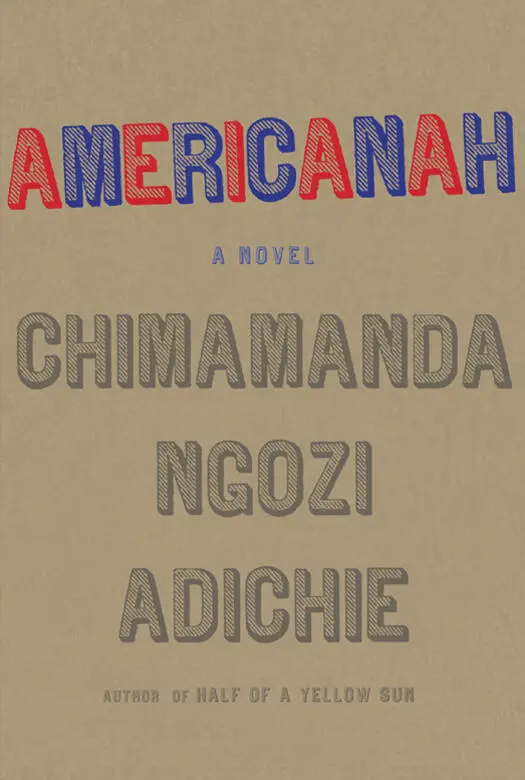
- Название:Americanah
- Автор:
- Издательство:Knopf
- Жанр:
- Год:2013
- ISBN:нет данных
- Рейтинг книги:4 / 5. Голосов: 1
-
Избранное:Добавить в избранное
- Отзывы:
-
Ваша оценка:
Americanah: краткое содержание, описание и аннотация
Предлагаем к чтению аннотацию, описание, краткое содержание или предисловие (зависит от того, что написал сам автор книги «Americanah»). Если вы не нашли необходимую информацию о книге — напишите в комментариях, мы постараемся отыскать её.
, a dazzling new novel: a story of love and race centered around a young man and woman from Nigeria who face difficult choices and challenges in the countries they come to call home.
As teenagers in a Lagos secondary school, Ifemelu and Obinze fall in love. Their Nigeria is under military dictatorship, and people are leaving the country if they can. Ifemelu — beautiful, self-assured — departs for America to study. She suffers defeats and triumphs, finds and loses relationships and friendships, all the while feeling the weight of something she never thought of back home: race. Obinze — the quiet, thoughtful son of a professor — had hoped to join her, but post-9/11 America will not let him in, and he plunges into a dangerous, undocumented life in London.
Years later, Obinze is a wealthy man in a newly democratic Nigeria, while Ifemelu has achieved success as a writer of an eye-opening blog about race in America. But when Ifemelu returns to Nigeria, and she and Obinze reignite their shared passion — for their homeland and for each other — they will face the toughest decisions of their lives.
Fearless, gripping, at once darkly funny and tender, spanning three continents and numerous lives,
is a richly told story set in today’s globalized world: Chimamanda Ngozi Adichie’s most powerful and astonishing novel yet.
Americanah — читать онлайн бесплатно полную книгу (весь текст) целиком
Ниже представлен текст книги, разбитый по страницам. Система сохранения места последней прочитанной страницы, позволяет с удобством читать онлайн бесплатно книгу «Americanah», без необходимости каждый раз заново искать на чём Вы остановились. Поставьте закладку, и сможете в любой момент перейти на страницу, на которой закончили чтение.
Интервал:
Закладка:
She woke up every day worrying about money. If she bought all the textbooks she needed, she would not have enough to pay her rent, and so she borrowed textbooks during class and made feverish notes which, reading them later, sometimes confused her. Her new class friend, Samantha, a thin woman who avoided the sun, often saying “I burn easily,” would, from time to time, let her take a textbook home. “Keep it until tomorrow and make notes if you need to,” she would say. “I know how tough things can be, that’s why I dropped out of college years ago to work.” Samantha was older, and a relief to befriend, because she was not a slack-jawed eighteen-year-old as so many others in her communications major were. Still, Ifemelu never kept the books for more than a day, and sometimes refused to take them home. It stung her, to have to beg. Sometimes after classes, she would sit on a bench in the quad and watch the students walking past the large gray sculpture in the middle; they all seemed to have their lives in the shape that they wanted, they could have jobs if they wanted to have jobs, and above them, small flags fluttered serenely from lampposts.

SHE HUNGERED to understand everything about America, to wear a new, knowing skin right away: to support a team at the Super Bowl, understand what a Twinkie was and what sports “lockouts” meant, measure in ounces and square feet, order a “muffin” without thinking that it really was a cake, and say “I ‘scored’ a deal” without feeling silly.
Obinze suggested she read American books, novels and histories and biographies. In his first e-mail to her — a cybercafé had just opened in Nsukka — he gave her a list of books. The Fire Next Time was the first. She stood by the library shelf and skimmed the opening chapter, braced for boredom, but slowly she moved to a couch and sat down and kept reading until three-quarters of the book was gone, then she stopped and took down every James Baldwin title on the shelf. She spent her free hours in the library, so wondrously well lit; the sweep of computers, the large, clean, airy reading spaces, the welcoming brightness of it all, seemed like a sinful decadence. She was used, after all, to reading books with pages missing, fallen off while passing through too many hands. And now to be in a cavalcade of books with healthy spines. She wrote to Obinze about the books she read, careful, sumptuous letters that opened, between them, a new intimacy; she had begun, finally, to grasp the power books had over him. His longing for Ibadan because of “Ibadan” had puzzled her; how could a string of words make a person ache for a place he did not know? But in those weeks when she discovered the rows and rows of books with their leathery smell and their promise of pleasures unknown, when she sat, knees tucked underneath her, on an armchair in the lower level or at a table upstairs with the fluorescent light reflecting off the book’s pages, she finally understood. She read the books on Obinze’s list but also, randomly, pulled out book after book, reading a chapter before deciding which she would speed-read in the library and which she would check out. And as she read, America’s mythologies began to take on meaning, America’s tribalisms — race, ideology, and region — became clear. And she was consoled by her new knowledge.
“YOU KNOW you said ‘excited’?” Obinze asked her one day, his voice amused. “You said you were excited about your media class.”
“I did?”
New words were falling out of her mouth. Columns of mist were dispersing. Back home, she would wash her underwear every night and hang it in a discreet corner of the bathroom. Now that she piled them up in a basket and threw them into the washing machine on Friday evenings, she had come to see this, the heaping of dirty underwear, as normal. She spoke up in class, buoyed by the books she read, thrilled that she could disagree with professors, and get, in return, not a scolding about being disrespectful but an encouraging nod.
“We watch films in class,” she told Obinze. “They talk about films here as if films are as important as books. So we watch films and then we write a response paper and almost everybody gets an A. Can you imagine? These Americans are not serious o.”
In her honors history seminar, Professor Moore, a tiny, tentative woman with the emotionally malnourished look of someone who did not have friends, showed some scenes from Roots , the images bright on the board of the darkened classroom. When she turned off the projector, a ghostly white patch hovered on the wall for a moment before disappearing. Ifemelu had first watched Roots on video with Obinze and his mother, sunk into sofas in their living room in Nsukka. As Kunta Kinte was being flogged into accepting his slave name, Obinze’s mother got up abruptly, so abruptly she almost tripped on a leather pouf, and left the room, but not before Ifemelu saw her reddened eyes. It startled her, that Obinze’s mother, fully hemmed into her self-containment, her intense privacy, could cry watching a film. Now, as the window blinds were raised and the classroom once again plunged into light, Ifemelu remembered that Saturday afternoon, and how she had felt lacking, watching Obinze’s mother, and wishing that she, too, could cry.
“Let’s talk about historical representation in film,” Professor Moore said.
A firm, female voice from the back of the class, with a non-American accent, asked, “Why was ‘nigger’ bleeped out?”
And a collective sigh, like a small wind, swept through the class.
“Well, this was a recording from network television and one of the things I wanted us to talk about is how we represent history in popular culture and the use of the N-word is certainly an important part of that,” Professor Moore said.
“It makes no sense to me,” the firm voice said. Ifemelu turned. The speaker’s natural hair was cut as low as a boy’s and her pretty face, wide-foreheaded and fleshless, reminded Ifemelu of the East Africans who always won long-distance races on television.
“I mean, ‘nigger’ is a word that exists. People use it. It is part of America. It has caused a lot of pain to people and I think it is insulting to bleep it out.”
“Well,” Professor Moore said, looking around, as though for help.
It came from a gravelly voice in the middle of the class. “Well, it’s because of the pain that word has caused that you shouldn’t use it!” Shouldn’t sailed astringently into the air, the speaker an African-American girl wearing bamboo hoop earrings.
“Thing is, each time you say it, the word hurts African Americans,” a pale, shaggy-haired boy in front said.
Ifemelu raised her hand; Faulkner’s Light in August , which she had just read, was on her mind. “I don’t think it’s always hurtful. I think it depends on the intent and also on who is using it.”
A girl next to her, face flushing bright red, burst out, “No! The word is the same for whoever says it.”
“That is nonsense.” The firm voice again. A voice unafraid. “If my mother hits me with a stick and a stranger hits me with a stick, it’s not the same thing.”
Ifemelu looked at Professor Moore to see how the word “nonsense” had been received. She did not seem to have noticed; instead, a vague terror was freezing her features into a smirk-smile.
“I agree it’s different when African Americans say it, but I don’t think it should be used in films because that way people who shouldn’t use it can use it and hurt other people’s feelings,” a light-skinned African-American girl said, the last of the four black people in class, her sweater an unsettling shade of fuchsia.
Читать дальшеИнтервал:
Закладка:
Похожие книги на «Americanah»
Представляем Вашему вниманию похожие книги на «Americanah» списком для выбора. Мы отобрали схожую по названию и смыслу литературу в надежде предоставить читателям больше вариантов отыскать новые, интересные, ещё непрочитанные произведения.





Обсуждение, отзывы о книге «Americanah» и просто собственные мнения читателей. Оставьте ваши комментарии, напишите, что Вы думаете о произведении, его смысле или главных героях. Укажите что конкретно понравилось, а что нет, и почему Вы так считаете.