Chimamanda Adichie - Americanah
Здесь есть возможность читать онлайн «Chimamanda Adichie - Americanah» весь текст электронной книги совершенно бесплатно (целиком полную версию без сокращений). В некоторых случаях можно слушать аудио, скачать через торрент в формате fb2 и присутствует краткое содержание. Год выпуска: 2013, Издательство: Knopf, Жанр: Современная проза, на английском языке. Описание произведения, (предисловие) а так же отзывы посетителей доступны на портале библиотеки ЛибКат.
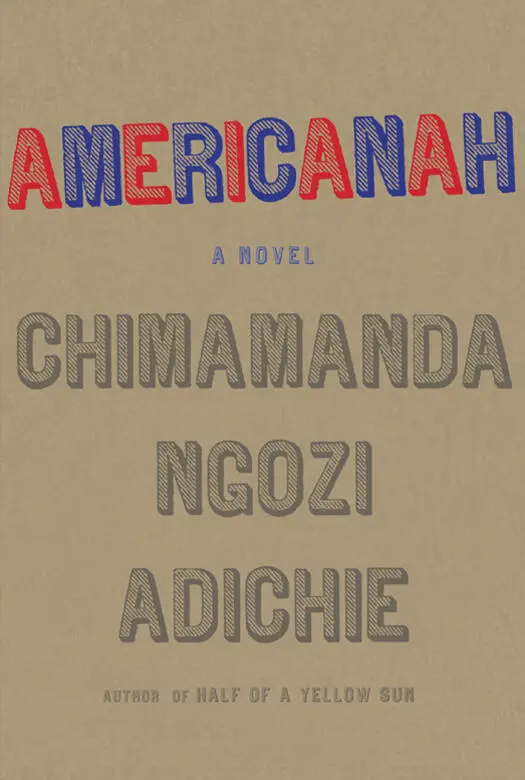
- Название:Americanah
- Автор:
- Издательство:Knopf
- Жанр:
- Год:2013
- ISBN:нет данных
- Рейтинг книги:4 / 5. Голосов: 1
-
Избранное:Добавить в избранное
- Отзывы:
-
Ваша оценка:
Americanah: краткое содержание, описание и аннотация
Предлагаем к чтению аннотацию, описание, краткое содержание или предисловие (зависит от того, что написал сам автор книги «Americanah»). Если вы не нашли необходимую информацию о книге — напишите в комментариях, мы постараемся отыскать её.
, a dazzling new novel: a story of love and race centered around a young man and woman from Nigeria who face difficult choices and challenges in the countries they come to call home.
As teenagers in a Lagos secondary school, Ifemelu and Obinze fall in love. Their Nigeria is under military dictatorship, and people are leaving the country if they can. Ifemelu — beautiful, self-assured — departs for America to study. She suffers defeats and triumphs, finds and loses relationships and friendships, all the while feeling the weight of something she never thought of back home: race. Obinze — the quiet, thoughtful son of a professor — had hoped to join her, but post-9/11 America will not let him in, and he plunges into a dangerous, undocumented life in London.
Years later, Obinze is a wealthy man in a newly democratic Nigeria, while Ifemelu has achieved success as a writer of an eye-opening blog about race in America. But when Ifemelu returns to Nigeria, and she and Obinze reignite their shared passion — for their homeland and for each other — they will face the toughest decisions of their lives.
Fearless, gripping, at once darkly funny and tender, spanning three continents and numerous lives,
is a richly told story set in today’s globalized world: Chimamanda Ngozi Adichie’s most powerful and astonishing novel yet.
Americanah — читать онлайн бесплатно полную книгу (весь текст) целиком
Ниже представлен текст книги, разбитый по страницам. Система сохранения места последней прочитанной страницы, позволяет с удобством читать онлайн бесплатно книгу «Americanah», без необходимости каждый раз заново искать на чём Вы остановились. Поставьте закладку, и сможете в любой момент перейти на страницу, на которой закончили чтение.
Интервал:
Закладка:
“That’s a pretty accent. Where are you from?”
“Nigeria.”
“Nigeria. Isn’t there a war going on there?”
“No.”
“Can I see your ID?” the woman asked, and then, glancing at the license, added, “How do you pronounce your name again?”
“Ifemelu.”
“What?”
Ifemelu almost choked. “Ngozi. You hum the N .”
“Really.” The woman, with her air of unending exhaustion, seemed too tired to question the two different pronunciations. “Can you live in?”
“Live in?”
“Yes. Live here with my dad. There’s a spare bedroom. You would do three nights a week. You’d need to clean him up in the morning.” The woman paused. “You are pretty slight. Look, I’ve two more people to interview and I’ll get back to you.”
“Okay. Thank you.” Ifemelu knew she would not get the job and for this she was grateful.
She repeated “I’m Ngozi Okonkwo” in front of the mirror before her next interview, at the Seaview restaurant. “Can I call you Goz?” the manager asked after they shook hands, and she said yes, but before she said yes, she paused, the slightest and shortest of pauses, but still a pause. And she wondered if that was why she did not get the job.
Later Ginika said, “You could have just said Ngozi is your tribal name and Ifemelu is your jungle name and throw in one more as your spiritual name. They’ll believe all kinds of shit about Africa.”
Ginika laughed, a sure throaty laugh. Ifemelu laughed, too, although she did not fully understand the joke. And she had the sudden sensation of fogginess, of a milky web through which she tried to claw. Her autumn of half blindness had begun, the autumn of puzzlements, of experiences she had knowing there were slippery layers of meaning that eluded her.

THE WORLD WAS WRAPPED in gauze; she could see the shapes of things but not clearly enough, never enough. She told Obinze that there were things she should know how to do, but didn’t, details she should have corralled into her space but hadn’t. And he reminded her of how quickly she was adapting, his tone always calm, always consoling. She applied to be a waitress, hostess, bartender, cashier, and then waited for job offers that never came, and for this she blamed herself. It had to be that she was not doing something right; and yet she did not know what it might be. Autumn had come, wet and gray-skied. Her meager bank account was leaking money. The cheapest sweaters from Ross still startled with their high cost, bus and train tickets added up, and groceries punctured holes in her bank balance, even though she stood guard at the checkout, watching the electronic display and saying, “Please stop. I won’t be taking the rest,” when it got to thirty dollars. Each day, there seemed to be a letter for her on the kitchen table, and inside the envelope was a tuition bill, and words printed in capital letters: YOUR RECORDS WILL BE FROZEN UNLESS PAYMENT IS RECEIVED BY THE DATE AT THE BOTTOM OF THIS NOTICE .
It was the boldness of the capital letters more than the words that frightened her. She worried about the possible consequences, a vague but constant worry. She did not imagine a police arrest for not paying her school fees, but what did happen if you did not pay your school fees in America? Obinze told her nothing would happen, suggested she speak to the bursar about getting on a payment plan so that she would at least have taken some action. She called him often, with cheap phone cards she bought from the crowded store of a gas station on Lancaster Avenue, and just scratching off the metallic dust, to reveal the numbers printed beneath, flooded her with anticipation: to hear Obinze’s voice again. He calmed her. With him, she could feel whatever she felt, and she did not have to force some cheer into her voice, as she did with her parents, telling them she was very fine, very hopeful to get a waitress job, settling down very well with her classes.
The highlight of her days was talking to Dike. His voice, higher-pitched on the phone, warmed her as he told her what had happened on his TV show, how he had just beat a new level on Game Boy. “When are you coming to visit, Coz?” he asked often. “I wish you were taking care of me. I don’t like going to Miss Brown’s. Her bathroom is stinky.”
She missed him. Sometimes she told him things she knew he would not understand, but she told him anyway. She told him about her professor who sat on the grass at lunch to eat a sandwich, the one who asked her to call him by his first name, Al, the one who wore a studded leather jacket and had a motorcycle. On the day she got her first piece of junk mail, she told him, “Guess what? I got a letter today.” That credit card preapproval, with her name correctly spelled and elegantly italicized, had roused her spirits, made her a little less invisible, a little more present. Somebody knew her.
CHAPTER 14
And then there was Cristina Tomas. Cristina Tomas with her rinsed-out look, her washy blue eyes, faded hair, and pallid skin, Cristina Tomas seated at the front desk with a smile, Cristina Tomas wearing whitish tights that made her legs look like death. It was a warm day, Ifemelu had walked past students sprawled on green lawns; cheery balloons were clustered below a welcome FRESHMEN sign.
“Good afternoon. Is this the right place for registration?” Ifemelu asked Cristina Tomas, whose name she did not then know.
“Yes. Now. Are. You. An. International. Student?”
“Yes.”
“You. Will. First. Need. To. Get. A. Letter. From. The. International. Students. Office.”
Ifemelu half smiled in sympathy, because Cristina Tomas had to have some sort of illness that made her speak so slowly, lips scrunching and puckering, as she gave directions to the international students office. But when Ifemelu returned with the letter, Cristina Tomas said, “I. Need. You. To. Fill. Out. A. Couple. Of. Forms. Do. You. Understand. How. To. Fill. These. Out?” and she realized that Cristina Tomas was speaking like that because of her , her foreign accent, and she felt for a moment like a small child, lazy-limbed and drooling.
“I speak English,” she said.
“I bet you do,” Cristina Tomas said. “I just don’t know how well.”
Ifemelu shrank. In that strained, still second when her eyes met Cristina Tomas’s before she took the forms, she shrank. She shrank like a dried leaf. She had spoken English all her life, led the debating society in secondary school, and always thought the American twang inchoate; she should not have cowered and shrunk, but she did. And in the following weeks, as autumn’s coolness descended, she began to practice an American accent.
SCHOOL IN AMERICA was easy, assignments sent in by e-mail, classrooms air-conditioned, professors willing to give makeup tests. But she was uncomfortable with what the professors called “participation,” and did not see why it should be part of the final grade; it merely made students talk and talk, class time wasted on obvious words, hollow words, sometimes meaningless words. It had to be that Americans were taught, from elementary school, to always say something in class, no matter what. And so she sat stiff-tongued, surrounded by students who were all folded easily on their seats, all flush with knowledge, not of the subject of the classes, but of how to be in the classes. They never said “I don’t know.” They said, instead, “I’m not sure,” which did not give any information but still suggested the possibility of knowledge. And they ambled, these Americans, they walked without rhythm. They avoided giving direct instructions: they did not say “Ask somebody upstairs”; they said “You might want to ask somebody upstairs.” When you tripped and fell, when you choked, when misfortune befell you, they did not say “Sorry.” They said “Are you okay?” when it was obvious that you were not. And when you said “Sorry” to them when they choked or tripped or encountered misfortune, they replied, eyes wide with surprise, “Oh, it’s not your fault.” And they overused the word “excited,” a professor excited about a new book, a student excited about a class, a politician on TV excited about a law; it was altogether too much excitement. Some of the expressions she heard every day astonished her, jarred her, and she wondered what Obinze’s mother would make of them. You shouldn’t of done that. There is three things. I had a apple. A couple days. I want to lay down . “These Americans cannot speak English o,” she told Obinze. On her first day at school, she had visited the health center, and had stared a little too long at the bin filled with free condoms in the corner. After her physical, the receptionist told her, “You’re all set!” and she, blank, wondered what “You’re all set” meant until she assumed it had to mean that she had done all she needed to.
Читать дальшеИнтервал:
Закладка:
Похожие книги на «Americanah»
Представляем Вашему вниманию похожие книги на «Americanah» списком для выбора. Мы отобрали схожую по названию и смыслу литературу в надежде предоставить читателям больше вариантов отыскать новые, интересные, ещё непрочитанные произведения.










Обсуждение, отзывы о книге «Americanah» и просто собственные мнения читателей. Оставьте ваши комментарии, напишите, что Вы думаете о произведении, его смысле или главных героях. Укажите что конкретно понравилось, а что нет, и почему Вы так считаете.