Bruce Bauman - Broken Sleep
Здесь есть возможность читать онлайн «Bruce Bauman - Broken Sleep» весь текст электронной книги совершенно бесплатно (целиком полную версию без сокращений). В некоторых случаях можно слушать аудио, скачать через торрент в формате fb2 и присутствует краткое содержание. Год выпуска: 2015, Издательство: Other Press, Жанр: Современная проза, на английском языке. Описание произведения, (предисловие) а так же отзывы посетителей доступны на портале библиотеки ЛибКат.
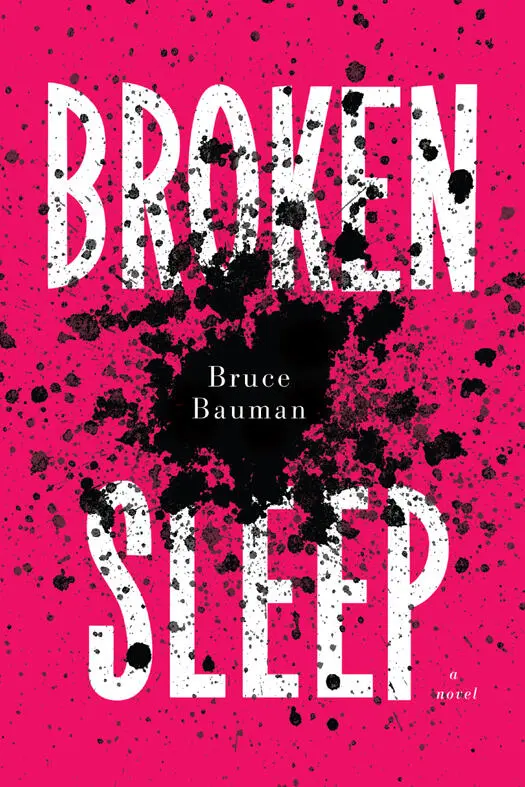
- Название:Broken Sleep
- Автор:
- Издательство:Other Press
- Жанр:
- Год:2015
- ISBN:нет данных
- Рейтинг книги:5 / 5. Голосов: 1
-
Избранное:Добавить в избранное
- Отзывы:
-
Ваша оценка:
Broken Sleep: краткое содержание, описание и аннотация
Предлагаем к чтению аннотацию, описание, краткое содержание или предисловие (зависит от того, что написал сам автор книги «Broken Sleep»). Если вы не нашли необходимую информацию о книге — напишите в комментариях, мы постараемся отыскать её.
Salome Savant, Moses’s birth mother, is an avant-garde artist who has spent her life in and out of a mental health facility. Her son and Moses’s half-brother, Alchemy Savant, the mercurial front man of the world-renowned rock band The Insatiables, abandons music to launch a political campaign to revolutionize 2020s America. And then there’s Ambitious Mindswallow, aka Ricky McFinn, who journeys from juvenile delinquency in Queens to being The Insatiables’ bassist and Alchemy’s Sancho Panza. Bauman skillfully weaves the threads that intertwine these characters and the histories that divide them, creating a postmodern vision of America that is at once sweeping, irreverent, and heartbreaking.
Broken Sleep — читать онлайн бесплатно полную книгу (весь текст) целиком
Ниже представлен текст книги, разбитый по страницам. Система сохранения места последней прочитанной страницы, позволяет с удобством читать онлайн бесплатно книгу «Broken Sleep», без необходимости каждый раз заново искать на чём Вы остановились. Поставьте закладку, и сможете в любой момент перейти на страницу, на которой закончили чтение.
Интервал:
Закладка:
Teumer addressed Moses’s half sister in Portuguese. She bent over and pecked their father on his cheek. She reached out her hand to shake Moses’s. He could not resist; he felt her touch, held it too long, hoping — for what? Finally, he released it. “Have a nice chat. João will be outside if you need anything.”
Father and son waited until they were alone.
“You received my letter?”
“Yes.”
“Although it took some time, I am gratified you found the courage to disobey my wishes, to face me.”
Barely able to form words, Moses asked, “She doesn’t know about me?”
“Speak up. Talk like a man.”
Moses repeated the question.
“Why should she?”
“So you assumed I wouldn’t say anything?”
“Yes. And if you did? Would she care? I don’t think so. Now that you are here, what do you want?”
Moses needn’t ask about the letter or medal. He accepted them as mean-spirited, truthful, almost childish — yet effective — ploys to cause emotional turmoil. “Did you really think I might come here to hurt you?”
“One can never be too cautious. I don’t know the depth of your hate or desire for revenge. After all, I was prepared to let you die.”
“From the looks of it, you’ll be dead soon enough. And I’m still here.”
Teumer nodded his head, as if he approved of his son’s combativeness.
“Who told Salome I was stillborn?”
“Not I. Laban and Bickley oversaw the mechanics of the birth and your delivery to Hannah and me.”
“Did you rape Salome?”
Teumer laughed so hard he began to cough. João rushed in and handed Teumer a glass of water. Teumer waved off the need for his inhaler and spoke to João in Portuguese before returning to Moses. A minute later João returned and handed Moses a sealed plastic bag. “Open it. Look closely.”
Moses delicately removed a piece of tissue paper that concealed a brittle black-and-white photograph — the teenage Salome, hair dancing in the Long Island breeze, head turned slightly to the right so her gaze denied the viewer eye contact, white shorts and a half-unbuttoned blouse, her breasts partially exposed. A man in a T-shirt, jeans, sunglasses, and a classic Borsalino hat, self-satisfied grin — Malcolm — beside her, right arm draped over her shoulder, hand cupping her right breast through the open blouse. “If anything, she seduced me. Your mother was voracious in her appetites.”
Moses gripped the photo. He began to sweat again. He closed his eyes, waiting for rage or nausea or the lust for vengeance both he and Teumer expected to well in him. No, those virulent emotions remained almost inexplicably quiescent. He slipped the photo carefully back in the bag and held it out to Teumer, who refused it.
“I no longer have need for it. You keep it.”
Moses placed it on the table and pressed on with his prepared questions. “Why did you behave so terribly to my mom … Hannah?”
“Circumstance and self-preservation. At first, I needed her. But you misinterpret my effect on her life. For almost three years I made her feel more special than she ever had or ever would again. I rescued her from a wretched ghetto life and introduced her to a cosmopolitan world she had only imagined, and where she remained even after I left. I had hoped to take you with me when I departed. Unfortunately, sooner than anticipated, let’s say an old acquaintance recognized me in a Waldbaum’s and caused a scene. So I immediately put into effect a contingency plan.”
“Your Nazi name wasn’t Malcolm Teumer?”
“No.”
“You adopted it from a murdered Jew as your identity along with the story about leaving Temisvar for Germany?”
“Yes, something like that.”
“What was your name?”
“Oh, I can’t seem to remember.”
Moses leaned closer into him. “What? You’re afraid to tell me?”
“There is a fine line between courage and stupidity.”
“And a finer line between semantics and a cowardly lie.”
“Good. Good.” They locked stares. “You are thinking you are not me, not like me — that you are better than me. You’re clever but also a fool. You cannot escape being of my blood, just as I can disown but not dismiss you. I tried when you got sick. I chose not to save you.”
This time, Moses could not resist reacting. “You didn’t care if I died?”
“You were already dead to me.”
“Not so dead that you didn’t track my life. My whereabouts.”
“When I lived in America, a Negro baseball player was famous for saying, ‘Don’t look back, something may be gaining on you.’ His proposition is correct, but his conclusion indicated inferior thinking. Something is gaining on you, and you must look back to make sure it doesn’t catch you. If it does, you must be ready.”
“I’ve caught you now. Do your other children know about your past?’
“They know me as a good father and a provider. You saw her affection for me.”
Indeed, he had. “You’re so sure I won’t expose your lies to them.”
“You’d consider it ignoble.”
Teumer had calculated correctly. Moses knew that the momentary thrill of causing his father embarrassment, if that were even possible, would solve nothing.
“What if I tell some Nazi hunters or official organizations?”
“The U.S. government does not want me or others like me exposed. You know that. You’re a historian.”
Moses nodded. He was well aware that the Reagan administration had put a stop to all pursuits of former Nazis living in the United States, and the policy remained in force.
“And I have been and will remain well protected here.”
“Protected from others, perhaps. I’ve always wondered how cold-blooded murderers like you live with yourselves.”
“What some call murder, others call natural selection. Don’t scoff. Nature is a slow process of weeding out the weak. We sped up the process by selecting, in a most humane manner, those who over time nature would have eliminated. The weak must not inherit the earth or humanity will face extinction. We came close but were thwarted … for now. History is still on our side. As for my decision with you, modern medicine should only be used upon the sacred few. For the rest … let nature decide.”
Moses shook his head. This man exulted in evils large and small, in the fastidiousness of the crematoriums and the personal cruelties perpetrated against himself and his mom. Moses had heard and seen enough. He stood up. “Even before I got your letter and found out about your monstrous life, I swore to myself not to behave like the emotional coward that you are.” He winced ever so slightly at the thought of Jay and how he had behaved like a graceless coward. No, he couldn’t punish himself right then. “I am so glad we finally met.”
Moses moved closer. Teumer stared up at him, wetting his bloodless aged lips with his tongue. Moses picked up the envelope and took out the photo of his parents. He stared at it once more and placed it between his fingers as if he were going to rip it in half. “I don’t have any need for this.” He hesitated and dropped it on the table. “I’ll let myself out.”
Moses’s invisible angel of torment had been transformed — not into a smiling seraph of lightness but a declawed demon. The ever-changing past once again became new, a future filled with possibilities of forgiveness or bitterness, compassion or heartlessness. The choice would not be easy, but it would be his.
BOOK THREE
The only consolation would be:
it happens whether you like or no.
And what you like is of infinitesimally little help.
More than consolation is: You too have weapons.
Интервал:
Закладка:
Похожие книги на «Broken Sleep»
Представляем Вашему вниманию похожие книги на «Broken Sleep» списком для выбора. Мы отобрали схожую по названию и смыслу литературу в надежде предоставить читателям больше вариантов отыскать новые, интересные, ещё непрочитанные произведения.









Обсуждение, отзывы о книге «Broken Sleep» и просто собственные мнения читателей. Оставьте ваши комментарии, напишите, что Вы думаете о произведении, его смысле или главных героях. Укажите что конкретно понравилось, а что нет, и почему Вы так считаете.