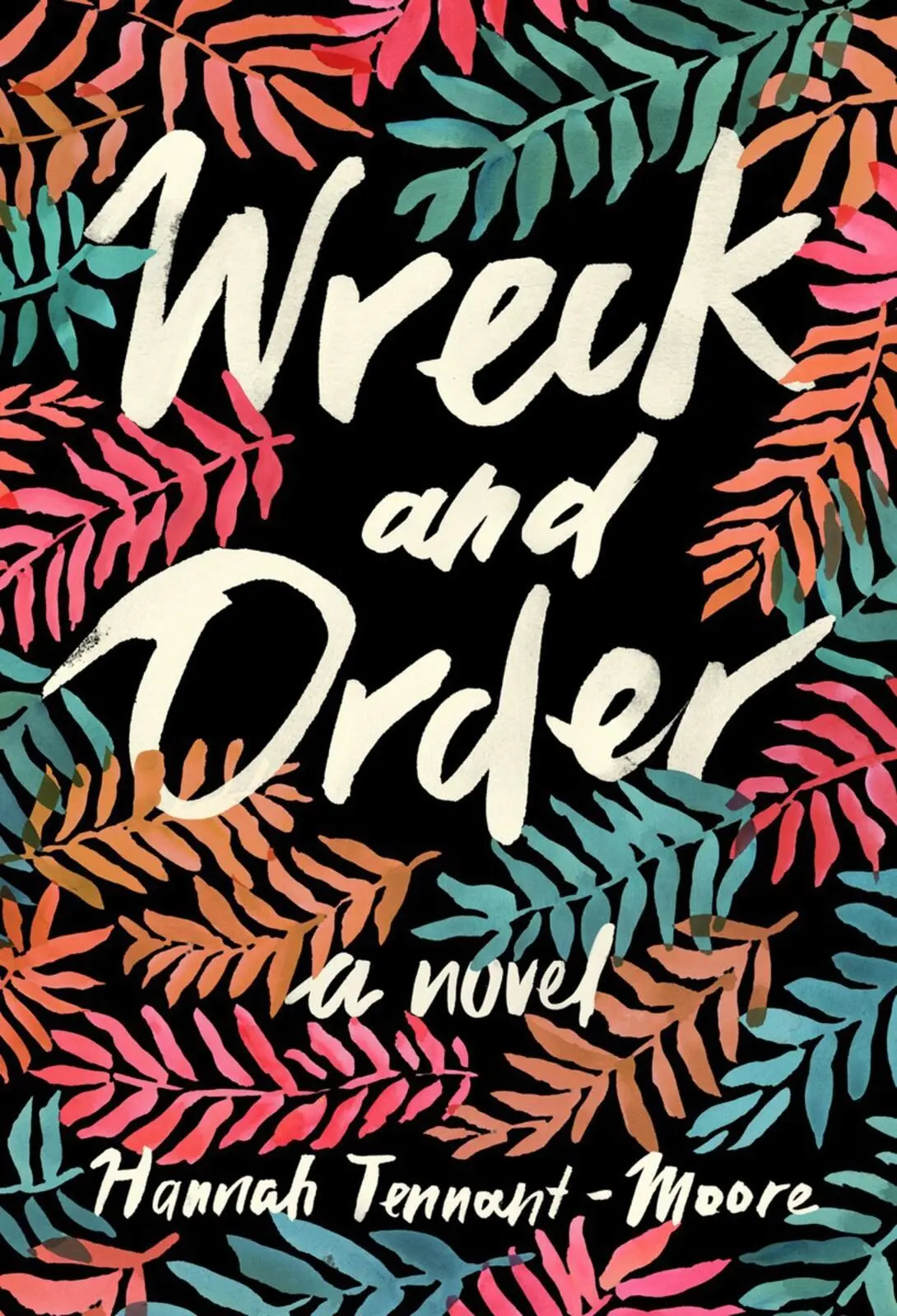
Hannah Tennant-Moore - Wreck and Order
Здесь есть возможность читать онлайн «Hannah Tennant-Moore - Wreck and Order» весь текст электронной книги совершенно бесплатно (целиком полную версию без сокращений). В некоторых случаях можно слушать аудио, скачать через торрент в формате fb2 и присутствует краткое содержание. Год выпуска: 2016, Издательство: Hogarth, Жанр: Современная проза, на английском языке. Описание произведения, (предисловие) а так же отзывы посетителей доступны на портале библиотеки ЛибКат.
- Название:Wreck and Order
- Автор:
- Издательство:Hogarth
- Жанр:
- Год:2016
- ISBN:нет данных
- Рейтинг книги:4 / 5. Голосов: 1
-
Избранное:Добавить в избранное
- Отзывы:
-
Ваша оценка:
Wreck and Order: краткое содержание, описание и аннотация
Предлагаем к чтению аннотацию, описание, краткое содержание или предисловие (зависит от того, что написал сам автор книги «Wreck and Order»). Если вы не нашли необходимую информацию о книге — напишите в комментариях, мы постараемся отыскать её.
Decisively aimless, self-destructive, and impulsively in and out of love, Elsie is a young woman who feels stuck. She has a tumultuous relationship with an abusive boyfriend, a dead-end job at a newspaper, and a sharp intelligence that’s constantly at odds with her many bad decisions. When her initial attempts to improve her life go awry, Elsie decides that a dramatic change is the only solution.
An auto-didact who prefers the education of travel to college, Elsie uses an inheritance to support her as she travels to Paris and Sri Lanka, hoping to accumulate experiences, create connections, and discover a new way to live. Along the way, she meets men and women who challenge and provoke her towards the change she genuinely hopes to find. But in the end, she must still come face-to-face with herself.
Whole-hearted, fiercely honest and inexorably human,
is a stirring debut that, in mirroring one young woman's dizzying quest for answers, illuminates the important questions that drive us all.
Wreck and Order — читать онлайн бесплатно полную книгу (весь текст) целиком
Ниже представлен текст книги, разбитый по страницам. Система сохранения места последней прочитанной страницы, позволяет с удобством читать онлайн бесплатно книгу «Wreck and Order», без необходимости каждый раз заново искать на чём Вы остановились. Поставьте закладку, и сможете в любой момент перейти на страницу, на которой закончили чтение.
Интервал:
Закладка:
Ducking under arms, swinging from one seat back to another, I make my way to the front of the bus and deposit my bag under the driver’s seat. A young woman holding a baby and sitting beside a small boy points at me and nods her head toward the few inches of space next to her older son until I sit down. The musculature of the woman’s face seems to have wasted away around its frame, displaying her gums and teeth like the plaster model of a mouth in a dentist’s office. Her cheekbones press into her skin, half-moons extending from her temples to her nostrils. Her sari is tied in the Indian manner, bunched and stretched in a thin strip over her shoulder for ease in traveling. Her torso is a small, hard cylinder. The baby lies across her lap, his thick eyelashes pressed together and his tiny tongue falling to the side of his mouth. The mother couldn’t be much older than twenty. She reaches into the purse sitting on her older son’s lap and takes out two pieces of dull yellow candy. She hands one to the boy and the other to me. I open my mouth wide and dramatically place the candy on my tongue. The child imitates me with slow precision. The baby gurgles and paddles its feet against his mother’s concave stomach. She puts him over her shoulder and pats his back, but it’s too late. He is wide awake and suffering and his suffering must end now. He pulls at his mother’s sari blouse, pushing his feet into her stomach and trying to scale her upper body. The mother pulls — gently, gently — his hands from her blouse buttons. She puts her index finger in his mouth. He cranes his neck back and bites down. Her eyebrows wince lazily. He spits out her finger and resumes his wail. She holds him against her chest, rocking methodically, her face blank with exhaustion. Motherhood: the greatest gift of all time, according to Suriya and government posters pasted throughout Sri Lanka. The little boy sits with his hands on his knees, leaning forward to see out the window past his mother’s shoulder. The baby’s wail claws at my throat.
When I was a little girl, I had the usual fantasy of feeling the baby kick in my stomach, singing it to sleep, nourishing it through my breasts, my body existing only as sustenance for another creature. The fantasy began ebbing in adolescence, as I retreated further and further from my peers, lusting after vagueness. I have little respect for the maternal instinct now, the hope for self-fulfillment through the most obvious pathway of the body, the dumb ease of a woman with a baby, their bodies so perfectly suited to each other it’s as if they’re already dead and appearing in an album of old family photographs. At what used to be called childbearing age, Virginia Woolf wrote in her diary about the devils that plagued her, “heavy black ones,” devils of failure — a twenty-nine-year-old woman, unmarried, childless. Twenty years later, she wrote to herself that children were nothing compared to writing. But of course I am no Virginia Woolf. I am a modern evolutionary casualty, a woman capable of bearing children but deprived of the will to do so; a woman endowed with the will for meaningful work but constitutionally incapable of pursuing it. I am the type of human who will die out.
[Three]
COLOMBO
Outside the train station, vendors are building pyramids out of watermelons, papayas, and wood apples. They shake out their legs, down clay cups of tea, yawn, hack, spit. “I give you good price, madam,” a man says, holding out a watermelon to me. I’m carrying a water bottle in one hand and a coconut roti in the other. The straps of my backpack dig into my shoulders. Heat surges through the veins in my face. I look down at the watermelon and shake my head, scowling.
“But you can balance on your head, no, madam?”
Peals of laughter from the vendors.
A man covered in warts and fist-size moles shuffles his bare feet along the pavement, hand outstretched, repeating a Sinhalese plea in a monotone. I put a coin in his hand as we pass each other. He scowls at his palm. He expects paper money from tourists.
I was relieved the first time I heard the anti-panhandling announcements on the subway in New York. We ask you NOT to give. Please help us maintain an orderly subway. There was a gray-haired black man who kept showing up in my subway car. His tiny eyes blinked under thick brows as he shook the coins at the bottom of his battered twenty-ounce Pepsi cup, intoning, “If you can spare anything in the category of a few dollars or a few cents. If you can spare anything in the category of a few dollars or a few cents…” The vain, stubborn care of the word category was a fist around my heart. The authoritative voice on the intercom required me to ignore it. I tried to explain the sadness of this relief to Brian. “But it doesn’t help anyone to collect a handful of coins on the train,” he said.
“But that might be the only way some people can make money,” I said.
“You can’t really believe that.”
So many times a day I loathed him. Why does it still feel terrible to be exiled from the “normal days” he promised?
I walk into the train station and buy a ticket south. I want to find a sleepy beach town to finish my translation, stare at the ocean, reckon with the state of my life. When the train arrives, I heave my pack through the window to reserve an open seat and then clamber aboard after my belongings. I lean back against the sticky leather seat and close my eyes. My favorite fact of traveling: so many hours in which it is impossible to do anything at all. The train grumbles and lurches. I rest my elbow on the ledge of the open window. The wind tastes sweet on my arms. Suriya will be alone in the kitchen tonight. The image is a lump in my throat. But I don’t wish I were there with her.
We chug through the hysteria of Colombo’s sounds and smells and competing needs until we are riding the spine of a high, narrow mountain, alongside a river gilded with mineral silt. Fragments of artificial color dot the hillside — the saris of Tamil tea pickers plucking rough leaves by the handful and dropping them in giant sacks tied to their backs. Water buffalo crawl antlike in the paddy fields below layers of mountains, the closest ones feathery with giant pines, the farthest purpled silhouettes.
We stop at a town that has set precarious roots in the hillside just below the tracks. A pudgy woman gets on the train and sits next to me, a toddler on her lap. The girl wears a red tank top on which sequins form the words HEARTS HEARTS HEARTS!!! She eats cookies out of her mother’s purse and beats a rhythm on her knees. “Butalay, butalay, boom boom!” Men walk up and down the aisles, hawking fried fish and dhal balls, calling “Swaray, swaray!” Sunlight spears the tip of my elbow. Metallic claps coming from the floorboards between cars keep time with the jolting of my seat. As pictures outside the window flash and disappear — waves hurling themselves at shore, women weaving palm fronds into roofs in their front yards — I feel myself inside a small, sparse room. Curtainless. Bright. White walls, heavy furniture with peeling white paint. A bed covered only in a white sheet, always mussed. Clean but untidy. Objects lie about, living inside their discrete functions. A mew of contentment presses against my closed lips. For a short while I am so relaxed that where I imagine myself to be is the same place as where I am. The train picks up speed and jostles the room out of my hands.
—
Hours pass. I sit. The mother and toddler are replaced by a man with a small, deeply creased face. He nods at me in greeting, picks up an English-language newspaper that has been abandoned in the aisle, shakes it open and laughs. I glance at the headlines: President Lowers Rice Prices! President De-mines Northern Region! President Opens State-of-Art Cinema!
Читать дальшеИнтервал:
Закладка:
Похожие книги на «Wreck and Order»
Представляем Вашему вниманию похожие книги на «Wreck and Order» списком для выбора. Мы отобрали схожую по названию и смыслу литературу в надежде предоставить читателям больше вариантов отыскать новые, интересные, ещё непрочитанные произведения.


Обсуждение, отзывы о книге «Wreck and Order» и просто собственные мнения читателей. Оставьте ваши комментарии, напишите, что Вы думаете о произведении, его смысле или главных героях. Укажите что конкретно понравилось, а что нет, и почему Вы так считаете.