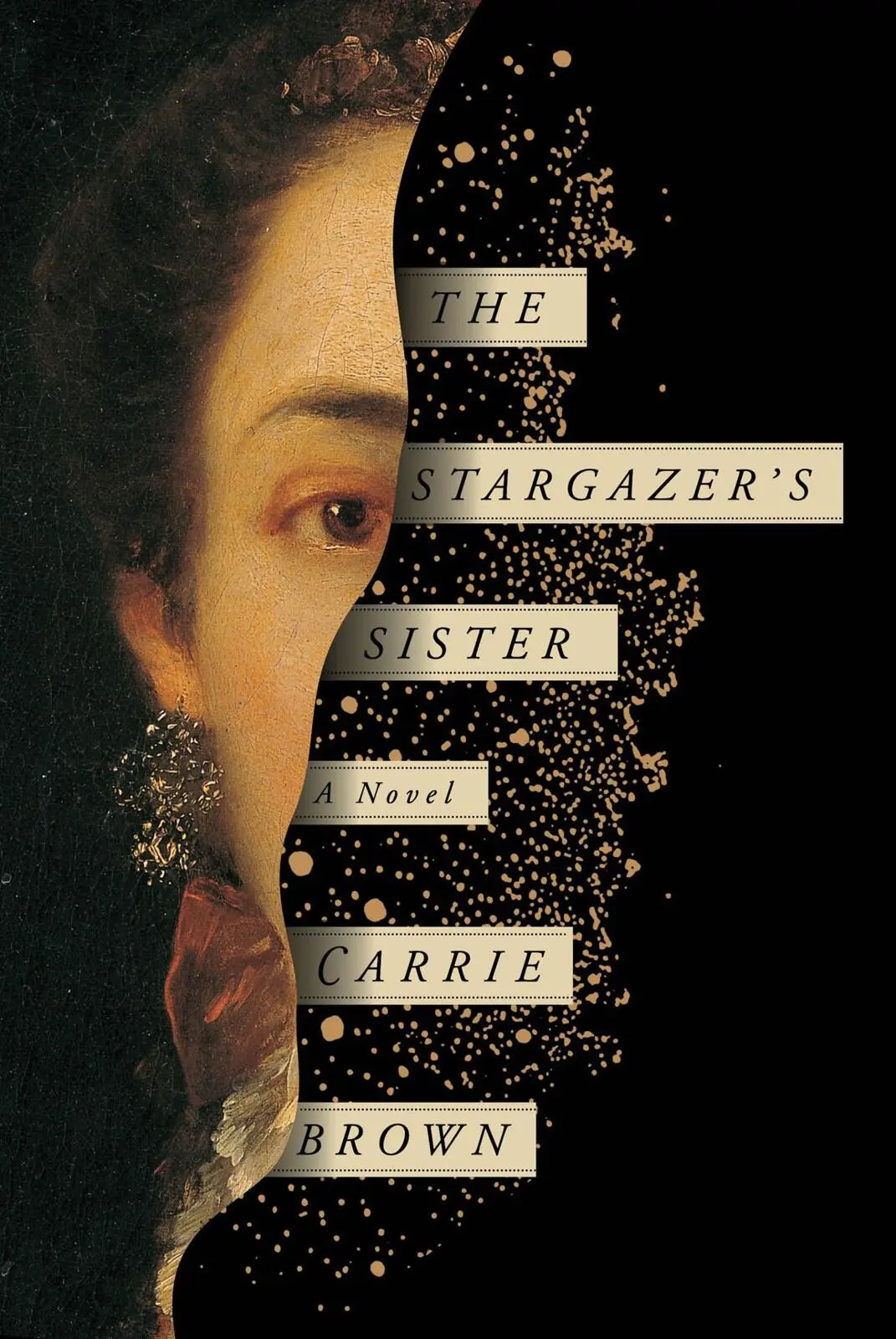
Carrie Brown - The Stargazer's Sister
Здесь есть возможность читать онлайн «Carrie Brown - The Stargazer's Sister» весь текст электронной книги совершенно бесплатно (целиком полную версию без сокращений). В некоторых случаях можно слушать аудио, скачать через торрент в формате fb2 и присутствует краткое содержание. Год выпуска: 2016, Издательство: Knopf Doubleday Publishing Group, Жанр: Современная проза, на английском языке. Описание произведения, (предисловие) а так же отзывы посетителей доступны на портале библиотеки ЛибКат.
- Название:The Stargazer's Sister
- Автор:
- Издательство:Knopf Doubleday Publishing Group
- Жанр:
- Год:2016
- ISBN:нет данных
- Рейтинг книги:5 / 5. Голосов: 1
-
Избранное:Добавить в избранное
- Отзывы:
-
Ваша оценка:
The Stargazer's Sister: краткое содержание, описание и аннотация
Предлагаем к чтению аннотацию, описание, краткое содержание или предисловие (зависит от того, что написал сам автор книги «The Stargazer's Sister»). Если вы не нашли необходимую информацию о книге — напишите в комментариях, мы постараемся отыскать её.
a beautiful new period novel — a nineteenth-century story of female empowerment before its time — based on the life of Caroline Herschel, sister of the great astronomer William Herschel and an astronomer in her own right. This exquisitely imagined novel opens as the great astronomer and composer William Herschel rescues his sister Caroline from a life of drudgery in Germany and brings her to England and a world of music-making and stargazing. Lina, as Caroline is known, serves as William’s assistant and the captain of his exhilaratingly busy household. William is generous, wise, and charismatic, an obsessive genius whom Lina adores and serves with the fervency of a beloved wife. When William suddenly announces that he will be married, Lina watches as her world collapses.
With her characteristically elegant prose, Brown creates from history a compelling story of familial collaboration and conflict, the sublime beauty of astronomy, and the small but essential place we have within a vast and astonishing cosmos. Through Lina’s trials and successes, we witness the dawning of an early feminist consciousness, of a woman struggling to find her own place among the stars.
The Stargazer's Sister — читать онлайн бесплатно полную книгу (весь текст) целиком
Ниже представлен текст книги, разбитый по страницам. Система сохранения места последней прочитанной страницы, позволяет с удобством читать онлайн бесплатно книгу «The Stargazer's Sister», без необходимости каждый раз заново искать на чём Вы остановились. Поставьте закладку, и сможете в любой момент перейти на страницу, на которой закончили чтение.
Интервал:
Закладка:
The Royal Society, she learns, has confirmed William’s observation that the Pole Star, Stella Polaris, depended on by sailors and caravans of travelers across the deserts and lone wanderers to help point them north, is not one star, but two. Moreover it also has accepted his expanded catalog of the sky’s double stars, his work of the past several months. William has identified 269. Of these, 227 have never been seen by anyone before. The achievement, she knows, is nothing short of astonishing.
She knows that most of William’s observations that fall and winter have pointed to the probability that the universe is not, after all, in a stable state — a limited number of fixed stars revolving in predictable patterns — but in motion…or, rather, in evolution, as he has told her. That William has revealed even the familiar Pole Star to be not a single star but two in fixed orbit…with only this single observation confirmed, the universe is suddenly much larger than anyone has yet imagined. She knows, too, that Henry Spencer has helped persuade his colleagues in the Royal Society of the truth of William’s claims about the magnification powers of his eyepieces, traveling himself to show various members — with equipment built and furnished by William himself — what he has been able to see.
William keeps a duplicate record of all his correspondence, and she had copied the letter he’d written to Henry in which he’d asked for his assistance. Lina knows the gentlemen of the Royal Society have been slow to accept William’s findings; he has not come from within their own ranks, after all, and his discoveries are not only startling but also challenging.
It would be a poor fate to be condemned because I have tried to improve telescopes & practiced continually to see with them, William had written to Henry with some exasperation. They have played me so many tricks, and it would be hard if they had not proved kind to me at last.
Nearly everything William surmises has to do with his assumption that the solar system is one of uncountable numbers of other solar systems. She knows that one hundred nebulae have been identified so far, for instance, and that it is William’s sense that these glittering vaults, star clouds rich with color and light, are like doorways into other, secret realms in the universe that he — and at least a few others — suspects exist.
Henry had sent William a reply.
If it lays in my power, you shall not be sent to Bedlam alone, for I incline much to be of the party.
They have much to be grateful for in Henry’s friendship, she knows. Still, she wishes he would not be so painfully awkward around her.
“How can I put him at his ease,” she asked William, “so that we may be friends?”
“What do you want with him?” William said, though not unkindly. “He wishes only for the company of his books.”
“He makes me sad,” she said.
“Why? It is only sad if you imagine him to be longing for something else,” William replied. “I assure you: Henry is happy with his books and his horses and his farm and his patients and his telescopes. He wants for nothing else. Only for his mother to stop worrying him to marry.”
Yet sometimes when Henry comes to visit with William, she catches him glancing at her with an expression she cannot quite read. They are like two stars in orbit around William, she has thought. They circle each other endlessly, but they will never meet.
That afternoon, as she works in the kitchen, she listens to William singing in the smaller workshop. She is glad of the day’s news, the Royal Society conferring its blessing on William and — at long last — extending its formal invitation for him to become one of its members. She has copied enough of her brother’s correspondence with other astronomers to know the widespread doubt that surrounds his findings. She feels offended by the stiffly worded hesitancy of his skeptics, though William appears to welcome invitations to prove his theories. She is touched by the earnestness and the civility of his replies, the effort he makes to send detailed drawings to other astronomers so that they might see what he sees, the gifts he has made of telescopes to enable others to share his own triumphs. There is little of selfishness in William in this regard.
Throughout these months, in fact, she has seen little in William she does not admire. He possesses qualities — confidence, charm, enthusiasm — that draw people to him naturally. And he is not afraid of hard work, a trait that endears him to those he employs and that earns him, in the end, the trust of those whose views he challenges. The men William hires to help build the outer workshop shake their heads over him, but Lina knows that they respect him, too, for he works alongside them with equal vigor. They are all excited by what he envisions, the construction of the twenty-foot telescope — one day, a forty-foot — that will allow a view into the heavens such as can hardly be imagined.
But every man William employs needs to be paid, and his supplies cost money, and sometimes they go hungry.
She had not expected that.
“Again, soup?” William says, when there is nothing but turnips and potatoes and carrots in the cellar.
His unhappiness at these moments pierces her.
She has come to hate evenings of poor weather, despite her gratitude for the intervals of rest they provide. She hates the silence of the house when there is no money to pay the workers, when William comes, dejected, to the meal she prepares at the end of day. He does not talk much then, but sits by the fire with a book and reads as if he is alone. On these nights, when his eyes are turned to the page, she supplements his bowl with potatoes from her own, and she watches the room fill with shadows.
—
YET THESE SPELLS of relative poverty never seem to last long. William organizes the musicians at the Octagon for an additional series of performances, and he recruits several new music pupils. Even in bad weather that winter, he has traveled to conduct concerts or to rehearse orchestras elsewhere. To improve the chorus in Bath and to encourage greater audiences, he has recruited singers with no experience at all, including from among the carpenters and joiners he hires for work with the telescopes.
Lina slips into the chapel one day to hear them rehearse, and she is amazed at the success with which these untutored men and women, under her brother’s direction, render the choruses of the oratorios he has put before them. Such a sound he has coaxed from these common people! But it is their happiness, all their faces turned toward her beloved, handsome brother, conducting them with his customary energy, that most touches her. Of course people want to be in his company, to follow him on whatever untraveled path he charts. Flowers naturally turn their faces to the sun.
—
SEVERAL DAYS AFTER THE LETTER from the Royal Society arrives, a cold rain falls. That evening, Lina heats bowls of lamb stew for herself and William, and they pull the table close to the fire. William is disappointed to be prevented by bad weather from the hours he would prefer to spend at the telescope, but a copy of a book by Erasmus Darwin, The Botanic Garden, has arrived, and it has offered William some happy distraction. Darwin is a member of the Lunar Society in Birmingham, where William goes occasionally for meetings and conversation, Lina knows, and William was pleased when a messenger delivered the book earlier that day.
William sits down at the table with the book. Lina looks at the titles of the two long poems it contains: “The Economy of Vegetation” and “The Loves of the Plants.” William is not usually much interested in poetry, but the book has caused a stir among his scientific acquaintance, he tells her. They eat in silence for a while, William reading.
Читать дальшеИнтервал:
Закладка:
Похожие книги на «The Stargazer's Sister»
Представляем Вашему вниманию похожие книги на «The Stargazer's Sister» списком для выбора. Мы отобрали схожую по названию и смыслу литературу в надежде предоставить читателям больше вариантов отыскать новые, интересные, ещё непрочитанные произведения.










Обсуждение, отзывы о книге «The Stargazer's Sister» и просто собственные мнения читателей. Оставьте ваши комментарии, напишите, что Вы думаете о произведении, его смысле или главных героях. Укажите что конкретно понравилось, а что нет, и почему Вы так считаете.