Olja Savicevic - Adios, Cowboy
Здесь есть возможность читать онлайн «Olja Savicevic - Adios, Cowboy» весь текст электронной книги совершенно бесплатно (целиком полную версию без сокращений). В некоторых случаях можно слушать аудио, скачать через торрент в формате fb2 и присутствует краткое содержание. Год выпуска: 2016, Издательство: McSweeney's, Жанр: Современная проза, на английском языке. Описание произведения, (предисловие) а так же отзывы посетителей доступны на портале библиотеки ЛибКат.
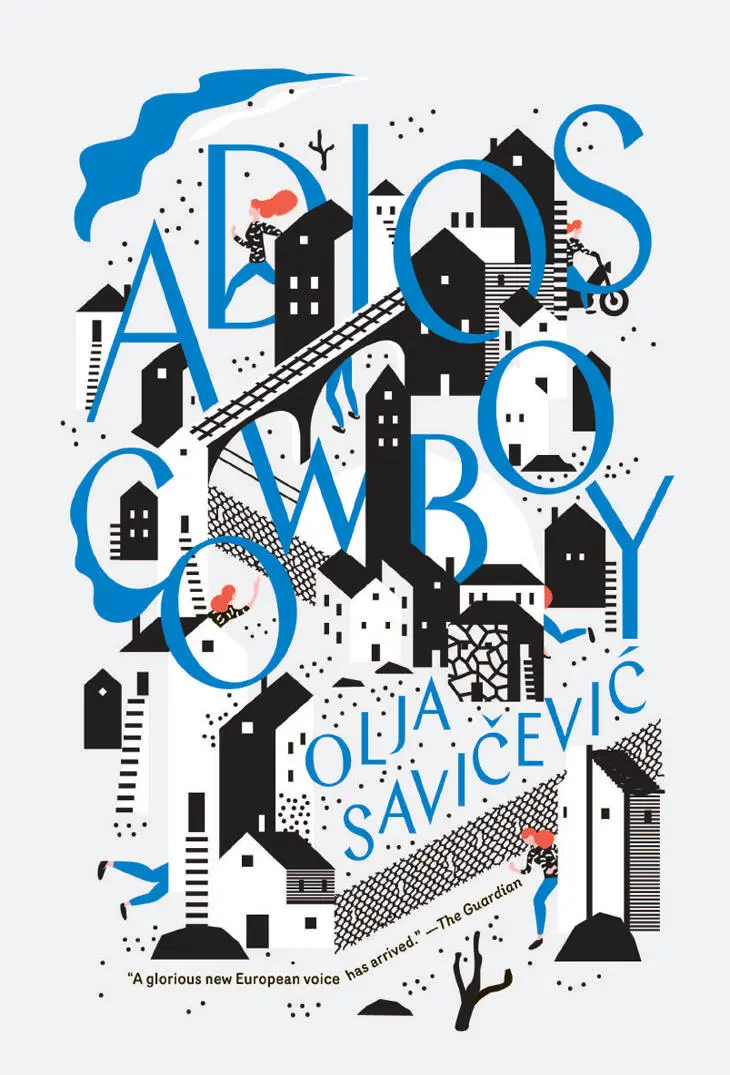
- Название:Adios, Cowboy
- Автор:
- Издательство:McSweeney's
- Жанр:
- Год:2016
- ISBN:нет данных
- Рейтинг книги:4 / 5. Голосов: 1
-
Избранное:Добавить в избранное
- Отзывы:
-
Ваша оценка:
Adios, Cowboy: краткое содержание, описание и аннотация
Предлагаем к чтению аннотацию, описание, краткое содержание или предисловие (зависит от того, что написал сам автор книги «Adios, Cowboy»). Если вы не нашли необходимую информацию о книге — напишите в комментариях, мы постараемся отыскать её.
Hoping to free her family from the grip of the past, Dada vows to unravel the mystery of Daniel’s final days. This American debut by a poet from Croatia’s “lost generation” explores a beautiful Mediterranean town’s darkest alleys: the bars where secrets can be bought, the rooms where bodies can be sold, the plains and streets and houses where blood is shed. By the end of the long summer, the lies, lust, feuds, and frustration will come to a violent and hallucinatory head.
Adios, Cowboy — читать онлайн бесплатно полную книгу (весь текст) целиком
Ниже представлен текст книги, разбитый по страницам. Система сохранения места последней прочитанной страницы, позволяет с удобством читать онлайн бесплатно книгу «Adios, Cowboy», без необходимости каждый раз заново искать на чём Вы остановились. Поставьте закладку, и сможете в любой момент перейти на страницу, на которой закончили чтение.
Интервал:
Закладка:
Without a word, Ma opened the top cupboard and took out sugar and coffee, lit the gas.
“This is still my house,” she said quietly.
Out of the box I took a pistol, carefully wrapped in a soft rag.
“The Colt got its name from Samuel Colt,” said the man who had sold our father the Colt as a present for Daniel. I was standing beside my father and although I’d never been interested in pistols, for an instant I coveted that Colt. The winter light gleamed on its cylinder, like an ornament. An ornamental weapon. A surprise for my brother’s birthday.
Later, as he handed it to Daniel, my father said it was “out of commission, but it had once fired very accurately.”
“D’you think this Colt ever shot anyone?” my brother asked, aiming it at me. “Maybe it was Shane’s pistol, or Clyde’s.”
“Don’t get carried away, Daniel, it’s just a broken barrel, it’s not a Stradivarius,” said my sister.
A weapon isn’t romantic, as someone once said, what’s romantic is the death that sleeps in the barrel. As long as it just sleeps.
Samuel Colt lost two sisters and his mother while he was still a child, and his one surviving sister later committed suicide, the man who sold my father the Colt told him, I recalled. “But he got on very well with his brothers,” he said that too.
Did all of that have anything to do with his invention? I wondered, holding the gun with the barrel pointing toward the floor.
If you try to invent a pistol willy-nilly, you must often think about death.
Ma covered her mouth with her hand, and my sister her forehead. They looked at the object in my hands.
“Did you know that the inventor of this pistol died in poverty, although he was pretty rich most of his life?” I said, laying the object on the table. That’s what the man who sold our father the pistol for Daniel told us. Death exploited and rejected Samuel Colt. But there’s no doubt that he devoted his life to it.
“That’s Daniel’s,” said Ma.
“You just landed from Mars, Ma,” my sister snapped darkly.
She picked up the silver object for a moment, and immediately threw it down again, as though it was hot. In fact it was an unpleasantly cold piece of metal under the fingers — with a smooth wooden handle.
“That’s it,” I said, collapsing onto a chair. I thrust the blue envelope that had been in the bottom of the box into my pocket, without them seeing — I felt something hard and flat in it. My heart beat a gong and stopped it between my ribs.
That’s it, I repeated to myself: the answer.
The two of them studied the pistol, touched it carefully, not like a weapon, more like a sea bass that might suddenly leap off the table. They were comical.
“It’s nice of the vet to give Daniel’s pistol back,” said Ma.
My sister looked at me suspiciously.
Then Ma turned away from us, put the coffee pot on the heat, and waited for the water to start bubbling.
U ncle Braco is taking us on his boat to the island. It’s the only video where we’re all together, apart from my father. He’s filming, that’s why he’s not in it, but you can just occasionally hear his voice.
“The Istranka’ s great,” says my father, pleased with his employer’s boat.
Braco, also pleased, says “a-huh” and strokes his mustache. Ma takes beers for my father, herself, and Braco out of the garish green portable fridge.
We had hung our feet into the foam and were singing: my sister and I. We were sitting on the prow and feeding each other grapes. Daniel, in striped trousers from Trieste, had climbed onto the roof of the cabin and was spitting blue skins into the sea. His spittle stuck to our hands and legs, rubbed with oil and shining in the sun.
“You’s really a savage, spitting like that,” says my sister.
“Didn’t mean to.”
“So why’s you spitting grapes, you clown?”
“Not my fault. The skins should be thinner,” says Daniel.
“What you say?”
The wind carries off their words and the chugging of the engine, takatakatakataka.
“The skin should be…” yells Daniel.
“Idiot,” says my sister to the camera.
“I told you he’s an idiot,” she turns to me and says. “He’s spitting grapes, the skin bothers him.”
Daniel gets to his feet, his head becomes a glistening ball of sun, and the adults wave at him: “Get down, get down, you’ll fall.”
Uncle Braco turns the tiller and draws back the throttle.
“A stag,” says Daniel, dancing on the roof of the cabin.
Then more loudly: “There’s a stag in the sea! People, people! There’s a stag in the sea!”
“What’s got into the child, inheavensname?” Uncle Braco twists around.
A wave breaks over the little Istranka at the prow and the stern; little drops spatter the screen. The sea looks plump and deeper than the sky, friable, then glassy.
The swell makes us feel sick. The dull bright light torments us.
Then the camera comes to rest and finally homes in on something that looks like a tree trunk. Our eyes try to identify something like a large brown dog.
When the boat comes closer, we can see it clearly, for a moment: the antlers, the blue belly of the corpse. One cloudy dark eye — a white tongue. The focus is suddenly lost — my father switches off the camera.
* * *
There’s a herd of hoofed animals on the little island — people say that monks brought them, or that the herd belonged to Comrade Tito. People know about them, in the summer they come down to the island beach among the tourists and eat their rubbish, such as watermelon skins.
People said that in the mating season the males hear the love call of does from the mainland and swim, roaring loudly, toward the shore. Fishermen have seen sights like that in the sea: sometimes a roe buck, and sometimes even a hungry boar in the channel.
“What d’you think happened to the doe on the shore?” Angelo asks me.
(We’re sitting in my room, watching films from my box.)
“She was sad for a while,” I reply. “And then maybe she called to a different roe buck.”
“Evil doe.”
“Not evil, just a doe,” I say, kissing him between his imaginary antlers.
5
IN A STORY IT WOULD SAY THERE hadn’t been a wedding like it in living memory. That’s what the feast at Verica Vrdovđek’s was like.
Tables with white cloths stretched from the terrace of the ex-Illyria, along the waterfront on one side to the beach, and on the other to the port and pier above it. Traffic through the Settlement was stopped, holes in the asphalt repaired, streets swept, windows cleaned. Around the new statue of St. Fjoko, an unusual flaming garden spread, radially, like a sound, with begonias, petunias, dazzling fuschias and dahlias, and on candelabras and over the pergolas hung pieces of real fishermen’s macramé with hard knots and little geranium flowers.
It seemed as though even the air was lighter, freed of death and dust, asbestos and lead — just distilled ether, and, as in a recipe for perfume, hypnotic drifts of Lavandula angustifolia , the sweat of women’s backs and tart male breath with grains of black pepper. And above it all: the fragrance of grilled meat. An electric spit turned lambs and suckling pigs and a two-month-old donkey foal for the top table.
Oh yes, Vrdovđek was a prophet in his village. Torches blazed, car horns blared, bells pealed from all the little churches, flags with crowing cockerels fluttered. Onto a stage, specially made for the festivities, climbed a showbiz star with new silicon in her boobs and top lip who sang the anthem, and the Settlement rose to its light feet, with sound heart and empty belly.
Читать дальшеИнтервал:
Закладка:
Похожие книги на «Adios, Cowboy»
Представляем Вашему вниманию похожие книги на «Adios, Cowboy» списком для выбора. Мы отобрали схожую по названию и смыслу литературу в надежде предоставить читателям больше вариантов отыскать новые, интересные, ещё непрочитанные произведения.





Обсуждение, отзывы о книге «Adios, Cowboy» и просто собственные мнения читателей. Оставьте ваши комментарии, напишите, что Вы думаете о произведении, его смысле или главных героях. Укажите что конкретно понравилось, а что нет, и почему Вы так считаете.