Olja Savicevic - Adios, Cowboy
Здесь есть возможность читать онлайн «Olja Savicevic - Adios, Cowboy» весь текст электронной книги совершенно бесплатно (целиком полную версию без сокращений). В некоторых случаях можно слушать аудио, скачать через торрент в формате fb2 и присутствует краткое содержание. Год выпуска: 2016, Издательство: McSweeney's, Жанр: Современная проза, на английском языке. Описание произведения, (предисловие) а так же отзывы посетителей доступны на портале библиотеки ЛибКат.
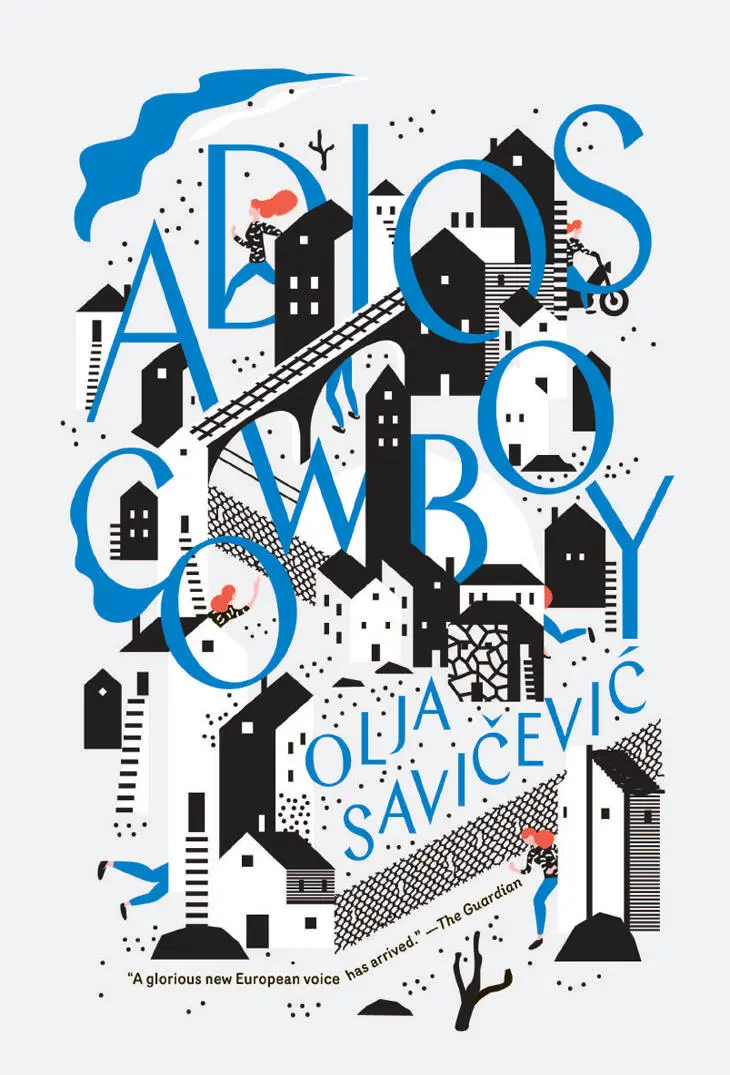
- Название:Adios, Cowboy
- Автор:
- Издательство:McSweeney's
- Жанр:
- Год:2016
- ISBN:нет данных
- Рейтинг книги:4 / 5. Голосов: 1
-
Избранное:Добавить в избранное
- Отзывы:
-
Ваша оценка:
Adios, Cowboy: краткое содержание, описание и аннотация
Предлагаем к чтению аннотацию, описание, краткое содержание или предисловие (зависит от того, что написал сам автор книги «Adios, Cowboy»). Если вы не нашли необходимую информацию о книге — напишите в комментариях, мы постараемся отыскать её.
Hoping to free her family from the grip of the past, Dada vows to unravel the mystery of Daniel’s final days. This American debut by a poet from Croatia’s “lost generation” explores a beautiful Mediterranean town’s darkest alleys: the bars where secrets can be bought, the rooms where bodies can be sold, the plains and streets and houses where blood is shed. By the end of the long summer, the lies, lust, feuds, and frustration will come to a violent and hallucinatory head.
Adios, Cowboy — читать онлайн бесплатно полную книгу (весь текст) целиком
Ниже представлен текст книги, разбитый по страницам. Система сохранения места последней прочитанной страницы, позволяет с удобством читать онлайн бесплатно книгу «Adios, Cowboy», без необходимости каждый раз заново искать на чём Вы остановились. Поставьте закладку, и сможете в любой момент перейти на страницу, на которой закончили чтение.
Интервал:
Закладка:
Maybe there’ll be no Old Settlement soon, I reflected.
The Illyria hotel was mine more than it could ever be Vrdovđek’s, but still there’s absolutely nothing I can do about the fact that it has vanished, I reflected. I can go and draw a cock on it, that’s all. And they’ll paint over it and that’ll be that. “The wolf ate the ass,” the insatiable one would say.
“You don’t feed yourselves properly,” said my sister. Of Ma and me. “And you’re both good cooks, former and future.” She was winding us up.
I don’t know what’s bad about goulash. “I’m cooking this for Ma. I promised. She has a problem with vegetarian dishes. She says, ‘If there’s no meat or fish, I don’t get what’s the main thing on the plate and what goes with what,’” I said and went on cutting up the pieces of meat. The onion was sizzling in the oil and smelling good.
“What an approach to food, hierarchical! Patriarchal, in essence,” said my sister. “You’re bleedin’,” she said. My finger was stinging, but the knife was sharp, so I hadn’t felt the blade. I thought the blood came from the animal.
“That knife is ruddy,” she said, tossing it into the sink. She took my hand and sucked the blood out of my finger, then spat into the sink as well. And twice more. Fingers always bleed inordinately, I reflected.
“You taste of iron, ruddy-Rusty,” she said, spitting. She hadn’t called me that in ages. She washed my hand with alcohol and bound it tightly with a cloth. Then she wiped her lips, carefully dabbing them, not to spoil her lipstick.
“Ma’s goin’ to come to my place when she gets out of the hospital, and we’ll let or sell the house,” said my sister.
Okay. I don’t care anymore. Let them sell the house. I watched the blood seeping through the cloth. “Okay,” I said.
My sister tossed the meat into the pan, then sat down opposite me, laid her hands in her lap, sighed, and looked at me as at a lost cause.
She sat down opposite me, laid her hands in her lap, and crossed her legs, with her feet in little sandals with high pointy heels. Those sandals were attached to her feet only by two tiny straps, one around her ankle and the other over her toes, I observed. She moved about in shoes like that as freely as it was possible to do, sometimes even running down steps like a chamois down a mountain. The high heels demanded concentration on one’s feet, watchfulness, as when you’re in charge of a vehicle, I reflected. Even in a woman like my sister who wore them every day.
She saw I was watching her.
“High heels’re a weapon,” she said, displaying her pedicured foot.
“An objectively lovely foot in a lovely sandal,” her former husband had once said, and I recalled that as well. But she still left him, I reflected.
In recent years my sister had grown rounder and heavier like some mythic woman. “A Valkyrie,” Herr Professor said of her. “There is no hero here to measure his strength against such a Valkyrie,” he said. He’s right, I thought, it’s rotten luck, beside her men seemed either weak or coarse.
She lost the sharpness of her elbows and knees, acquired fleshy thighs and forearms, but she retained her slender joints, suppleness in her hips, and the head of a little girl. Like that woman from the print in the toilet of the Last Chance under which is written P. P. REUBENS: Venus Frigida.
But when she appears on those heels, I can easily imagine her also with a tail, like that English lady holding a glass of champagne, putting on makeup and at the same time — thanks to her tail — smoking.
“I think Marilyn Monroe was wrong about high heels and women’s insecurity,” said my sister suddenly, seriously, and as though addressing her shoes. “High heels’re shoes for the brave.”
Marilyn had said, roughly, that women who wore high heels were attractive because they looked insecure. Marilyn was just flirting when she made that announcement, I thought. Just as she was flirting with her insecurity, I thought.
“What kind of world is it where Marilyn Monroe has issues of self-confidence?” said my sister. “What hope is there for the rest of us?”
I shrugged my shoulders: I don’t want to think about my feet while I walk the way women in high heels must. I want just to walk, and not to be aware of my shoes. I’d rather take off my T-shirt and go around naked on a hot day than put on heels like that, there’d certainly be more freedom in that kind of courage, and more sense. That’s roughly what I said to her.
Then I added that Marilyn Monroe had proved that flirting could kill you if you made it too much of a habit. Like Kurt Cobain too, for that matter. Death was part of their performance. Mayakovsky, Yesenin, and Isadora Duncan plus their fans, that whole Russian chain gang, focused on themselves. I said that, roughly.
I think it saddened her, I wasn’t expecting that.
“I don’t like it when you talk like that,” she said drily, although I’d never talked like that to her before.
She was just happy because of her new shoes.
It isn’t pure fetishism, I reflected. High heels are part of her, a continuation. What do I know about her freedom?! When she’s wearing slippers she really does look disarmed.
What do I know about her courage, she’s the one who’s staying, I thought, watching my sister walking in front of me as she crosses the hospital linoleum as though it was a red carpet, toward the exit. She’s carrying a plastic bag and an empty Tupperware box, which had contained goulash and macaroni, as though it was a new handbag. She is that radiance Herr Karlo talked about; all waiting rooms have revolting air and are colorless. “That girl’s luxury,” her former husband would have said, and he’d grin, but much good did it do him.
Perfume — hair — footsteps.
Hospital — goulash — Mother.
“When you open the door of a hospital, you open a Pandora’s box,” said one of the several great-aunts who used to visit the insatiable one in the years of her illness, nodding their hairdos, but I don’t remember which of those old ladies it was. They would pat me on the top of my head and stick chips in my mouth, as in a mini communion. The three of us didn’t particularly interest them because we were the poor relations’ children, a pain in the ass. One of them asked Ma if she had a lover, I recall that. And when Ma replied, embarrassed, that she hadn’t, the great-aunt said: “Ah, my dear, we’ll never make a lady of you.”
Let’s go out into the sun, I thought. Onto the surface. The air here is desperate.
As a child I’d been afraid of getting lost down below, in the hospital basement, among the loonies. Now I was equally nauseated on all the floors.
“This is the only ward where we’re allowed to smoke,” said Ma as we swung up and down the corridor where three skinny women in nightdresses were smoking.
I recalled Millimeter, the lunatic who used to appear in the Settlement every few years, walking ceaselessly and counting the metres and holding at least one cigarette in different stages of being smoked in each hand. His figure embodied my need for walking and Mother’s dependence on smokes like a mirror image. I said that to Ma and she shook her head. I wasn’t able to interpret that gesture.
“The doctor says I’ll be going home on Friday,” she said.
“Super,” said my sister. “They must be full up for the weekend.”
Ma ate the goulash — and all the macaroni, and then mopped up the sauce with bread and then we had to leave “so as not to miss the train,” said my sister.
“Off you go,” said Ma. When I looked back from the exit, she was already in bed, with her back to the door.
People who have been lucky sometimes talk about the worst and best days or the worst and best nights of their life. We who have been less lucky don’t talk about that, we know there are days after which things can be good or bad, but nothing can any longer be the worst or the best.
Читать дальшеИнтервал:
Закладка:
Похожие книги на «Adios, Cowboy»
Представляем Вашему вниманию похожие книги на «Adios, Cowboy» списком для выбора. Мы отобрали схожую по названию и смыслу литературу в надежде предоставить читателям больше вариантов отыскать новые, интересные, ещё непрочитанные произведения.




Обсуждение, отзывы о книге «Adios, Cowboy» и просто собственные мнения читателей. Оставьте ваши комментарии, напишите, что Вы думаете о произведении, его смысле или главных героях. Укажите что конкретно понравилось, а что нет, и почему Вы так считаете.