Andrea Barrett - The Air We Breathe
Здесь есть возможность читать онлайн «Andrea Barrett - The Air We Breathe» весь текст электронной книги совершенно бесплатно (целиком полную версию без сокращений). В некоторых случаях можно слушать аудио, скачать через торрент в формате fb2 и присутствует краткое содержание. Год выпуска: 2007, Издательство: W. W. Norton & Company, Жанр: Современная проза, на английском языке. Описание произведения, (предисловие) а так же отзывы посетителей доступны на портале библиотеки ЛибКат.
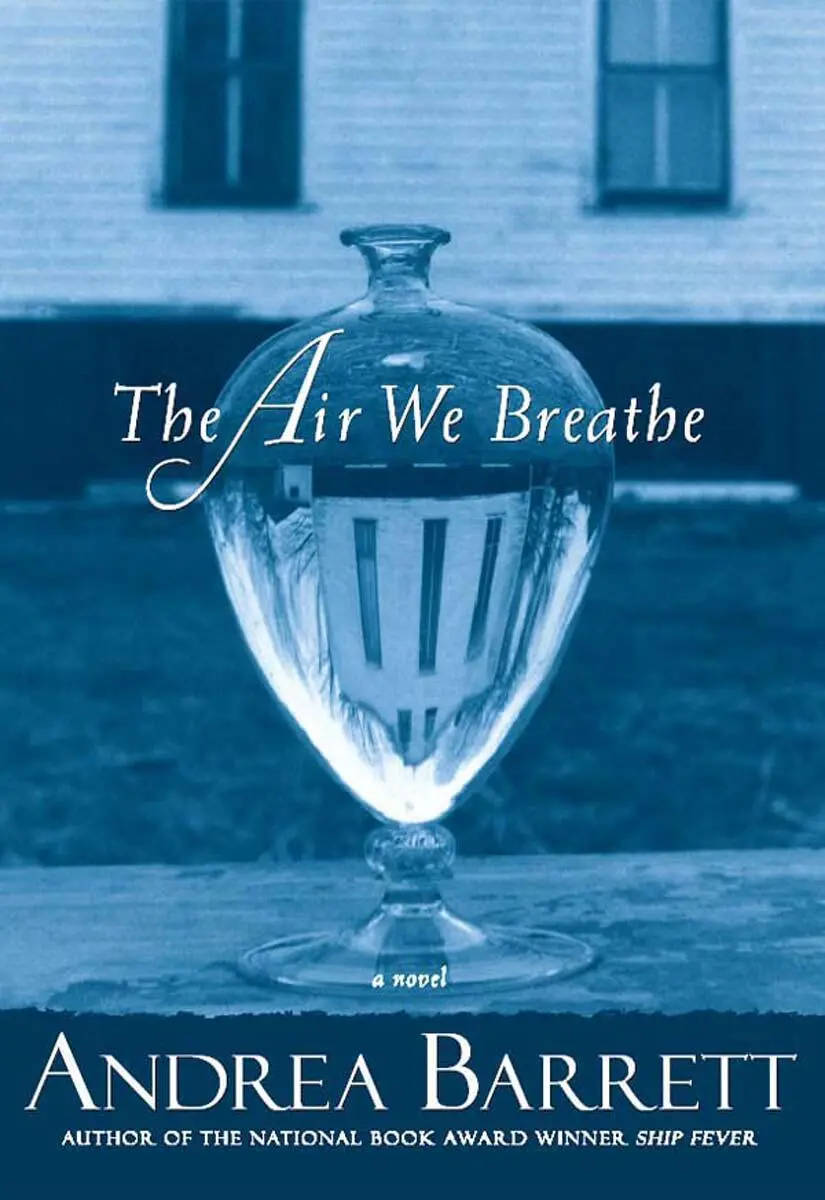
- Название:The Air We Breathe
- Автор:
- Издательство:W. W. Norton & Company
- Жанр:
- Год:2007
- ISBN:нет данных
- Рейтинг книги:3 / 5. Голосов: 1
-
Избранное:Добавить в избранное
- Отзывы:
-
Ваша оценка:
The Air We Breathe: краткое содержание, описание и аннотация
Предлагаем к чтению аннотацию, описание, краткое содержание или предисловие (зависит от того, что написал сам автор книги «The Air We Breathe»). Если вы не нашли необходимую информацию о книге — напишите в комментариях, мы постараемся отыскать её.
) by the National Book Award-winning author of
. In the fall of 1916, America prepares for war — but in the community of Tamarack Lake, the focus is on the sick. Wealthy tubercular patients live in private cure cottages; charity patients, mainly immigrants, fill the large public sanatorium. Prisoners of routine, they take solace in gossip, rumor, and — sometimes — secret attachments. But when the well-meaning efforts of one enterprising patient lead to a tragic accident and a terrible betrayal, the war comes home, bringing with it a surge of anti-immigrant prejudice and vigilante sentiment.
The Air We Breathe — читать онлайн бесплатно полную книгу (весь текст) целиком
Ниже представлен текст книги, разбитый по страницам. Система сохранения места последней прочитанной страницы, позволяет с удобством читать онлайн бесплатно книгу «The Air We Breathe», без необходимости каждый раз заново искать на чём Вы остановились. Поставьте закладку, и сможете в любой момент перейти на страницу, на которой закончили чтение.
Интервал:
Закладка:
In our chairs we shifted uneasily; would this be like our first meetings, when Miles had spoken so abstractly, and at such tedious length, about a subject that meant nothing to us? Right away, though, Irene made it clear why we should be interested. This man, she said, had changed our conception of time and shown that what had once been thought to be absolute was really relative. What could be more important? Here at Tamarack State, time passed so slowly that it sometimes seemed to stop entirely, but outside, she said — outside, where men in trenches were dying daily — clocks were ticking relentlessly and time was speeding down a giant hole.
We could feel this, she said — that time did not flow at the same speed for all of us, nor did it flow consistently — but until Einstein formulated his theory of relativity no one had articulated what that meant. Around us the walls glowed with the afternoon sun. Kathleen moved her chair so the rays wouldn’t shine on her face; Ian moved to make room for her; the movement passed through our circle of chairs like a puff of wind through wheat. Irene said that while many of us might know the theory already, because she herself still wrestled with the basic idea she thought perhaps some of us did as well. Her violet-gloved hand swooped with her words and one lock of hair detached itself from her loosely pinned braid. Both Celia and Pearl, wondering when she’d tuck it back in, kept losing track of her argument.
“Einstein,” Irene explained, “published a crucial paper a dozen years ago, in 1905, when he was twenty-six and working as a patent clerk in Berne.”
Deftly she wove the strand of hair back into place, describing how she’d paid no attention to that work until, during her first winter at Tamarack State, a Hungarian physicist curing in the village had been sent to her for a radiograph. While she was struggling to get the best view of his chest, he’d tried to explain his own work to her and mentioned how much he relied on Einstein’s discoveries. After she’d confessed her ignorance, he sent over some papers for her to read — but these, she said, had only bewildered her further. Yet the central idea was so interesting, and these days so essential, that she wanted to try to explain it.
“Time,” she said, catching the eyes of first David and then Seth, Olga and Sophie and finally Pearl, “is not something out there, something beyond us that flows serenely like a river, without any reference to us or our doings; it is not a fixed reference against which our own lives move. It is not background, it is not—
“It is not . That’s the strangest part of what Einstein said: time is not a thing but a relationship . Things moving in relation to each other. All of us grew up thinking that if everything around us disappeared, our world and even the stars in the sky, time and space would still continue on. Einstein says that time and space would disappear together with the things.”
Eudora, rapt until now, felt Naomi poking her elbow and looked down to see a note sliding from Naomi’s pad of paper onto her lap. Irritated, she looked back at Irene without reading the note but then felt Naomi’s hand again. I’m bored, Naomi had written. Aren’t you?
Eudora frowned, slid the note into her pocket, and turned away, only to find herself caught in Leo’s gaze. Him on her right, Naomi on her left; where was a person to find any peace? Already she’d begun to fret about agreeing to meet Leo for movie night. Standing there in Irene’s laboratory, his chest revealed on the film they’d made, he’d seemed truly transparent. Nowhere had she seen a speck of interest in Naomi, and when he’d dismissed Naomi’s feelings for him so firmly, it was almost as if the feelings themselves had disappeared. But Eudora was surprised to find, in the space opened up by that, her own curiosity as to what might happen between the two of them. When she’d accepted his invitation, she’d been thinking of movie night as an experiment akin to trying out a new tube on the machine, which might yield interesting results, or nothing at all.
By the time she turned her attention back to Irene’s talk, Pearl and Sophie had started taking notes. Sophie had a small brown volume on her lap, which Eudora hadn’t seen before, while Pearl was writing on a single sheet of paper folded into quarters. Both were using the stubby pencils kept in our library, which we were forbidden to take. Before Einstein wrote that paper, Irene was saying, he’d worked on other problems, important but not revolutionary; no one could have expected what he’d do next. He’d written about Brownian motion, photons, a method for determining the size of molecules…
“I read that paper,” Leo interrupted. “In German, a few years ago.”
Our heads, as if they were attached to a single string, swiveled together. Miles, who’d been irritable all afternoon, sniffed and said, “German science is nothing to be proud of, these days.”
“But you wouldn’t really call this German science,” Irene said, impatient with the interruption. “It’s just — science.”
She turned back to Leo. Obviously he was ready to start the next part of his training, and the timing was right: there’d always been more work than hands to do it but now, with so many doctors and nurses heading overseas, her laboratory might well end up serving the whole village and she could use him right away. Still, she worried about the consequences of him working with Eudora. She’d seen the radiograph of his chest, and while at first she’d been amazed at the quality of the image and delighted to see the old machine so well restored, she’d also been startled to find Eudora experimenting without her. That the subject had been Leo concerned her even more. Twenty years ago, she and her brother-in-law, experimenting eagerly in the first months after the rays were discovered, had in the process of peering into each other’s bodies felt a kind of electricity that had nothing to do with an induction coil.
“I was sure I wouldn’t be the only person who knew of Einstein’s work,” she said, seeing even as she smiled at Leo the small, unhealed spot on his left lung: another cause for concern. “In this paper, he’s simply exploring the idea that time is not absolute but flows at different rates depending upon where you are and how fast you are moving.”
Someone groaned — Polly, perhaps? — and Ian dropped his head in his hands.
“I know it’s confusing,” Irene said. “I don’t really understand it either although I’m told it makes perfect sense mathematically. But the point is just to think about what it means in the most basic terms: that time doesn’t move at the same speed for everyone everywhere. You know this is true; we all feel it.”
She paused while we murmured and shifted; unlike Miles, she paid attention to the way we responded to her words and she gave us time to try to absorb them. Sophie and Pearl both wrote down her last sentences exactly as she’d said them. Then she continued, “There’s so little time, now, between discovering something and applying it. Barely twenty years from the first hints of the Roentgen rays through the early apparatus to the equipment I have downstairs and the portable units in France. Everything moves so quickly. My fingers”—here she held up her glove—“got lost along the way. The lives of my friends. Time was moving slowly for me as I lived it — I think it moves even more slowly for you — but very swiftly in the world of science. Who knows how it moves for a soldier caught in battle? That’s not really what Einstein meant when he spoke of time being relative; he sees things mathematically and he was concerned with something different, the speed of light and the nature of energy. But in our everyday lives, we feel his ideas in a different way. Do you know what I mean?”
Читать дальшеИнтервал:
Закладка:
Похожие книги на «The Air We Breathe»
Представляем Вашему вниманию похожие книги на «The Air We Breathe» списком для выбора. Мы отобрали схожую по названию и смыслу литературу в надежде предоставить читателям больше вариантов отыскать новые, интересные, ещё непрочитанные произведения.





Обсуждение, отзывы о книге «The Air We Breathe» и просто собственные мнения читателей. Оставьте ваши комментарии, напишите, что Вы думаете о произведении, его смысле или главных героях. Укажите что конкретно понравилось, а что нет, и почему Вы так считаете.