A. Barrett - Blackass
Здесь есть возможность читать онлайн «A. Barrett - Blackass» весь текст электронной книги совершенно бесплатно (целиком полную версию без сокращений). В некоторых случаях можно слушать аудио, скачать через торрент в формате fb2 и присутствует краткое содержание. Год выпуска: 2016, ISBN: 2016, Издательство: Graywolf Press, Жанр: Современная проза, на английском языке. Описание произведения, (предисловие) а так же отзывы посетителей доступны на портале библиотеки ЛибКат.
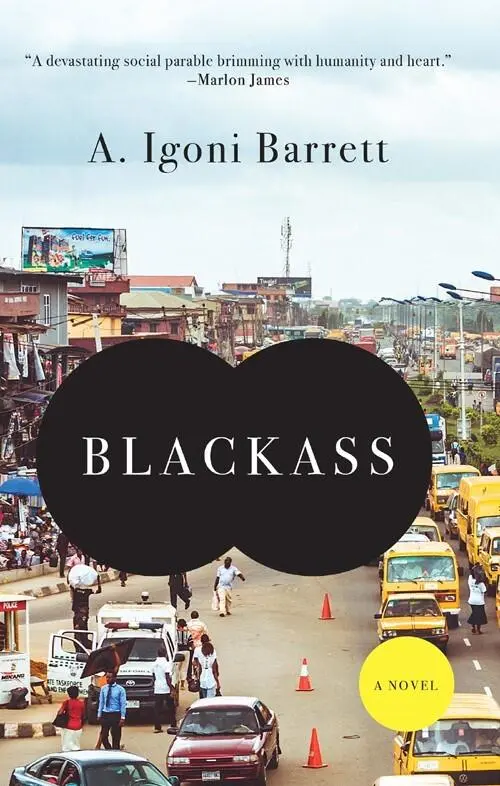
- Название:Blackass
- Автор:
- Издательство:Graywolf Press
- Жанр:
- Год:2016
- ISBN:9781555979263
- Рейтинг книги:4 / 5. Голосов: 1
-
Избранное:Добавить в избранное
- Отзывы:
-
Ваша оценка:
Blackass: краткое содержание, описание и аннотация
Предлагаем к чтению аннотацию, описание, краткое содержание или предисловие (зависит от того, что написал сам автор книги «Blackass»). Если вы не нашли необходимую информацию о книге — напишите в комментариях, мы постараемся отыскать её.
A. Igoni Barrett's
is a fierce comic satire that touches on everything from race to social media while at the same time questioning the values society places on us simply by virtue of the way we look. As he did in
, Barrett brilliantly depicts life in contemporary Nigeria and details the double-dealing and code-switching that are implicit in everyday business. But it's Furo's search for an identity-one deeper than skin-that leads to the final unraveling of his own carefully constructed story.
Blackass — читать онлайн бесплатно полную книгу (весь текст) целиком
Ниже представлен текст книги, разбитый по страницам. Система сохранения места последней прочитанной страницы, позволяет с удобством читать онлайн бесплатно книгу «Blackass», без необходимости каждый раз заново искать на чём Вы остановились. Поставьте закладку, и сможете в любой момент перейти на страницу, на которой закончили чтение.
Интервал:
Закладка:
The thing is, on seeing Tekena my thoughts flew to my mother. She, too, wore red blusher in my childhood memories. My sentiments about my father are less conflicted: he left when I was eight. My mother stayed to be condemned to failure in raising her son. Because the success of a man, our people say, is the father’s doing. You are your father’s son — you follow in your father’s footsteps. Manhood and its machismo are attributed to the seed, which then follows that the failure to make a man is the egg’s burden. Your papa born you well , they will sing to a man in praise, but when he disappoints so-and-so’s expectations of XY manliness, it becomes Nah your mama I blame. My say is this: when you live in a worldwide bullring, bullshit is what you’ll get. If they say I cannot be my mother’s son, then it must be that I’m her daughter.
After we sat down in the food court of The Palms to eat our ice cream, I began asking Tekena about her brother. I lapped up all the details she gave of his disappearance, which it turned out weren’t much, not enough to slake my thirst. She had awoken on that Monday morning to find he had left the house for the job interview he’d only mentioned to her when he was ironing his clothes the previous night, and since neither she nor her father had thought there was anything odd about his long absence, he wasn’t missed until her mother returned from the office and asked after him. That was when Tekena went into his bedroom and found his mobile phone. And the rest, as she said, was a disaster. From Tekena’s tweets I already knew that she and her parents had no inkling of the change that had happened to Furo, hence I made no mention of my meeting with him. As I uttered suitable noises of sympathy in response to her recounting of the grief his disappearance had wrought upon the household, I couldn’t help asking myself, what if Furo had remained behind after he found himself transformed? This was the question I wanted answered, and one I would have to find out for myself.
There and then I decided I would ask Tekena if I could pay her a visit her at home. Before I could find an opening to put the question, something happened. This was some time later, after we’d left the food court and gone upstairs to catch a movie. We were waiting in line to buy our tickets at the box office when a man walked up to us. I had seen him coming, and I suspected he was trouble, though I’d thought his trouble was my companion’s to rebuff. I was wrong. It was me his potbelly was jiggling towards. He had an enormous one, which he carried with as much pride as the tablet-sized smartphone clutched in his left hand. He looked to me like some local government chairman, one of those gruff-voiced goons who had moved on from extorting bus conductors and now made their money in ballot-box bullying. I was already irritated by the way he smirked at me, and I was tense on account of how close he was standing, but when he said, ‘I like your hair o,’ raising his hand at the same time to stroke my locks, the violence of my shudder shocked me as well. I sensed Tekena’s look of vicarious horror before she struck his hand away and said in a furious tone, ‘Leave my girlfriend alone!’
Crudity is a disease that money exacerbates rather than cures. And that man was an exemplar of the condition. Leave my girlfriend alone, Tekena said. A statement that left no wriggle room. A less vulgar man, if he were still intent on wooing a woman whose animosity was so evident, would have first apologised for his forwardness, and then he might have offered one of those flattering lies or I’ve-seen-you-before lines that constitute the arsenal of impromptu courtship speech. Not our man. He was too hippopotamus-skinned. His own response was rank aggression. ‘Which kin’ girlfriend?’ he sneered at Tekena, and when she threw him a glance that told him to go and die, he said with a filthy laugh: ‘Una be lesbo?’
Tekena, for all her playfulness on Twitter, was a Lagos pikin. She could give as good as she got. Brinkmanship, one-upmanship, fuck-that-man-up-ship — these were acquired skills in a city where even beggars cursed you out at the drop of a coin. Thus the overboard-ness of her response, which she began by hooking an arm around my waist in a suggestive manner before saying to the man: ‘And so what if we’re lesbians? How does that concern you? Abi you think sey if we want man nah you we go come meet? You, ke? With this your big belleh that can even crush a cow?’ These words were delivered in a tone of sweetened poison, and for some seconds after she spoke, the man was as stunned as I was. He recovered first, and opened his mouth to bellow, but thinking better of it, he walked away. ‘Smart move!’ Tekena called out after him.
A woman defended me from what I used to be.
Womanhood comes with its peculiar burdens, among them the constant reminder of a subordinate status whose dominant symptom was uninvited sexual attention from men. I hadn’t foreseen this fact of my new identity. Bus conductors whistled at me on the street; drivers pulled over to offer me rides to bars; and when I went shopping for my new wardrobe in Yaba market, the touts grabbed at my hands and laughed off my protests. All manner and ages of male called me fine girl, sweet lips, correct pawpaw, big bakassi. Landlords wanted to know if I would soon marry, if I had children, if my father or my boss would stand surety for me. A woman is not expected to live alone, to walk alone in peace, or to want to be alone.
Pity the man who never becomes the woman he could be.
It was early yet in my journey to the far reaches of my identity. Like those before me who had transitioned into otherness, I was finding out that appearances would always be a point of conflict. Male or female, black or white, the eye of the beholder and the fashion sense of the beholden, all of these feed into our desire to classify by sight. The woman and the man: stuck together in a species and yet divided by a gendered history going back to the womb. But in this war of the selves, I had switched sides. Despite the snake of maleness that still tethered me to the past, I was more than man, interrupted.
I was whoever I wanted me to be.
When Tekena and I emerged from the movie theatre, I told her I planned to be in Egbeda on Saturday (a small lie) and asked if it was OK to stop by her house for a quick visit. She gave her consent with expressions of genuine pleasure, and the next weekend, shortly before midday on the last day in June, I knocked at her gate. She came to open it and we went into the sitting room, where I spotted those two objects of my rampant curiosity: Furo’s mother and father.
Monima Wariboko was a former civil servant who now owned a chicken farm. He was sixty-four years old and had been married for thirty-five of those years. The first time I saw him, he was slouched in an armchair that occupied prime position in front of the TV. He was a big-boned man, larger in stature than his son, and yet, sitting there, hypnotised by the TV, he seemed the smallest person I had ever seen. He was thoroughly broken. This was apparent from the slackness of his lips when he raised his head to accept my greeting, and that wheezing voice, that exhausted way of speaking, so disheartening to hear in a person who wasn’t Marlon Brando. He was unclothed except for an old wrapper of his wife’s, a colourful wax-print fabric, which he wore around his waist and knotted under the Gollum swell of his belly. He resembled a fisherman straight out of a daguerreotype, a wastrel who hadn’t netted a catch for years and yet fatted himself on the cassava from his wife’s farm, and then went to pose for the camera because he was the only one not at sea when the colonialists came calling. He annoyed me on sight.
That’s how I felt the first time I saw Furo’s father, but later, upon reflection, I picked out the nettles from my eyes. Yes, he was indeed a broken man, housebroken and heartbroken, and a broke ass, too, but he had stuck around. He was a father figure to his children, a weak father for sure, but a father they could see. He was good friends with his daughter, who clearly loved him dearly. He didn’t assault his wife or embarrass her with roadside sexual affairs. He didn’t remain in the civil service to do nothing and embezzle money. He established his own business through honest work and gave his best at running it, and though his best ended up ruining it, at least, on the day his coffin is lowered into the ground, someone can say in truth, ‘Here lies a good man.’
Читать дальшеИнтервал:
Закладка:
Похожие книги на «Blackass»
Представляем Вашему вниманию похожие книги на «Blackass» списком для выбора. Мы отобрали схожую по названию и смыслу литературу в надежде предоставить читателям больше вариантов отыскать новые, интересные, ещё непрочитанные произведения.









Обсуждение, отзывы о книге «Blackass» и просто собственные мнения читателей. Оставьте ваши комментарии, напишите, что Вы думаете о произведении, его смысле или главных героях. Укажите что конкретно понравилось, а что нет, и почему Вы так считаете.