Conrad Aiken - Blue Voyage
Здесь есть возможность читать онлайн «Conrad Aiken - Blue Voyage» весь текст электронной книги совершенно бесплатно (целиком полную версию без сокращений). В некоторых случаях можно слушать аудио, скачать через торрент в формате fb2 и присутствует краткое содержание. Год выпуска: 2015, ISBN: 2015, Издательство: Open Road Media, Жанр: Современная проза, на английском языке. Описание произведения, (предисловие) а так же отзывы посетителей доступны на портале библиотеки ЛибКат.
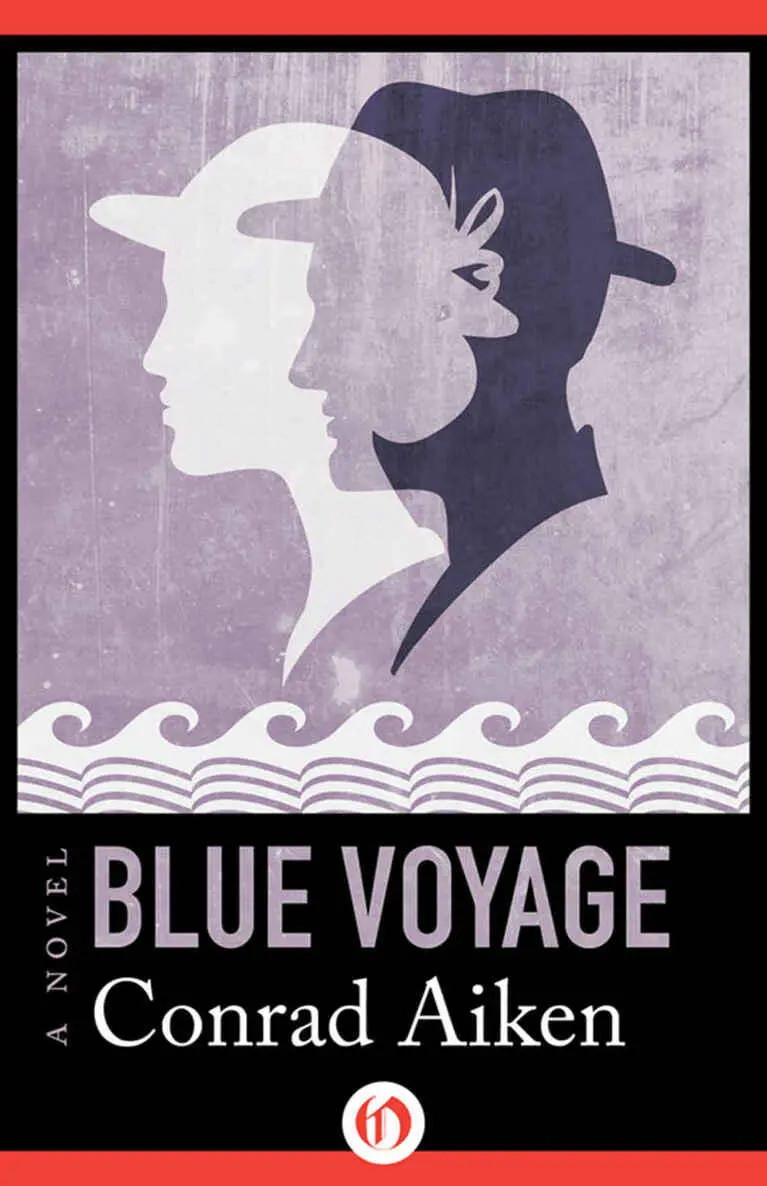
- Название:Blue Voyage
- Автор:
- Издательство:Open Road Media
- Жанр:
- Год:2015
- ISBN:9781504011396
- Рейтинг книги:4 / 5. Голосов: 1
-
Избранное:Добавить в избранное
- Отзывы:
-
Ваша оценка:
Blue Voyage: краткое содержание, описание и аннотация
Предлагаем к чтению аннотацию, описание, краткое содержание или предисловие (зависит от того, что написал сам автор книги «Blue Voyage»). Если вы не нашли необходимую информацию о книге — напишите в комментариях, мы постараемся отыскать её.
A brilliant novel of psychological insight and formal experimentation reminiscent of the stories of James Joyce,
is a bold work of art from a winner of the National Book Award and the Pulitzer Prize.
Blue Voyage — читать онлайн бесплатно полную книгу (весь текст) целиком
Ниже представлен текст книги, разбитый по страницам. Система сохранения места последней прочитанной страницы, позволяет с удобством читать онлайн бесплатно книгу «Blue Voyage», без необходимости каждый раз заново искать на чём Вы остановились. Поставьте закладку, и сможете в любой момент перейти на страницу, на которой закончили чтение.
Интервал:
Закладка:
And the impulse to write to you, by way of leave-taking, is imperious. It seems to me that I have an infinitude of things that I must say to you. You know how one feels on a dock, when one sees one’s friend sail away, perhaps forever? the regret, almost the agony, with which one remembers a few of the things one has forgotten to say, or hadn’t the courage to say? One never, after all, told him how much one loved him. Not even a hint. One never, after all, showed one’s simple joy in the fact that one, at least partially, possessed him. One never so much as breathed the suggestion that one would feel his absence. And then, there is all the good advice that one has forgotten to give, all the solicitude for his future that one has somehow failed to express! You are going to a tropical climate? Do not forget your cork helmet and your parasol! Remember, when you get up in the morning, to empty the scorpions out of your boots!.. You are going to the North Pole? Be sure, then, to take a thermos flask filled with hot rum and coffee, and plenty of almond chocolate, and your goloshes, and your heaviest woolens!.. Nor do I mean this facetiously. The advice is usually just as stupid as this, just as useless. But it serves its purpose: no matter how clumsily administered, it serves to express the aching concern with which one sees the departure; and its expression is at once accepted as just that and nothing else. And so it is with me, Cynthia. I have never told you in so many words that I love you — partly because there was no time for it, our acquaintance being so brief and so scattered; and partly for psychological reasons: my profound sense of inferiority, my sense of filthiness, and my fear of all decisive action, all being partially responsible. And now it is too late, for I find you (again in mid-Atlantic! surely one of the most remarkable coincidences that ever befell two human creatures!) engaged to be married; and no sooner am I informed of this fact than I am “dropped” by you — given, in fact, the “cut direct” by your mother. Well! This has one saving grace, this magnificent disaster — for I can now say, once and for all, that I love you.
Having said this much, however, I find myself oddly at a loss as to how to continue. The truth is, my imagination has dealt with you so continuously, and so strenuously, and so richly, that I have no longer any definite sense as to where, exactly, between us, the psychological boundary lies. Two nights ago, for example, after our encounter on the deck (where, of course, as I am in the second cabin, I had no right to be) I lay awake all night, re-enacting every scrap of our little history, and improvising a good deal besides. In this you were — as indeed you are in all my reflections—“Cynthia”; and you were admitted to an intimacy with me (this may surprise you!) which I have vouchsafed to no one else. As I look back on that long orgy of self-communion, which had you as its chief but not as its only theme, I find in it naïveté a good deal that amuses me. It is a curious and instructive fact, for example, that in that moment of Sturm und Drang I should have experienced so powerfully a desire to talk to you about my childhood. I found myself constantly reverting to that — babbling to you my absurd infantine confidences and secrets, as if you were — ah! — my mother. Exactly! And isn’t that the secret of your quite extraordinary influence upon me? For some reason which I cannot possibly analyze, you strike to more numerous and deeper responses in me than any other woman has done. It must be that you correspond, in ways that only my unconscious memory identifies, to my mother, who died when I was very small. Can it be that?… Anyway, there it is; and as I sit here in my beloved smoking room, waited on by Malvolio, (do you remember how, on the nice old Silurian, you reproached me for sitting in the smoking room so much? do you remember how, one evening, we listened, standing just outside the door, on the dark deck, to the men singing there?) — well, as I sit here, hearing the slap of rubber quoits on the deck above, it is again a desire to talk to you of my childhood that comes uppermost. Strange! It really seems to me that there is something exquisitely appropriate in this: it seems to me that in this there might be some hope of really touching you. I do not mean that I harbor any hope that you will break off your engagement and engage yourself to me. (For one thing, I am not at all sure that I would want to marry.) Nor do I mean anything quite so obvious as that you should be touched sentimentally . No. What do I mean, then? Well, I mean that this would be the most direct, simple, and really effective mode of establishing the right communion between us. I don’t think this is merely a circumlocution or clumsy evasion. What I am trying to say, perhaps, is that to talk to you of my childhood — to tell you of some one particular episode — would be for us what the good advice regarding goloshes was for the departing traveler: a profound symbol of intimacy. Even that is not the whole story. For also — and here, I admit, I do plunge recklessly into the treacherous underworld of effects — I feel with a divine confidence that is tantamount to clairvoyance that to tell you of some such episode would be to do you an exquisite violence . Why? Because I am perfectly certain that whatever is true — I mean idiosyncratically true — of me, is also deeply true of you; and my confession would therefore be your — accusation! An impeachment which you would be the first (but with a delighted shock) to admit.
But no — This is an evasion, an attempt to rationalize a mere feeling, ex post facto . The truth is, I am confused, and scarcely for the moment know what I do think or feel. Unhappy? Oh, yes! as the Negro spiritual says. What else could be expected? Yet I blame no one but myself for my unhappiness, and I hope I am too intelligent to suppose that my unhappiness is of any importance. Confused. My imagination darts in fifty directions, checked in each. I desire you — I hate you — I want to talk intimately with you — I want to say something horribly injurious to you … At one moment, it is of the purely trivial that I should like to talk to you. I should like to tell you of the amusing affair of old Smith (who was with me when I met you) and Mrs. Faubion, who sits opposite us at table; of how, last night, having made himself mildly tipsy with Guinness, he attempted to get into Mrs. Faubion’s room, just as she and her roommate (an incredible young woman!) were going to bed; how he put his foot inside her stateroom door (and such funny shoes he wears! horned like the rhino!) and tried to engage her in banter, meanwhile displaying, as if guilelessly, a purse full of gold sovereigns! At dinner, last night, he had told me of this project, and I had tried to dissuade him from it. No use. He was convinced that Mrs. Faubion was “ that sort ” … And this morning at breakfast, when Mrs. Faubion and I were alone, it all came out, the whole wretched story. “What was the matter with Mr. Smith last night?” “Matter? Was something the matter?” “Yes! He came to our room, and got his foot inside the door, and wouldn’t go away — all the time trying to show some gold money he had in a pocketbook! We had to shut the door in his face!.. Actually!.. And then he tried to come back again! I had to threaten to ring for the steward …” She looked at me, while she said this, with an air of profound wonder and mystification, perhaps just faintly tinged with suspicion. It puzzled her. What could have been the matter with the old man? And was I involved?… I suggested, of course, that he was just a little tipsy, and urged her to pay no attention to it. She remained, however, puzzled, and a little unconvinced … And Smith! When I walked round the deck with him later in the morning, did he say anything to me about this tragic — for him, I assure you, tragic — adventure? Not a word. Not a single word. But he was unhappy, and quiet — I could see the misery in him turning and turning round that dreadful and brief little disaster; while he revolved in his mouth one of the “expensive” cigars which his employer had given him as a parting present … Well, a horrible little episode, you will say, and why should I want to describe it to you? Again, because I am sure it will touch in you certain obscure chords which it touched in me, and set us to vibrating in subconscious harmony. Pity? Horror? Wonder? A sense of the disordered splendor and unexpectedness and tragedy of life? All these things, Cynthia; but chiefly the desire that we might again, as last year at the Bach concert, listen together .
Читать дальшеИнтервал:
Закладка:
Похожие книги на «Blue Voyage»
Представляем Вашему вниманию похожие книги на «Blue Voyage» списком для выбора. Мы отобрали схожую по названию и смыслу литературу в надежде предоставить читателям больше вариантов отыскать новые, интересные, ещё непрочитанные произведения.









Обсуждение, отзывы о книге «Blue Voyage» и просто собственные мнения читателей. Оставьте ваши комментарии, напишите, что Вы думаете о произведении, его смысле или главных героях. Укажите что конкретно понравилось, а что нет, и почему Вы так считаете.