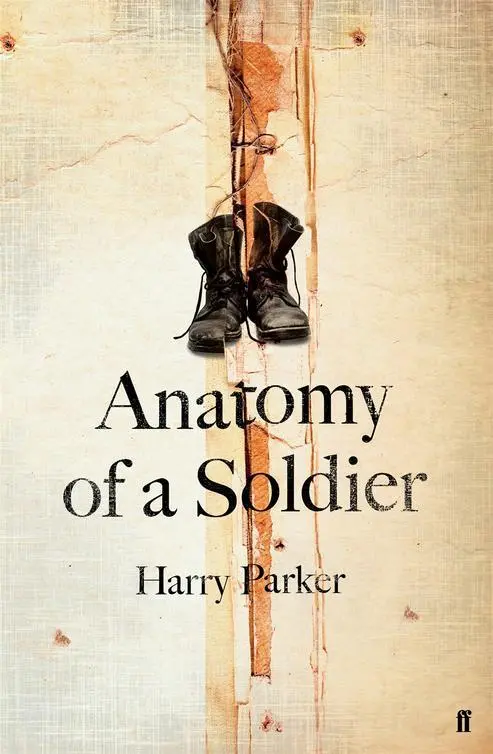
Harry Parker - Anatomy of a Soldier
Здесь есть возможность читать онлайн «Harry Parker - Anatomy of a Soldier» весь текст электронной книги совершенно бесплатно (целиком полную версию без сокращений). В некоторых случаях можно слушать аудио, скачать через торрент в формате fb2 и присутствует краткое содержание. Год выпуска: 2016, ISBN: 2016, Издательство: Faber & Faber, Жанр: Современная проза, на английском языке. Описание произведения, (предисловие) а так же отзывы посетителей доступны на портале библиотеки ЛибКат.
- Название:Anatomy of a Soldier
- Автор:
- Издательство:Faber & Faber
- Жанр:
- Год:2016
- ISBN:9780571325849
- Рейтинг книги:5 / 5. Голосов: 1
-
Избранное:Добавить в избранное
- Отзывы:
-
Ваша оценка:
Anatomy of a Soldier: краткое содержание, описание и аннотация
Предлагаем к чтению аннотацию, описание, краткое содержание или предисловие (зависит от того, что написал сам автор книги «Anatomy of a Soldier»). Если вы не нашли необходимую информацию о книге — напишите в комментариях, мы постараемся отыскать её.
We see them not as they see themselves, but as all the objects surrounding them do: shoes and boots, a helmet, a trove of dollars, a drone, that bike, weaponry, a bag of fertilizer, a medal, a beer glass, a snowflake, dog tags, an exploding IED and the medical implements that are subsequently employed.
Anatomy of a Soldier is a moving, enlightening and fiercely dramatic novel about one man's journey of survival and the experiences of those around him. Forty-five objects, one unforgettable story.
'This is a brilliant book, direct from the battle zone, where all the paraphernalia of slaughter is deployed to tell its particular and savage story.' Edna O'Brien
'A tour de force. In this brilliant and beguiling novel Harry Parker sees the hidden forces that act on the bodies and souls of combatants and non-combatants. . It feels like war through the looking glass but it is utterly real.' Nadeem Aslam
Anatomy of a Soldier — читать онлайн бесплатно полную книгу (весь текст) целиком
Ниже представлен текст книги, разбитый по страницам. Система сохранения места последней прочитанной страницы, позволяет с удобством читать онлайн бесплатно книгу «Anatomy of a Soldier», без необходимости каждый раз заново искать на чём Вы остановились. Поставьте закладку, и сможете в любой момент перейти на страницу, на которой закончили чтение.
Интервал:
Закладка:
The gate opened and Faridun came out and saw his father. ‘These men want to see you, Father,’ he said.
‘I know, son. I have just heard.’ He smiled at him and turned to the soldier. ‘Please wait for one moment,’ he said. ‘I need to make sure my house is ready. Then we shall talk.’
Faridun grabbed hold of my handlebars, wheeled me through the gate and propped me against the post of an awning at the edge of the garden. His father signalled that the women were not visible, and Faridun led three of the soldiers inside the large room at the end of the compound, beyond the veranda.
When they had finished talking and the men were gone, Faridun’s father came into the garden and sat on a low bench near where I waited.
Faridun followed him at a distance. ‘I am sorry, Father,’ he said softly and twisted a vine leaf in his fingers. ‘I should not have brought them. But I thought, with their weapons and power and money — I thought you might want to talk to them.’
‘It is done now, Faridun.’
Faridun looked over at him. ‘Will they punish us? Will Lalma be okay?’
‘I don’t know, Faridun,’ he said. ‘We will have to wait. God willing it will be of some use.’
Faridun crouched down and dangled his fingers in the water that trickled along a concrete gutter into the garden, disturbing the small track of silt at the bottom. ‘Are they winning now?’
‘Winning?’
‘Will the soldiers make us safer? There seem to be more of them, and they come farther into our land. Are they pushing Hassan and his people away?’
‘It’s not just Hassan, Faridun. It is complex. The elders will want to know what I have said as well.’
He stared through the lattice of green that hung from the pergola: if he didn’t focus, it was a shifting emerald blur. Conflict had always raged beyond his walls but he and his family had only ever known peace in this compound. However, the world outside was encroaching now. He looked at his son.
‘What I do know,’ he said, ‘is that no one wins.’
*
Faridun rode me to work each day and the dread that he’d endangered his sister and family twisted through him. He wished he’d stayed quiet and lied to the soldiers. A bark of frustration burst out of him as he pedalled me and he shook his head, grasping his fingers tightly around my grips.
He returned home and expected that Hassan’s men had visited. As we rode down the track to the compound he imagined what they’d done to his family. He prepared himself to see his sister’s headless body and his dead father and mother, the rest of his family all slaughtered around them. He’d been told that’s what they could do. But everyone was fine and welcomed him in and he sat with them as they prepared for the wedding.
A few weeks later, Faridun’s father sent us up to the edge of the desert that had been abandoned when the soldiers arrived. Their base was attacked most days and the buildings and compounds were punctured with holes and strike marks. Many had collapsed and entire sections of wall had been destroyed. His father told Faridun that they had to keep the channels clear for when the people returned, for when the fighting was over. It was their duty, he said as he waved us off.
Faridun cycled me up to one of his father’s small buildings. The men were waiting and grunted at him. I was against the wall and he opened the door with the key his father had given him. The men filed in, took tools from the stacks by the walls and pushed a wheelbarrow out, then walked across a wheat field and started dredging a ditch.
That afternoon, I was flat in the dry grass beside Faridun. He was sitting on his haunches, loosening the jammed slat of a sluice gate, banging it with a hammer until it crunched free. Then he worked it up and down, untied a grimy bag of grease and spread it into the gate’s notches.
He looked up when the firing started, then over at the other men, who had also paused. There were trees blocking their view, but it was close and from the direction of the soldiers’ base. Faridun wiped his hands on the grass, lifted me up and pushed me towards the men.
‘It is near?’ one of them said.
‘From the base,’ Faridun called back. He wheeled me down the path next to the channel. The gunfire stuttered and then built again.
‘What do you think?’ Faridun said as he pushed me up to an old wall that ran alongside the ditch the men were clearing. They stepped up onto the path, drips from their clothes darkening the dust.
‘They are too close,’ one said. ‘I am going home.’ He picked up a shovel, put it in the wheelbarrow and walked away. The others followed.
‘Wait, it might be over soon,’ Faridun said.
One of them dismissed him with a wave and said it was nearly the end of the day anyway.
They began running when the air above started to crack. The sound sprayed across the sky as they sprinted in a crouch for the small building. Faridun saw them chuck the tools down by the door and sighed. They disappeared through the trees and down the road. They won’t be back today, he thought.
Faridun rested me beside the wall and slid down until he was leaning against it. With the wall between us and the firing he was safe and waited, listening to the bullets and looking up at the sky as it ruptured above him. There was no visible sign of the noise. He thought how odd that was but knew the tiny bits of metal would travel far into the district before they landed and kicked up a puff of dust in a field. He’d seen that several times.
The sound subsided and only the occasional bullet snapped overhead. Then it roared in a crescendo and he heard the whine of a ricochet sail up through the constant cracks. He didn’t feel frightened behind the wall, and told himself the firing would stop soon, the attackers would drift away and the soldiers would wait in their towers again.
But it went on much longer than Faridun expected and he took some dried apricots from his pocket and started eating. There was one last burst of gunfire and finally it was silent. He was about to get up and pack away the equipment when he heard shuffling through the foliage next to the wall, a hiss of breath and murmuring. Then they came around the corner and Faridun stood up and reached for me.
The injured man’s chin was flat against his chest and his grey trousers were dark with blood. He was held between two men. Faridun knew them all and he backed away. These were Hassan’s men and Latif was with them. They have come to punish me, Faridun thought.
‘You. Come here, we need help,’ one of them said. His accent was foreign.
It was the man who had pushed us over at the checkpoint. The weapon he had forced into Faridun’s mouth was slung across his back and the eyes that had threatened his sister flashed up at him. He didn’t seem to recognise Faridun and was less frightening now. His turban had been knocked back, exposing his forehead, and he stooped under the weight of the bleeding man, his expression desperate.
Faridun stepped away and held my handlebars.
‘I said come here, boy,’ the man said again, trying to be forceful through the strain.
Faridun didn’t move. He looked at Latif under the other arm of the hurt man. He was struggling to control his breathing, which came in faltering wheezes.
‘Latif?’ Faridun said. He was concerned for him.
‘How do you know Latif?’ the man said. He tried to heft the injured man up. ‘Quick, you can help us. We need to get this man to safety.’
‘Are you okay, Latif?’ Faridun said but the young man didn’t reply. Faridun pushed me out from the wall. ‘I know a place that’s not far. Follow me,’ he said, taking their weapons and hanging them from my handlebars. They dangled down beside me as I was wheeled across the field back towards the small building. They carried the injured man behind us, stumbling through the wheat and over the hard clumps of earth. A fourth man was with them and kept checking behind to make sure they weren’t being followed.
Читать дальшеИнтервал:
Закладка:
Похожие книги на «Anatomy of a Soldier»
Представляем Вашему вниманию похожие книги на «Anatomy of a Soldier» списком для выбора. Мы отобрали схожую по названию и смыслу литературу в надежде предоставить читателям больше вариантов отыскать новые, интересные, ещё непрочитанные произведения.








Обсуждение, отзывы о книге «Anatomy of a Soldier» и просто собственные мнения читателей. Оставьте ваши комментарии, напишите, что Вы думаете о произведении, его смысле или главных героях. Укажите что конкретно понравилось, а что нет, и почему Вы так считаете.