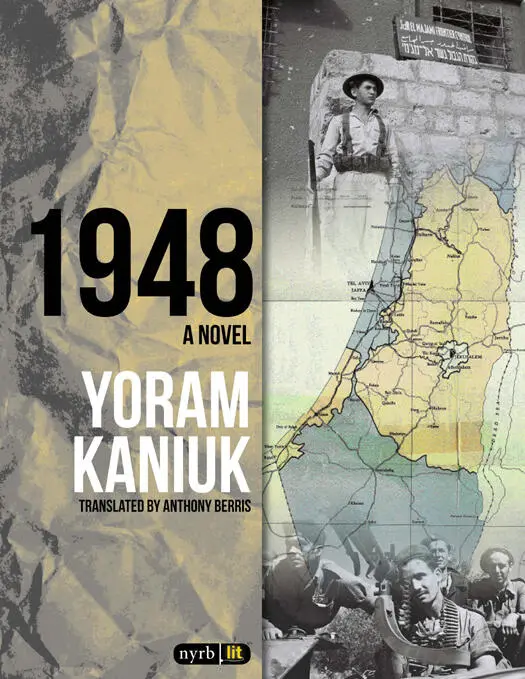
Yoram Kaniuk - 1948
Здесь есть возможность читать онлайн «Yoram Kaniuk - 1948» весь текст электронной книги совершенно бесплатно (целиком полную версию без сокращений). В некоторых случаях можно слушать аудио, скачать через торрент в формате fb2 и присутствует краткое содержание. Год выпуска: 2012, Издательство: NYRB LIT, Жанр: Современная проза, на английском языке. Описание произведения, (предисловие) а так же отзывы посетителей доступны на портале библиотеки ЛибКат.
- Название:1948
- Автор:
- Издательство:NYRB LIT
- Жанр:
- Год:2012
- ISBN:нет данных
- Рейтинг книги:3 / 5. Голосов: 1
-
Избранное:Добавить в избранное
- Отзывы:
-
Ваша оценка:
1948: краткое содержание, описание и аннотация
Предлагаем к чтению аннотацию, описание, краткое содержание или предисловие (зависит от того, что написал сам автор книги «1948»). Если вы не нашли необходимую информацию о книге — напишите в комментариях, мы постараемся отыскать её.
Eschewing self-righteousness in favor of self-criticism, Kaniuk's book, winner of the 2010 Sapir Prize for Literature, is the tale of a younger man told by his older, wiser self — the self who realizes that wars are pointless, and that he and his friends, young men from good homes forming an offbeat band of brothers, were senseless to see glory in the prospect of dying young. But it is also a painful, shocking, and tragically relevant homage to the importance of bearing witness to the follies of the past, even — or especially — when they are one's own.
1948 — читать онлайн бесплатно полную книгу (весь текст) целиком
Ниже представлен текст книги, разбитый по страницам. Система сохранения места последней прочитанной страницы, позволяет с удобством читать онлайн бесплатно книгу «1948», без необходимости каждый раз заново искать на чём Вы остановились. Поставьте закладку, и сможете в любой момент перейти на страницу, на которой закончили чтение.
Интервал:
Закладка:
Yashka and I stood in line at the dining hall with the little chits we had to give to Shika at the door. I’d taught him to make a salad from mallow leaves, vine leaves, bread crumbs, and weeds whose names I’ve forgotten. Shika — who during the war called the British and American troops the British army or the American army, but always called the Russians “our forces”—admiringly called Yashka “comrade partisan.”
We were driving together one day and suddenly I felt a burning sensation. I looked down and saw a hole in my pants and then another, and at that moment I saw that he too was looking at his pants and in the mixture of Hebrew, Russian, and German we used, he said, Bullet come in undertrousers. A foreign, hostile, and stupid bullet had penetrated the area of our rumps and sailed from one pant leg to the other and out, but except for burns and holes in our pants it didn’t leave a mark. We laughed and he said that we were ass -kameraden .
He was quiet, daring, and fought like they said the Polish cavalry did, what years later would be called “exposed in the turret,” but back then we didn’t have a turret to be exposed in. It was 1948, the time of the Children’s Crusade.
On mornings after a battle we divided up the clothes of the dead. The evenings were cold and Yashka sang Russian songs. In battle he’d stand as he fired. He said he could see the enemy better if he stood. He had no fear and obviously loved shooting. The moment he went into battle he’d glow and speak in Russian and sing, and in one of our assaults on Siris — two had already failed — or perhaps it was Beit Iksa or another village, I’ve forgotten where exactly, we were left in a scorched hilly area, everybody except the two of us was asleep, and Yashka the Partisan sat and let out a shout of joy as if he were an animal. I moved over to him and he gave me a Strand Special cigarette, which were hard to come by, and tried to explain something to me. I didn’t understand everything but he spoke with a lot of hand gestures. He didn’t know Yiddish, and I knew only very little, and I’m not even sure he was Jewish, not that I cared. From what he told me I understood that he’d fought in Stalingrad as a boy. He said that the battle there had been the bitterest ever fought and thousands had been killed, and once he’d killed a German with a head-butt. He said, apparently, that there was hunger and cold and he loved (here he drew a heart in the sand with a twig) our war because the Jews deserved a country because in Stalingrad many Jews had fought and died and were not awarded a medal of honor, and after the fighting they’d been attacked and murdered because they were Jews, and his grandfather had been a religious Jew in Siberia, and what we were doing here was right and true but was like a children’s war, against Arabs who yelled and slaughtered and fled at the first shot. He’d never, so he told me, seen worse soldiers, but not the Jordanians who are excellent soldiers. But the Arabs are many and they’ve got weapons, and he kills as many of them as he can because if he doesn’t you won’t have a state here. Perhaps he said “we” but I’m not sure.
He started singing a Russian song in a whisper and it sounded like a Hebrew song, and he embraced me tightly and said, Just as long as we succeed. We’ve got to fight well. You’re a bit funny. You also want morals. There are no morals in war, he said in broken Hebrew that’s hard for me to reconstruct today, but I understood him, he meant me because I’d made a song and dance about what is permitted and what is forbidden. He said he’d once read books on philosophy and knew that morals were all right for professors, every animal kills other animals, every man fights for his life and kills if he wants to live, there are no moral wars. Do you wait for someone to kill you and then what? Only afterward you shoot at him? Someone like you, who was in Hashomer Hatzair and lay wounded says you’ve got to be right, but you’ve also got to be bad. Without the bad guys there are no wars, said Yashka the Partisan, and he chewed on a stalk of grass and laughed. He had a lovely clear and wise and open laugh, and sometimes he’d even fall asleep in the middle of laughing.
We tried to sleep during the day. There was no food or water, and when we were in Jerusalem itself, after or before the battles, we went to see the only film showing in the city, Fiesta . The owner of the only cinema open at the time had a generator. He was madly in love with the cinema and it was said he’d sell his wife and children for one new film, but there weren’t any, all he had was this one, Fiesta , with Esther Williams and Ricardo Montalban. He’d watch it every day and when somebody came into the darkness he’d yell, Shalom folks, it’s two mils for the Jewish National Fund, and continue watching. Ricardo, wearing a silvery suit, sang in Spanish, which I thought was Mexican, and the blond Esther with the terrific body would dive into a pool filled with girls who looked like fish in their lustrous swimsuits, and the water sprayed in glorious Technicolor, and we’d sit with him in the dark and sing the theme song together. Yashka learned the song from us and maybe thought it was in Hebrew.
I remember becoming apathetic. I waited for death so I could rest awhile. I was tired. I recalled the monks at Latrun, to whom my father would take me when he went to read The City of God with them, a book that he loved. They didn’t speak and mumbled memento mori all day, remember death. And now the bullets whistled in my sleep too, and I remembered death. Even in my dreams. I tried to meet Death but it laughed at me and decided to give me a miss.
We went up to Jerusalem with its windows closed in fear and sang as we marched, and Death that had given me a miss applauded us. The brigade suffered so many dead, and we were all kids, bad and good. I tried to learn things from Yashka, for instance how the partisans fought, but his explanations were in Russian and I didn’t always understand. Now and then we wanted to ask him details about himself, where he was from, had he really been a partisan, how did he get to Palestine, on an illegal immigrant ship? But we were busy and tired and it was postponed. We wanted water. But instead we listened to records we’d taken as booty from Arab villages, tangos in Arabic. Abdel Wahab, Layla Murad, who they said was Jewish. I thought, Tomorrow I’ll ask what his surname is, but I didn’t. I was almost eighteen. He was about twenty. A girl I met on the lawn in the kibbutz said he’s a hell of a guy and looked at him admiringly. Maybe I was envious and maybe not. And then one night he was killed. That wasn’t out of the ordinary. We usually buried boys like him as “Unknown,” which is less appropriate than the “Known only to God” they wrote on graves from the riots of the 1920s and ’30s. Known only to God — powerful words.
He was killed beside me but I don’t remember where it happened. We were on the ground. I suddenly saw him writhing in pain. I cradled his head in my arms and wished him to live. Fuck it, he had to live. When he started to breathe quietly I was happy. I tried to think about how to get him someplace where there was a medic, and suddenly he began choking, then he stopped and breathed easily, and he took a deep breath and I could see how the air entered his lungs and I was sure he was safe but the air didn’t come out. He didn’t exhale. With that deep breath he died. The air didn’t want to come out.
I went up to Pension Fefferman and asked to speak to Yitzhak Rabin. They let me in and I told him that a true hero had been killed and perhaps we could write “Yashka the Partisan” on the temporary grave marker. Rabin thought about it and approved. The dead were buried each morning, and when his turn came, the body was placed in the grave. We were usually too tired to attend the burials but this time we came, it was uncharacteristic, but we said, Poor guy, he’s got nobody else. As if the rest of us had. But he didn’t have parents in a village or city. We filled in the grave and stuck in the marker on which we’d written “Yashka the Partisan.”
Читать дальшеИнтервал:
Закладка:
Похожие книги на «1948»
Представляем Вашему вниманию похожие книги на «1948» списком для выбора. Мы отобрали схожую по названию и смыслу литературу в надежде предоставить читателям больше вариантов отыскать новые, интересные, ещё непрочитанные произведения.







Обсуждение, отзывы о книге «1948» и просто собственные мнения читателей. Оставьте ваши комментарии, напишите, что Вы думаете о произведении, его смысле или главных героях. Укажите что конкретно понравилось, а что нет, и почему Вы так считаете.