Enrique Vila-Matas - Montano's Malady
Здесь есть возможность читать онлайн «Enrique Vila-Matas - Montano's Malady» весь текст электронной книги совершенно бесплатно (целиком полную версию без сокращений). В некоторых случаях можно слушать аудио, скачать через торрент в формате fb2 и присутствует краткое содержание. Год выпуска: 2007, Издательство: New Directions, Жанр: Современная проза, на английском языке. Описание произведения, (предисловие) а так же отзывы посетителей доступны на портале библиотеки ЛибКат.
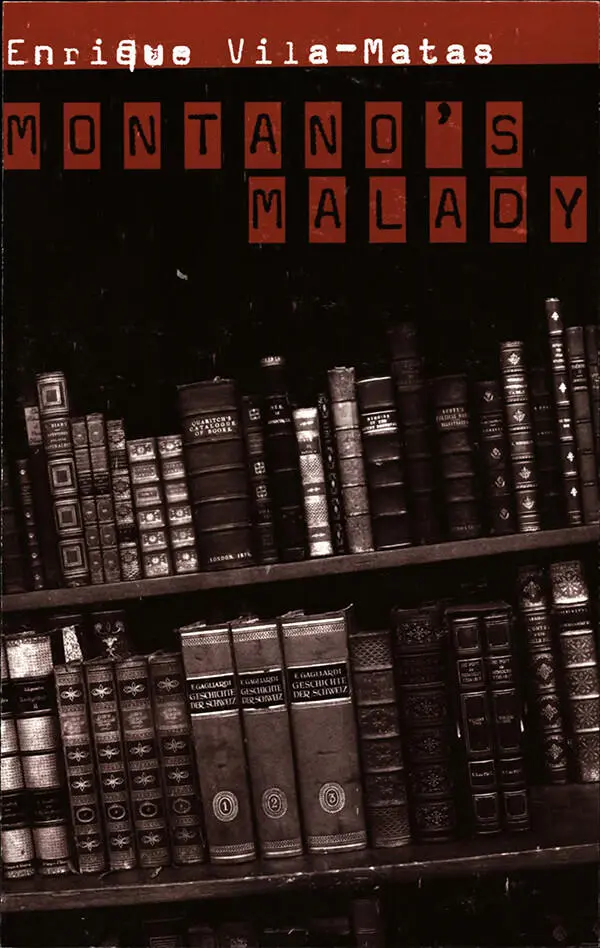
- Название:Montano's Malady
- Автор:
- Издательство:New Directions
- Жанр:
- Год:2007
- ISBN:нет данных
- Рейтинг книги:5 / 5. Голосов: 1
-
Избранное:Добавить в избранное
- Отзывы:
-
Ваша оценка:
Montano's Malady: краткое содержание, описание и аннотация
Предлагаем к чтению аннотацию, описание, краткое содержание или предисловие (зависит от того, что написал сам автор книги «Montano's Malady»). Если вы не нашли необходимую информацию о книге — напишите в комментариях, мы постараемся отыскать её.
is a writer named Jose who is so obsessed with literature that he finds it impossible to distinguish between real life and fictional reality. Part picaresque novel, part intimate diary, part memoir and philosophical musings, Enrique Vila-Matas has created a labyrinth in which writers as various as Cervantes, Sterne, Kafka, Musil, Bolano, Coetzee, and Sebald cross endlessly surprising paths. Trying to piece together his life of loss and pain, Jose leads the reader on an unsettling journey from European cities such as Nantes, Barcelona, Lisbon, Prague and Budapest to the Azores and the Chilean port of Valparaiso. Exquisitely witty and erudite, it confirms the opinion of Bernardo Axtaga that Vila-Matas is "the most important living Spanish writer."
Montano's Malady — читать онлайн бесплатно полную книгу (весь текст) целиком
Ниже представлен текст книги, разбитый по страницам. Система сохранения места последней прочитанной страницы, позволяет с удобством читать онлайн бесплатно книгу «Montano's Malady», без необходимости каждый раз заново искать на чём Вы остановились. Поставьте закладку, и сможете в любой момент перейти на страницу, на которой закончили чтение.
Интервал:
Закладка:
I dined with the dead. The good part about not understanding a thing is that one can understand that thing however one chooses. Also, being radically alone and incommunicado, one has plenty of time to watch, analyze, delve into the surroundings. I dined with an illustrious group of the dead. There must have been about thirty writers with their eyes sunk into a monumental potato salad, talking melancholically about the peaceful setting and the eternal harmony of the Alpine universe. I remembered a poem in which the men and women of a town called Spoon River, in short epitaphs that are autobiographies, that are poems, tell the story of their sorrowful lives from the graveyard where they he buried. And I remembered the island of Pico, where there was not a soul in sight, but everything seemed ready for the wind at any time to bring voices speaking from sadness, grief, and death.
I dined with writers who, had they not been dead, I would have thought were civil servants. I dined with the constant impression that I was really in Haut-les-Aigues, a corner of the Jura near the Swiss border, where Dr. Alfred Attendu, in a story by Wilcock, directed his panoramic Re-education Sanatorium, meaning hospice for cretins or refuge for the mentally retarded. I looked at the writers, I listened to their voices, and all the time I thought about Dr. Attendu, who overturned an age-old prejudice and affirmed that the idiot is simply the primitive human prototype, of which we are just the corrupt version, subject, therefore, to disorders, to passions, and to unnatural vices that do not, however, affect the authentic, pure cretin.
I dined with cretins, lousy, dead writers cum civil servants. This race of writers, people who copy what has been done before and lack any literary (though not financial) ambition, is a plague even more pernicious than the plague of publishing directors working away enthusiastically against the literary. I spent the whole dinner in silence watching these writers, trying with my severe gaze to reproach them for their worthless literature. At various points I reminded myself that I was a heartless man with only literary emotions. And at various points I also struck quixotic poses. In an attempt to amuse myself and also to lash these morons who, at the start of the twenty-first century, were trying to finish literature off, from time to time I imagined that the whole of my body, because of the gigantic potato salad’s peculiar side effects, was changing inside and I was turning into, I was embodying the history of literature’s complete memory. And they were so stupid that they didn’t even realize.
There was nothing nice or exotic or original about this meeting. It was really just another literary conference of the many scattered throughout this world of corruption. It was a conference of twits, sectioned idiots, poets with swollen lips and pig eyes who seemed to be digging holes to sit in. This dinner with dead writers was endless and extremely irritating. After dinner, all of them appeared to be supplied with sticks. It wasn’t necessary to understand German to see that they were beating one another, as if it were a therapy imposed by the conference organizer, who, seeking to eliminate any trace of social aggressiveness from their mental void, seemed to have thought it best for them to whack one another with a stick. I realized that, since I had reached that hotel at the foot of Matz, only the vociferous electrician with the black headscarf had given reliable proof of being alive. The others were dead people who, among other things, were nothing out of this world, but at the same time they were of this world , bitter enemies of the literary and direct allies of Pico’s filth.
The electrician was friends with a mountain guide, who lived nearby and spoke Spanish because his wife was Cuban. This guide, who was from Basel and was called Thomas, dropped by the hotel shortly after the dinner ended and, although he was a little difficult to follow, I finally had somebody to talk to, while waiting for Miss Schneider to arrive. From the whole of our conversation, I could only make sense of the following: he liked Cuba more than the Swiss mountains, and he sometimes turned into a “very black Negro Cuban” and danced until dawn. Both the electrician and Thomas claimed — I later saw that they were lying — to have a passion for free events. Hence they planned to stay for the reading session. In July they were going to attend another literary gathering, which was also free, a festival taking place in Leukerbad; they went to everything in the Alps that was free.
The first session of open-air readings commenced at midnight. I was relieved that, as Thomas translated for me providentially in time, they didn’t need me for the opening-night session, nor was it entirely clear whether they would need me at any other time during the conference. I sat down with my book by Montaigne at one side of the stage, almost on the stage, at a distance from Thomas and the electrician, who were seated in an area of the stage that was more discreet and, above all, darker. I prepared to listen to all that fate had in store for me in German.
“ Boshaft wie goldene Rede beginnt diese Nacht, ” I heard the first dead writer recite. The sentence was in the program I kept inside Montaigne’s book, Thomas translated it for me during the intermission: “Malicious as golden speech this night begins.”
At the end of the long, and quite monotonous, reading session, divided into two soporific acts, I was just nodding off when suddenly someone whispered in my ear, “Come what has not yet been.” It was Thomas, abruptly transformed into my alarm clock and impromptu translator of German prose in the open air. The sentence—“Come what has not yet been”—penetrated and roused my brain from sleep. I looked at Thomas, who smiled at me: an open smile, a solid set of white teeth, it was easy to imagine him with a dark face dancing until dawn. Then, as if he were telling me something personal, he added, no doubt a sort of surprise password: “You mustn’t say you understand me.” He said this and left, he went over to where the electrician was and disappeared; I never saw him again, he merged with the area’s imposing darkness, he may have vanished while dancing, I don’t know what can have happened to him, and now I shall never know.
When, shortly afterward, I approached this area of darkness to exchange passwords with other possible accomplices, also fighting against the enemies of the literary, a thick mist had settled right in the middle of that area of darkness and, as the footmen of Action Without Parallel were maliciously circulating, you couldn’t see a thing. In fact everything now moved (because of the agents of Action Without Parallel, who suddenly revealed themselves as traitors to literature’s cause, infiltrators of the walled conspiracy, aiming to to destroy its work of resistance from the inside) everything moved in a radius of action whose center was the action’s own void. That said, not everything was so disappointing, since if, instead of talking to the members of Action, you talked to the walled conspirators; then you saw that the forces were divided: there were those of malicious Action with its void, but also those of the wall on the watch for enemy Action.
I recalled other times and took my leave in silence, there in the mist, of many worlds I hoped not to have to see again. I recalled other days, in which pale dreams in the hanging mist disappeared. I walked along in the darkness and mist; it started to rain. In the wind of the night, the road led nowhere, but it was good to walk in the fine rain that was falling. I recalled errant winds on other roads and other twilight rains on other days. Between false and genuine members of the resistance, as if I were walking to an ancient and literary rhythm, I, Robert Walser, began to stray across that dark area of thick, infinite mist, I began to walk alone and without direction on the byroad.
Читать дальшеИнтервал:
Закладка:
Похожие книги на «Montano's Malady»
Представляем Вашему вниманию похожие книги на «Montano's Malady» списком для выбора. Мы отобрали схожую по названию и смыслу литературу в надежде предоставить читателям больше вариантов отыскать новые, интересные, ещё непрочитанные произведения.





Обсуждение, отзывы о книге «Montano's Malady» и просто собственные мнения читателей. Оставьте ваши комментарии, напишите, что Вы думаете о произведении, его смысле или главных героях. Укажите что конкретно понравилось, а что нет, и почему Вы так считаете.