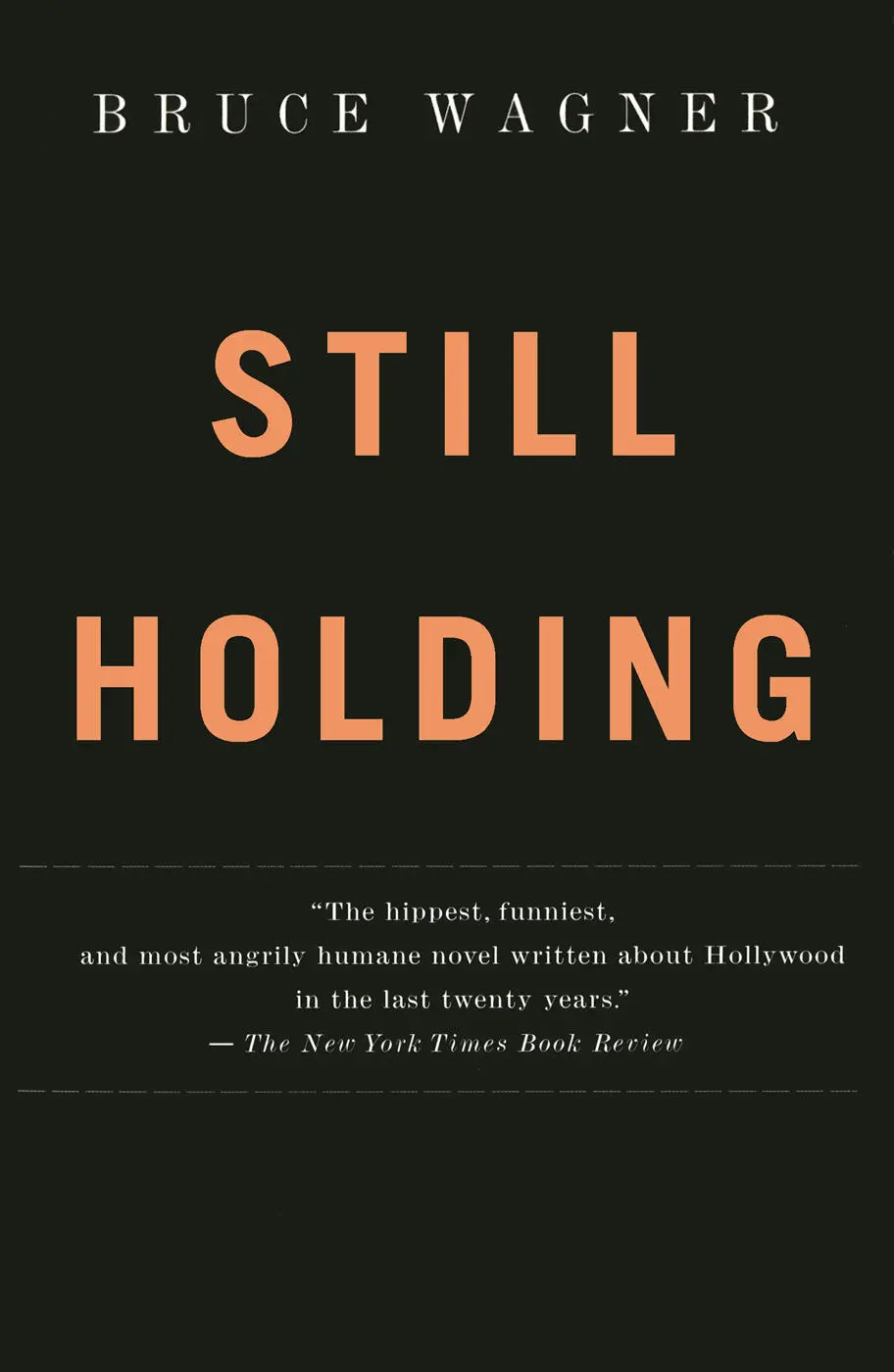
Bruce Wagner - Still Holding
Здесь есть возможность читать онлайн «Bruce Wagner - Still Holding» весь текст электронной книги совершенно бесплатно (целиком полную версию без сокращений). В некоторых случаях можно слушать аудио, скачать через торрент в формате fb2 и присутствует краткое содержание. Год выпуска: 2013, Издательство: Simon & Schuster, Жанр: Современная проза, на английском языке. Описание произведения, (предисловие) а так же отзывы посетителей доступны на портале библиотеки ЛибКат.
- Название:Still Holding
- Автор:
- Издательство:Simon & Schuster
- Жанр:
- Год:2013
- ISBN:нет данных
- Рейтинг книги:5 / 5. Голосов: 1
-
Избранное:Добавить в избранное
- Отзывы:
-
Ваша оценка:
Still Holding: краткое содержание, описание и аннотация
Предлагаем к чтению аннотацию, описание, краткое содержание или предисловие (зависит от того, что написал сам автор книги «Still Holding»). Если вы не нашли необходимую информацию о книге — напишите в комментариях, мы постараемся отыскать её.
Now, in his most ambitious book to date,
the third in the Cellular Trilogy that began with
and
Wagner immerses readers in post-September 11 Hollywood, revealing as much rabid ambition, rampant narcissism, and unchecked mental illness as ever. It is a scabrous, epiphanic, sometimes horrifying portrait of an entangled community of legitimate stars, delusional wanna-bes, and psychosociopaths. Wagner infiltrates the gilded life of a superstar actor/sex symbol/practicing Buddhist, the compromised world of a young actress whose big break comes when she's hired to play a corpse on
and the strange parallel universe of look-alikes — an entire industry in which struggling actors are hired out for parties and conventions to play their famous counterparts. Alternately hilarious and heartfelt, ferocious and empathetic,
is Bruce Wagner's most expertly calibrated work.
Still Holding — читать онлайн бесплатно полную книгу (весь текст) целиком
Ниже представлен текст книги, разбитый по страницам. Система сохранения места последней прочитанной страницы, позволяет с удобством читать онлайн бесплатно книгу «Still Holding», без необходимости каждый раз заново искать на чём Вы остановились. Поставьте закладку, и сможете в любой момент перейти на страницу, на которой закончили чтение.
Интервал:
Закладка:
“Do we have a Steadicam?” asked Kit.
“No, but I wish we did,” said the D.P.
“Just like a cinematographer, ” said the director. “They want a Steadicam for a stationary shot.”
“We could shoot this Russian Ark —style,” said the D.P.
“Dream on,” said the director. “Ready?”
“Ready-teddy,” said Kit.
“Let’s roll tape.”
“Camera is on.”
“Kit,” said the director, standing just behind the D.P. “Can you tell us why this new role is so important to you?”
“You mean, as spokesman?”
“I’m sorry — no. In the Rob Reiner film.”
“Sure, be happy to. I–I guess I’ve always liked a challenge. And… this — this has been the hardest one.”
“Hold it,” said the D.P.
“I’m sorry, Kit,” said the director.
“Not a problem,” said Kit.
“OK,” said the D.P. “We are good to go.”
“Rolling?”
“Rolling tape.”
“Kit, can you tell us why the role in your new film has been so important for you? Why it’s been important for you to take on?”
He hadn’t prepared, but that worked in his favor. He began to talk, heartfelt. “I’ve always really liked a challenge. And this has been a hard one! There are… so many people in my corner — friends and colleagues — so many fans. The fans helped pull me through. And there’s my mom, who was so brave. She passed away. I learned a lot from her! I still have that picture in my mind of my mother’s courage, and that was something to help me in my dark hours. And my dear friend Cela, who I knew since I was young. Another strong woman, important woman in my life. I am an artist, and just because I was injured… I still think like an artist — or hope I do! I have to do the things an artist does. So I do what I am doing for all artists and all friends — and all the friends and all the people who are alive who have suffered for… neurological injuries and trauma, and even for those who are dead but whose courage and struggles should not be forgotten…” His eyes filled with tears. “I–If I have one special wish, it is… to do my best —if I am real —to make people believe, with all their hearts, that this journey and this struggle can be so beautiful…” He looked down then back up, smiling sweetly. “To show the world. That you can be anything and dream anything…”
He trailed off, emotional.
Long silence from crew, punctuated by makeup girl sniffles.
The director softly conferred with the D.P., then said, “Kit, we had some technical difficulties, and for that I am very sorry. ” The actor shifted in his seat and minorly grimaced. “I’m being told the problem has been corrected and will not happen again. ” The last he lobbed toward the repentant D.P., who, avoiding his eyes, nodded militarily. “But that was fantastic, and I hate to ask you to do it over…”
“That’s OK,” said Kit, affably. “Shit happens.”
“OK, then let’s go once more! That was amazing, Kit — if you could do pretty much the same thing then I think we are golden. ”
“No problem,” said Kit. “ No estoy problema. No estoy proble mi ta, Señor it a Pe pi ta.”
“Rolling tape!” said the cameraman.
“All right, Kit — when you’re ready.”
~ ~ ~
Give me, O God, what you still have.
Give me what no one asks you for.
I don’t ask you for wealth
Nor for success,
Nor even for health.
People ask you for all that so often
That you can’t have any left.
Give me, O God, what you still have.
Give me what people
Refuse to accept from you.
I want insecurity and disquietude.
I want hardship
And struggle with no end.
And if you should give them to me, O God,
Give them to me once and for all,
For I will not always find the courage
To ask you for what you still have.
— ANONYMOUS
About the Author
BRUCE WAGNER is the author of three novels: Force Majeure, I’m Losing You, and I’ll Let You Go. He has written and directed two films, I’m Losing You and Women in Film, based on his novels. He lives in Los Angeles.
Интервал:
Закладка:
Похожие книги на «Still Holding»
Представляем Вашему вниманию похожие книги на «Still Holding» списком для выбора. Мы отобрали схожую по названию и смыслу литературу в надежде предоставить читателям больше вариантов отыскать новые, интересные, ещё непрочитанные произведения.





Обсуждение, отзывы о книге «Still Holding» и просто собственные мнения читателей. Оставьте ваши комментарии, напишите, что Вы думаете о произведении, его смысле или главных героях. Укажите что конкретно понравилось, а что нет, и почему Вы так считаете.