Rupert Thomson - Divided Kingdom
Здесь есть возможность читать онлайн «Rupert Thomson - Divided Kingdom» весь текст электронной книги совершенно бесплатно (целиком полную версию без сокращений). В некоторых случаях можно слушать аудио, скачать через торрент в формате fb2 и присутствует краткое содержание. Год выпуска: 2012, Издательство: Bloomsbury UK, Жанр: Современная проза, Фантастика и фэнтези, на английском языке. Описание произведения, (предисловие) а так же отзывы посетителей доступны на портале библиотеки ЛибКат.
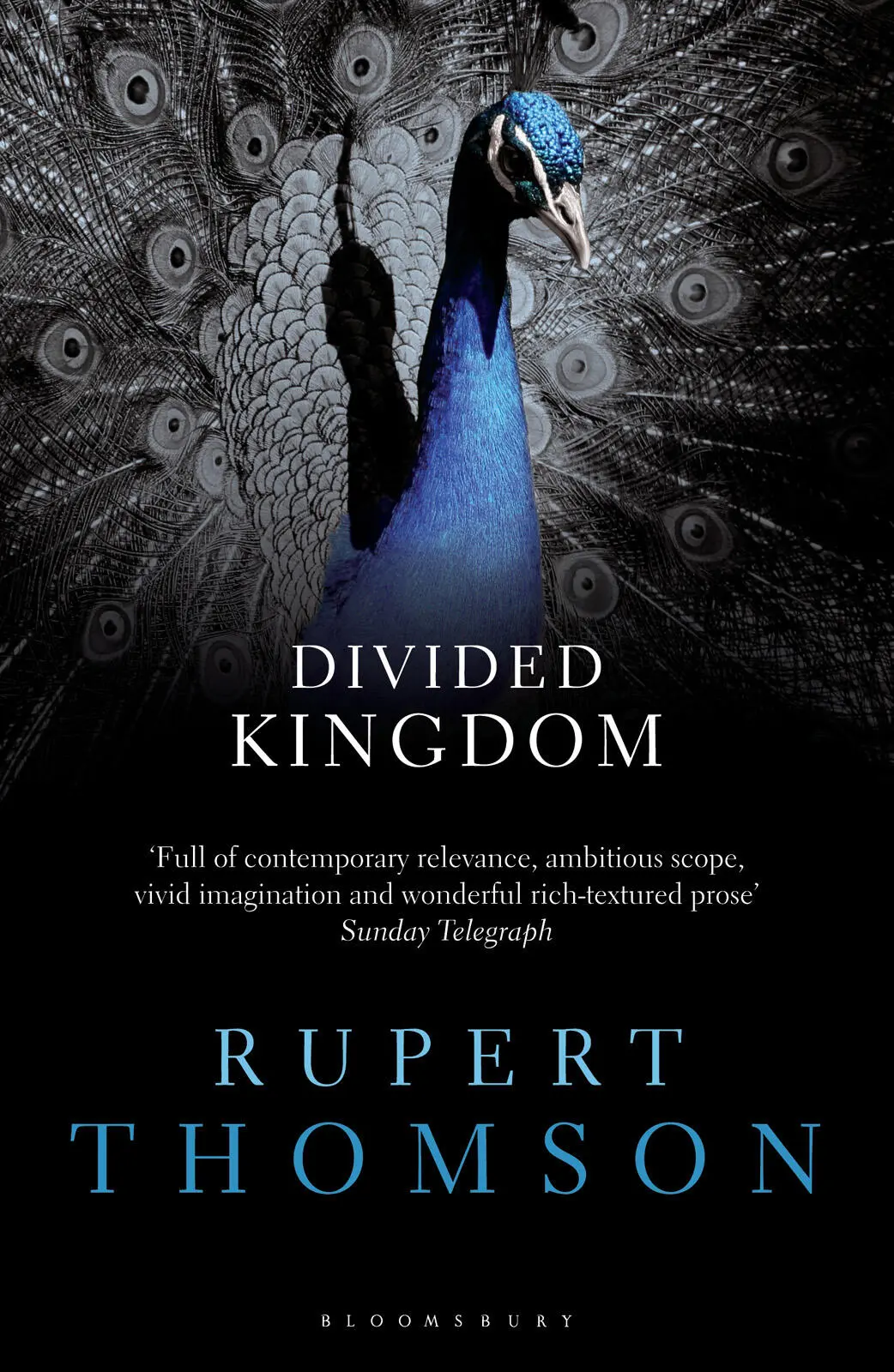
- Название:Divided Kingdom
- Автор:
- Издательство:Bloomsbury UK
- Жанр:
- Год:2012
- ISBN:нет данных
- Рейтинг книги:5 / 5. Голосов: 1
-
Избранное:Добавить в избранное
- Отзывы:
-
Ваша оценка:
Divided Kingdom: краткое содержание, описание и аннотация
Предлагаем к чтению аннотацию, описание, краткое содержание или предисловие (зависит от того, что написал сам автор книги «Divided Kingdom»). Если вы не нашли необходимую информацию о книге — напишите в комментариях, мы постараемся отыскать её.
Divided Kingdom — читать онлайн бесплатно полную книгу (весь текст) целиком
Ниже представлен текст книги, разбитый по страницам. Система сохранения места последней прочитанной страницы, позволяет с удобством читать онлайн бесплатно книгу «Divided Kingdom», без необходимости каждый раз заново искать на чём Вы остановились. Поставьте закладку, и сможете в любой момент перейти на страницу, на которой закончили чтение.
Интервал:
Закладка:
Towards evening we took refuge in a warehouse that backed on to the railway. On the top floor, in the corner, were three primitive beds built out of whatever came to hand — cardboard, polystyrene, scraps of rag and plastic. I watched my companions prepare themselves for sleep, two of them curling up on their sides. The man with the sore mouth lay on his back with his arms crossed on his chest, as though clutching a valuable possession. Their breathing slowed and deepened. I needed sleep too, more than anything, but first I had to make myself a bed. I walked down to the far end of the warehouse and started to hunt around for suitable materials. The building creaked gently as the light faded. Pigeons murmured on window-ledges.
That night a harsh, shallow panting woke me. As my eyes adjusted to the dark, I saw that the woman was sitting on top of one of the men. They were both still dressed. She had her hands laid flat on the man’s chest, and her head was thrown right back. Light caught on her teeth. It was the bearded man who was underneath her, the one I thought of as the prophet.
A train let out a long, mournful whistle.
I turned over and went back to sleep.
For the next few days we kept moving, sometimes basing ourselves in the outskirts of Iron Vale, sometimes traversing the town centre, but always using routes that meant we passed virtually unnoticed. I had found some old bandages in a rubbish bin behind the hospital and bound my feet in them, which made walking easier, and my blisters slowly hardened and healed. I was becoming used to the cloak too, managing the armholes with greater dexterity, and tripping far less often. There were times when I felt I was back in my childhood, dressed up like a vampire in my father’s cast-off gown … We generally slept at dawn, and then again in the afternoon, and never for more than four or five hours at a stretch. I gave myself up to their rhythms as one might surrender to an ocean’s currents. In a sense, I was deferring to their experience. After all, it was their life I was living, not mine. At first I assumed the constant movement was dictated by the search for food and shelter. Later, though, I realised it served an end in itself. If they had become nomadic, it was because they didn’t want their presence to weigh too heavily on any one section of the population. They were acting out a simple desire for anonymity and peace.
One evening we camped by the river, underneath a bridge. I had caught a chill that day, the first of many. As I sat close to the fire, trying to warm myself, the bearded man took hold of my wrist. He was peering at my watch. When I undid the strap and handed the watch to him, he placed it on the ground and reached for a piece of brick that lay near by. He carefully tapped the brick against the face until the glass disc shattered, then he tossed the brick to one side and bent over the watch, so close that his beard folded in the dirt. One by one, he began to pick out the tiny fragments of glass. He might have been removing lice from the head of his own child. His shadow leapt and ducked on the concrete stanchion behind him. Once all the glass was gone, he snapped off the two hands and threw them over his shoulder into the dark. He examined the watch again, then nodded and passed it back to me. The whole operation had been conducted with such serious intent and absolute precision that I had no choice, I felt, but to strap the watch on to my wrist again, as if it had just been mended. Later, as I curled up by the fire and closed my eyes, I saw the episode as an initiation ceremony. From now on I would be wearing a watch that didn’t have any hands. I had joined a people for whom time had no relevance at all. Even they appeared to be aware of that.
On the fourth evening, after our usual sleep, we set out along the east bank of the river, heading in a southerly direction, and I sensed a different mood, nothing so definite as a purpose, just the feeling that there had been a shift of some sort, a change of gear. After a while we arrived at an allotment, and my companions began to gather vegetables which they stored in the pockets of their cloaks. I did the same. The White People had no concept of property or ownership. If the man whose clothes I’d taken had been upset, it wasn’t because he thought the clothes belonged to him, but because he didn’t recognise what he’d been given in return. He’d been reacting not to loss but to the unknown. There were occasions, I suppose, when White People would be caught. They’d be accused of theft, but the word would have no meaning for them, nor would punishing them have much effect. Punishment only works if its relationship to the offence is clear. That night, though, we got away with it. A scarecrow watched us, its arms stretched wide as if to acknowledge its ineptitude, its face even blanker and more ghostly than our own. When we had filled our pockets, we moved through a gap in the hedge and on across the countryside.
I wondered whether they would ever realise I was an impostor. Surely, at some point, I told myself, their sixth sense would let them know. But then it occurred to me that they might actually be incapable of suspicion. To be suspicious, one needs a context or a precedent, and the White People had no understanding of either. The past meant nothing to them, and without that kind of framework suspicion simply couldn’t arise. Like children who had never grown up, the White People were sealed in an eternal condition of trust. As they floated ahead of me in the half-light, I was struck once again by their complacency, their good nature. They seemed so affable, so unruffled, so oddly content with their lot — and this despite the way society often mistreated them. They did not have an aggressive bone in their bodies. Luckily, they had learned to organise themselves into groups, responding to some deep-rooted instinct that told them there was safety in numbers. Could that be why they had accepted me so readily, why they had not, as Fernandez would have put it, seen through me? Because I’d made them stronger? We walked on in single file, the night wind pushing against our faces, and although I thought of Clarise and her boys from time to time I was glad to be leaving Iron Vale at last.
By my calculations we had been travelling for about a week when we came down out of the hills on to a plain, mist afloat in the dark fields, the bare trees loud with crows and magpies. Before too long, I saw signs informing us that the border lay just a short distance ahead, but we hurried on, unfaltering, the wet grass drenching the hems of our cloaks. We appeared to be about to cross into the Yellow Quarter, and at a point some eighty or ninety miles north of the place where I had attacked the guard. I had already been to the Yellow Quarter once, and I had no desire to repeat the experience, but I couldn’t part company with the White People. They were my passport, my camouflage; it would be a while before I had the confidence to strike out on my own. An expedition into choleric territory had only one advantage that I could think of: nobody would be looking for me there — or, if they were, then they’d be looking for a civil servant in a suit, and I had shed that version of myself whole lifetimes ago.
As we drew closer, it began to rain. I remembered my trip with Dunne and Whittle, and how the Yellow Quarter’s notorious commercialism had spilled over into the strip of sanguine land adjacent to the wall. There was none of that here. A community had grown up around the checkpoint, but there were no souvenir shops, no theme hotels. I saw an off-licence, a cut-price supermarket and a few drab streets of terraced housing, net curtains in all the downstairs windows. Some of the kerbstones had been painted a defiant patriotic shade of green.
The guard on duty waved us through without even bothering to glance up. Though I knew he must have seen us coming, I was disappointed all the same. I had wanted him to look deep into my eyes and be deceived by their apparent emptiness. One wall lay behind us, but a second loomed a hundred yards away, its concrete scarred and pitted like the back of an ancient whale. Head bent against the rain, which was falling more heavily now, I followed my companions across the mud of no man’s land. A ditch ran down the middle, with strips of sand on either side. There were searchlights on metal poles and rolls of razor wire. It was the first time I had crossed a border illegally. Actually crossed it. My cloak had soaked right through, weighing me down, and it was tiring just to walk. Up ahead, I saw a long, low shack raised up on breeze-blocks. This would be a guardhouse for Yellow Quarter personnel. I doubted we would have such an easy time of it with them.
Читать дальшеИнтервал:
Закладка:
Похожие книги на «Divided Kingdom»
Представляем Вашему вниманию похожие книги на «Divided Kingdom» списком для выбора. Мы отобрали схожую по названию и смыслу литературу в надежде предоставить читателям больше вариантов отыскать новые, интересные, ещё непрочитанные произведения.

Обсуждение, отзывы о книге «Divided Kingdom» и просто собственные мнения читателей. Оставьте ваши комментарии, напишите, что Вы думаете о произведении, его смысле или главных героях. Укажите что конкретно понравилось, а что нет, и почему Вы так считаете.