Georgi Tenev - Party Headquarters
Здесь есть возможность читать онлайн «Georgi Tenev - Party Headquarters» весь текст электронной книги совершенно бесплатно (целиком полную версию без сокращений). В некоторых случаях можно слушать аудио, скачать через торрент в формате fb2 и присутствует краткое содержание. Год выпуска: 2016, Издательство: Open Letter, Жанр: Современная проза, на английском языке. Описание произведения, (предисловие) а так же отзывы посетителей доступны на портале библиотеки ЛибКат.
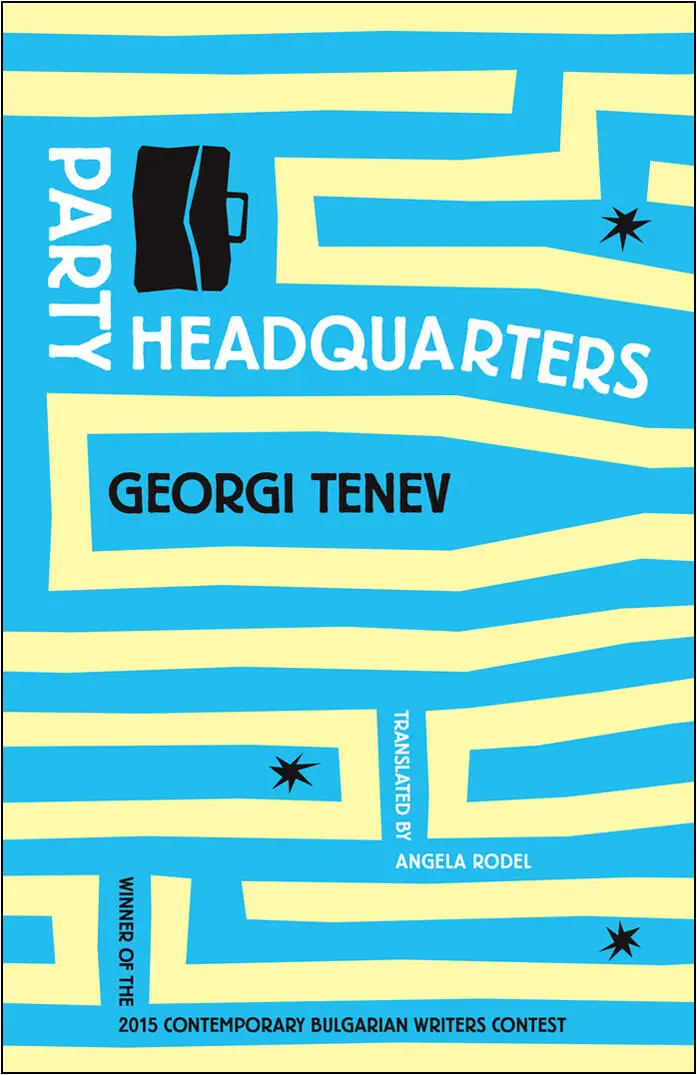
- Название:Party Headquarters
- Автор:
- Издательство:Open Letter
- Жанр:
- Год:2016
- ISBN:нет данных
- Рейтинг книги:5 / 5. Голосов: 1
-
Избранное:Добавить в избранное
- Отзывы:
-
Ваша оценка:
Party Headquarters: краткое содержание, описание и аннотация
Предлагаем к чтению аннотацию, описание, краткое содержание или предисловие (зависит от того, что написал сам автор книги «Party Headquarters»). Если вы не нашли необходимую информацию о книге — напишите в комментариях, мы постараемся отыскать её.
takes place in the eighties and nineties, during Bulgaria's transition from communist rule to democracy.
The book — which is a love story, a parody, and a thriller about a political hoax — opens with the main character visiting his father-in-law, an old communist party boss who is dying, and being tasked with delivering a suitcase filled with one-and-a-half million euros.
It's one of Bulgaria's most popular myths: As the communist party fell apart, high ranking officials squirreled away bags and suitcases containing a significant portion of the country's wealth, and that these bags are still circulating through Europe, waiting to be delivered to various conspirators.
But this is just the beginning of the corruption and inequality that plagued Bulgaria during this time. While immersing himself in pornography and prostitution, the hero of
reflects back on his life and the emblematic events that took place around that time — the anticommunist protests, the arson attack on the Communist Party Headquarters in Sofia, and, most tragically and crucially, the Chernobyl disaster, during which the families of party officials were sheltered away and fed special, safe food, while the regular citizens suffered.
Beautiful and tragic,
is an engrossing testament to the struggles that haunted Bulgaria after the fall of the Soviet Union, many of which continue to resonate today.
Before penning the Vick Prize-winning novel
,
had already published four books, founded the Triumviratus Art Group, hosted
television program about books, and written plays that have been performed in Germany, France, and Russia. He is also a screenwriter for film and TV.
Angela Rodel
Party Headquarters — читать онлайн бесплатно полную книгу (весь текст) целиком
Ниже представлен текст книги, разбитый по страницам. Система сохранения места последней прочитанной страницы, позволяет с удобством читать онлайн бесплатно книгу «Party Headquarters», без необходимости каждый раз заново искать на чём Вы остановились. Поставьте закладку, и сможете в любой момент перейти на страницу, на которой закончили чтение.
Интервал:
Закладка:
And to rub our noses in it — that is, in short, as intimidation — K-shev and his people, quite experienced in Party-style electrical engineering, harnessed the thunder and lightning hanging over the ruins of the Party structure. They stripped the lightning rods of their precious metals and left the negative waves to be unleashed in a controlled burn, for their own good and for the satisfaction of the general public.
I was there in order to understand, as it were, that an inescapable logic controls my fate. For that reason, the wee hours of August 27 thin front of the burning Party Headquarters also have a deeper meaning for me. And it is not symbolic, not merely symbolic as for everyone else.
What I remember most of all is this: it smelled terrible. Be it from the hissing panels in the hallways, from the droplets of aging tar mixed with decades-old dust that came sizzling out through the holes, burned away by red hot nails. Or from the melting sausage in the burning storerooms on the ground floor. And on top of everything — the scent of boiling Freon erupting through the cylinders of charred refrigerators — it smelled terrible, that much I remember.
I think that even there, at that very place, I ritually sacrificed part of myself — the fire was sufficiently strong to warm my blood to the decision. The red neckerchief blazed up and transformed into a black fuse even before the flames lapped at it. It immediately reminded me of the dripping streams of ash from the lit-up bottle of Vero dish soap. The cloth burned up instantly, without a trace. So did the shirt with the bleached collar. But first I tore the Bulgarian Communist Youth League emblem off the front of it. It was a nice shirt, I thought to myself — it fit me well. At the ends of its short sleeves there was a rather wide, turned up cuff. I don’t know why, but as I destroyed the wardrobe of the past, I heard engines and trains going by, chaotic noises, like the sound of a guerrilla propaganda movie unrolling its reels somewhere. Or was I just hearing things?
I know that K-shev himself also wanted to destroy something in that fire, otherwise he wouldn’t have set it — but why? Just to obliterate some stupid old documents, traces? To sneak out the back door with the money along with the strongbox — just like he’d done before — while the suckers out front rushed in to save the wounded?
In that sense, running toward a confrontation with him, I’m not looking for confessions or apologies. And that’s precisely why he’s waiting for me. How much longer can those doctors continue to treat him? They’ll only give up when the regular payments stop rolling in. It’s very easy to switch off the IVs if that’s what the patient’s loved ones want. They need only to hint that the cost has become excessive. And, in fact, the cost is ridiculously high, especially for an old man like him.
. for a sick old man like me.
For ten years the party paid for my treatment, for the next five — the remnants of the old upper echelon, my fellow antiques, with long years of service to the party under their belts. For some time I was still necessary to various circles, which vied with each other to pay for my salvation. However, when symbols become devoid of meaning, they must be recast. After the fifteenth year it became clear that I only caused them trouble. They’ve washed their hands of me and my demise is simply a matter of time. I know, I know all too well: you have to leave the wounded to die of their wounds. In that pouring rain — I remember well, there, as we were retreating through the forest — there, through the half-open door of the church, next to the monastery, I overheard just that: “leave the dead to bury their dead.” Now that’s what gave me the courage.
Out of the five partisans from our detachment who had managed to stay half alive, four of them fell on the road through the gorge. Two were killed or at least fatally wounded, I saw it with my own eyes. My comrade whose guerrilla name was Chavdar got stuck in the swamp — he couldn’t crawl out along the fallen tree because his leg was injured. I’m sure I should’ve tried to help him, I should’ve gone back down, broken off the branches, pulled him out. I should’ve stripped down and tied my shirt and sweater into a rope. But I didn’t, what would’ve been the point anyway? The police were sure to arrive any second, and catch me in the middle of my heroics. I turned my back on him and kept on climbing. Then I thought I heard a popping sound, as if I’d stepped on a dry branch, but I hadn’t — I assume he shot himself in the mouth, but the mud of the swamp muffled the sound.
I saw the fourth one of the five of us running after me up the slope like a shadow. He was clutching a grenade in his right hand. It’s really wet, I thought to myself, with all this rain the primer is never going to ignite, it’s ridiculous. He didn’t have any other weapon, so he kept clutching the grenade, even now, in desperation. If only I’d taken Comrade Chavdar’s revolver. If only I’d been able to pull my revolutionary brother out of the swamp. But it was too late now, it didn’t matter. Get rid of that grenade, I told him, put it away, we have to retreat. We have to retreat, I said, as if I were still commanding a detachment. As if there weren’t only five of us left, and now only two out of the five. And a little baggage — a radio transmitter, a notebook full of watchwords, passwords, and codenames of go-betweens, all written on cigarette papers inside a tobacco case. Traitor, I think he said. Why, I don’t know. Traitor, he repeated and squeezed the grenade in his mangled hand.
It’s only now that I realize that this comrade most likely had a bent for leftist fanaticism. I know that look: revolution to the bitter end, red terror. Actually, grenades are best suited to anarchists, for that reason our commissar, who knew all the recruits, didn’t issue him his own weapon — untrustworthy. Even though the truth was that the kid didn’t have any fingers on his hand — they’d been cut off during an interrogation at the police headquarters.
But no matter, I’m not one for crying over such things. I hit him once, it was enough. His body slid down the rocky slope into the ravine and in an instant he was gone. It was over.
I’m left alone, so now I can ditch the radio transmitter; against my chest under my windbreaker is a leather pouch full of documents. And the little suitcase, the strongbox, of course, the revolution’s gold reserves, the fruit of many years’ labor. Money for the insurrectional revolutionary committee — money that was donated, or confiscated, voluntarily, or not quite. The suitcase was nice and full, our comrade commissar wasn’t a spendthrift, not a single cent went to waste. Rightly so, comrade! — our comrade commissar, may he rest in peace, was the first to fall in the ambush.
Saturday, a requiem in the church. The voice of the priest and the cantor, singing deeply, as if in a well. Up above on the roof tiles, where the awning butts up against the monastery gates, drops are pelting down, the rain doesn’t stop. My eyes are closing — in the oats, I tell myself, in the sacks of hay is the best hiding place. I can’t let myself fall asleep, yet my eyes are closing on their own, I hear them whispering inside, with the cross, with the censer. The cantor is singing or reading something, undoubtedly from the Epistles. Then the priest: Leave, he says, the dead to bury their dead. Traitor, I say to myself, and fall asleep just like that. It’s only then that I see the donkey — munching oats in silence, his back is wet, sticking out from under the overhang, the rain pouring down on him from above.
And there really was an office there, I saw it, ratty with a broken-down door, in the center of the hallway, in the center of the central wing, where with watering yet curious eyes I went down the smoke-filled corridors. In order to realize that it was burning of its own accord —the Party Headquarters, lit up like a Christmas tree from the tension of memory-laden holiday electricity. Self-ignition, self-immolation, intended to illuminate — or to make futile all illumination of — the interior of the secret.
Читать дальшеИнтервал:
Закладка:
Похожие книги на «Party Headquarters»
Представляем Вашему вниманию похожие книги на «Party Headquarters» списком для выбора. Мы отобрали схожую по названию и смыслу литературу в надежде предоставить читателям больше вариантов отыскать новые, интересные, ещё непрочитанные произведения.










Обсуждение, отзывы о книге «Party Headquarters» и просто собственные мнения читателей. Оставьте ваши комментарии, напишите, что Вы думаете о произведении, его смысле или главных героях. Укажите что конкретно понравилось, а что нет, и почему Вы так считаете.