Georgi Tenev - Party Headquarters
Здесь есть возможность читать онлайн «Georgi Tenev - Party Headquarters» весь текст электронной книги совершенно бесплатно (целиком полную версию без сокращений). В некоторых случаях можно слушать аудио, скачать через торрент в формате fb2 и присутствует краткое содержание. Год выпуска: 2016, Издательство: Open Letter, Жанр: Современная проза, на английском языке. Описание произведения, (предисловие) а так же отзывы посетителей доступны на портале библиотеки ЛибКат.
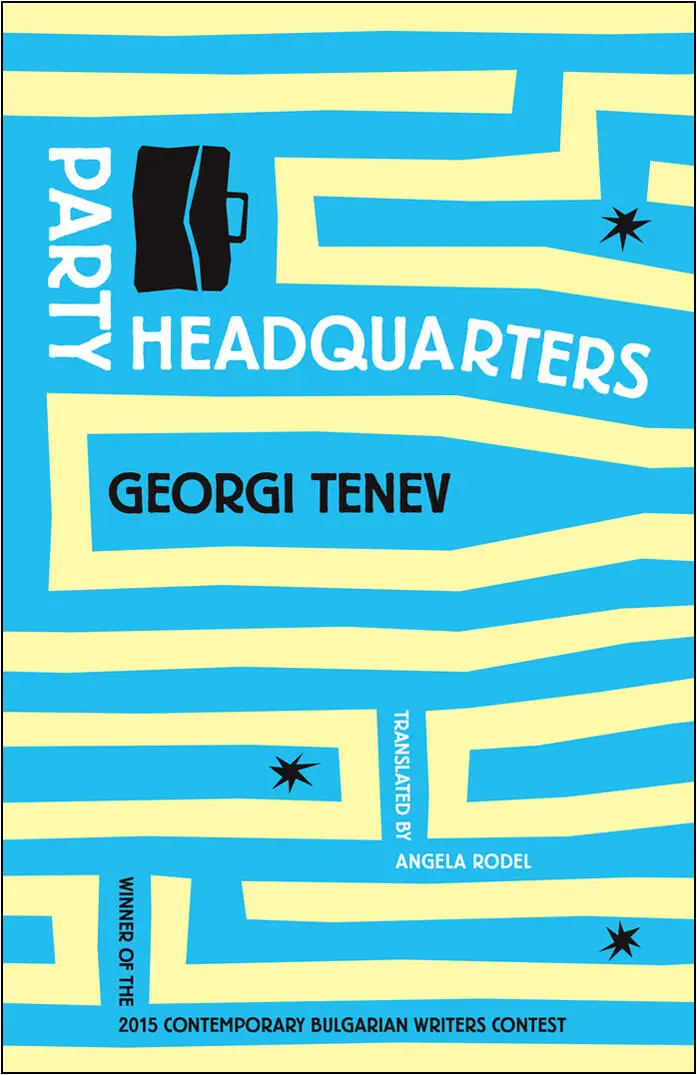
- Название:Party Headquarters
- Автор:
- Издательство:Open Letter
- Жанр:
- Год:2016
- ISBN:нет данных
- Рейтинг книги:5 / 5. Голосов: 1
-
Избранное:Добавить в избранное
- Отзывы:
-
Ваша оценка:
Party Headquarters: краткое содержание, описание и аннотация
Предлагаем к чтению аннотацию, описание, краткое содержание или предисловие (зависит от того, что написал сам автор книги «Party Headquarters»). Если вы не нашли необходимую информацию о книге — напишите в комментариях, мы постараемся отыскать её.
takes place in the eighties and nineties, during Bulgaria's transition from communist rule to democracy.
The book — which is a love story, a parody, and a thriller about a political hoax — opens with the main character visiting his father-in-law, an old communist party boss who is dying, and being tasked with delivering a suitcase filled with one-and-a-half million euros.
It's one of Bulgaria's most popular myths: As the communist party fell apart, high ranking officials squirreled away bags and suitcases containing a significant portion of the country's wealth, and that these bags are still circulating through Europe, waiting to be delivered to various conspirators.
But this is just the beginning of the corruption and inequality that plagued Bulgaria during this time. While immersing himself in pornography and prostitution, the hero of
reflects back on his life and the emblematic events that took place around that time — the anticommunist protests, the arson attack on the Communist Party Headquarters in Sofia, and, most tragically and crucially, the Chernobyl disaster, during which the families of party officials were sheltered away and fed special, safe food, while the regular citizens suffered.
Beautiful and tragic,
is an engrossing testament to the struggles that haunted Bulgaria after the fall of the Soviet Union, many of which continue to resonate today.
Before penning the Vick Prize-winning novel
,
had already published four books, founded the Triumviratus Art Group, hosted
television program about books, and written plays that have been performed in Germany, France, and Russia. He is also a screenwriter for film and TV.
Angela Rodel
Party Headquarters — читать онлайн бесплатно полную книгу (весь текст) целиком
Ниже представлен текст книги, разбитый по страницам. Система сохранения места последней прочитанной страницы, позволяет с удобством читать онлайн бесплатно книгу «Party Headquarters», без необходимости каждый раз заново искать на чём Вы остановились. Поставьте закладку, и сможете в любой момент перейти на страницу, на которой закончили чтение.
Интервал:
Закладка:
Running makes me all the more hostile — if that’s even possible. I know what’s going to happen after another kilometer if I don’t stop or slow down. It’s not necessary for me to do one or the other — my body is now moving on its own, the running is automatic, as mechanical as it is unpleasant, single-minded, surrendering to the pain that keeps growing in every muscle and especially the joints. And I myself have already noticed that I’m trying to do something that’s perhaps out of line, deceitful. To force a whole swath of my past through the fleshy filter that is the body. To burn it up as if in a stove, to cremate it by doing exercises to fill the emptiness inside me. I’ve done this before, I thought I’d given it up — but what do you know, when backed into a corner I run again toward it like the only escape route. Replacing the unfinished gestures of the past with active athletic movements — it’s absurd, boring, pitiful. And just look how many more runners there are here around me. The Germans, and particularly those from Hamburg, probably yearn for some impossible part of the gestures from the past. Or they just want to be healthy.
The time of the Transition, like I said. The attempts to replace the Comsomol with athletics had no way of achieving a total effect, despite superficial successes. The army also didn’t offer me anything more than a familiar backdrop. Distorted features of an image impressed upon me by youthful romanticism. Formerly handsome and monolithic, it would now look me in the eye polluted, with scratches on its very pupils. After being discharged I felt more confused about myself than ever.
Later — I’m talking about the time when the Transition was over and nothing external could be altered — in yet another attempt to change my very self, I resorted to my usual method. When I decided to take up boxing, however, I had no idea that my nose would get broken so quickly. Knowing my own character, I was afraid that after two or three workouts at the gym my self-confidence would skyrocket and I’d be unable to control myself, I’d bait somebody on the street and get my ass kicked. But let me reiterate that I’m talking about the time when violence had already taken on a new meaning. Just like the street itself, by the way. Collective spaces had shrunk, the street was the line of demarcation. And I always felt one category lighter than necessary, a slightly lower weight-class than everyone else. Who knows, maybe that was the reason I chose boxing — in the hopes that speed would compensate for mass. I also think that the incident from that night made a difference.
But things turned out differently than I expected. My nose was broken not in the outside world, but in the gym, at the second practice session. It wasn’t even during sparring, they wouldn’t let me get anywhere near the ring yet. It’s a mistake to think that the padded helmet that protects your cheekbones and chin will also protect your nose if you yourself aren’t protecting it. They smacked me good and despite the fact that the gloves soften the blow to some extent, I felt such a strong and blunt pain that with no qualms whatsoever I immediately felt like bawling, which I did. With tears, but silently. My coach wasn’t moved, he just stuffed wads of cotton up my nose and said that that was the beginning.
I decided, however, that it was the end and went into the locker room to gather up my stuff. Tears, like I said, have a strange, contradictory power.
I didn’t become a real street boxer. Even after tireless exercises targeting specific aspects of my body and mind, a fair amount of my original inconsistency still existed. Passivity, mixed with surprising and unexpected outbursts of hidden rage. Presumably the Party, just like the Comsomol before it, had no use for such quickly detonating fireworks. Plodding mediocrity is preferred, since it is far more predictable and can be governed. This must’ve been the reason that the Comsomol spurned me, in a sense that it spurned all of us together, following the example of the Party itself — like a fossilized creature giving a final croak beneath its shell and going belly up. We had become too spontaneous, the freedom of our bodies turned order into chaos.
Everything happened very quickly, during that night, I mean. The guy, the tall one whose bulging Adam’s apple was somehow ugly and menacing — he cracked first, his gaze became hostile, dangerous, and I felt the threat. At such moments it’s as if I’m seized by a strange sense of weightlessness.
She was sitting by me on the armrest of the battered sofa, holding onto my shoulder. She was touching me somehow ambiguously, but every time that guy, the tall one, tried to grab her around the waist, she would pull away, turning her back on him.
“Hey, whore,” that’s all he said, but it sounded sufficiently frightening.
“What are you playin’ at?” I saw the other guy snarl, emboldened. He was short and unpleasant in his track suit.
I didn’t realize the three of them had known each other for such a short time. It only now became clear to me — this was some kind of random boozing or hoodlum hang-out, they’d gotten together, found each other that night. What had I gotten myself into? The question crossed my mind. I had to run, to get out of there. I got up abruptly — why? To run for the door? I don’t know, I stood up.
“As for you, douchebag,” the tall one snarled and took a swing.
I could’ve stepped back, for example, because the movement of his arm was drunken and unsteady and way too slow. I didn’t move, though, I didn’t step back; his fist just got heavier from the slow swing and managed to take aim, connecting with my cheekbone and partially with the nose.
Good thing I didn’t yell — that somehow startled them, because I didn’t even raise a hand to my face, I just shut my eyes for a moment. When I opened them and looked around again, I saw that they were staring at me rather strangely.
“This is the force of nonresistance to force,” I thought to myself. “Like Mahatma Gandhi.”
Okay, so I didn’t think it then , but now when I remember it, I think it.
And then she started shouting, baring her teeth, her voice unexpectedly loud and sharp, husky from cigarettes:
“You dirty bastards! I knew you’d do it! Who you think you are, huh, who?” She barely came up to the tall guy’s shoulder, and leaning forward like that she looked even smaller, but somehow, I’m certain, it didn’t matter to her anymore. “Do you think you’d found yourself some stupid bimbo? You know what my name is? Do you? Do you know what’s gonna happen now? Do you know who my father is?!”
All of a sudden a passport appeared in her hand — from back in the day, those green passports with the black-and-white photo and the coat of arms, you know the ones — and she was waving it around. She even smacked him on the nose with it, whacked him in the face as if he were some little twerp. And he was ripped, like I said. At that moment, neither she alone nor the two of us together could’ve done anything to fight them off, we didn’t have a chance. But she slapped him across the face and laughed, kind of brattily, demonstratively, taking pleasure in humiliating him — that was what really did the trick, I figure. That’s what it seemed like to me at that moment, although I couldn’t really understand what was going on. Maybe I’d been KO’d.
K-shev, as he is understood, is a construct, the product of some moment or other of need or threat. In fact, you could say that he’s even ready-made, since part of him has to be thought up, while the other part of him exists in any case: somewhere up there , somewhere invisible. Some K-shev or other was nevertheless real.
And they were freaked out, they jumped when they heard his last name — without even looking at the name in the passport. And since they were drunk on top of everything, it scared the shit right out of them.
Читать дальшеИнтервал:
Закладка:
Похожие книги на «Party Headquarters»
Представляем Вашему вниманию похожие книги на «Party Headquarters» списком для выбора. Мы отобрали схожую по названию и смыслу литературу в надежде предоставить читателям больше вариантов отыскать новые, интересные, ещё непрочитанные произведения.










Обсуждение, отзывы о книге «Party Headquarters» и просто собственные мнения читателей. Оставьте ваши комментарии, напишите, что Вы думаете о произведении, его смысле или главных героях. Укажите что конкретно понравилось, а что нет, и почему Вы так считаете.