Borislav Pekic - Houses
Здесь есть возможность читать онлайн «Borislav Pekic - Houses» весь текст электронной книги совершенно бесплатно (целиком полную версию без сокращений). В некоторых случаях можно слушать аудио, скачать через торрент в формате fb2 и присутствует краткое содержание. Год выпуска: 2016, Издательство: NYRB Classics, Жанр: Современная проза, на английском языке. Описание произведения, (предисловие) а так же отзывы посетителей доступны на портале библиотеки ЛибКат.
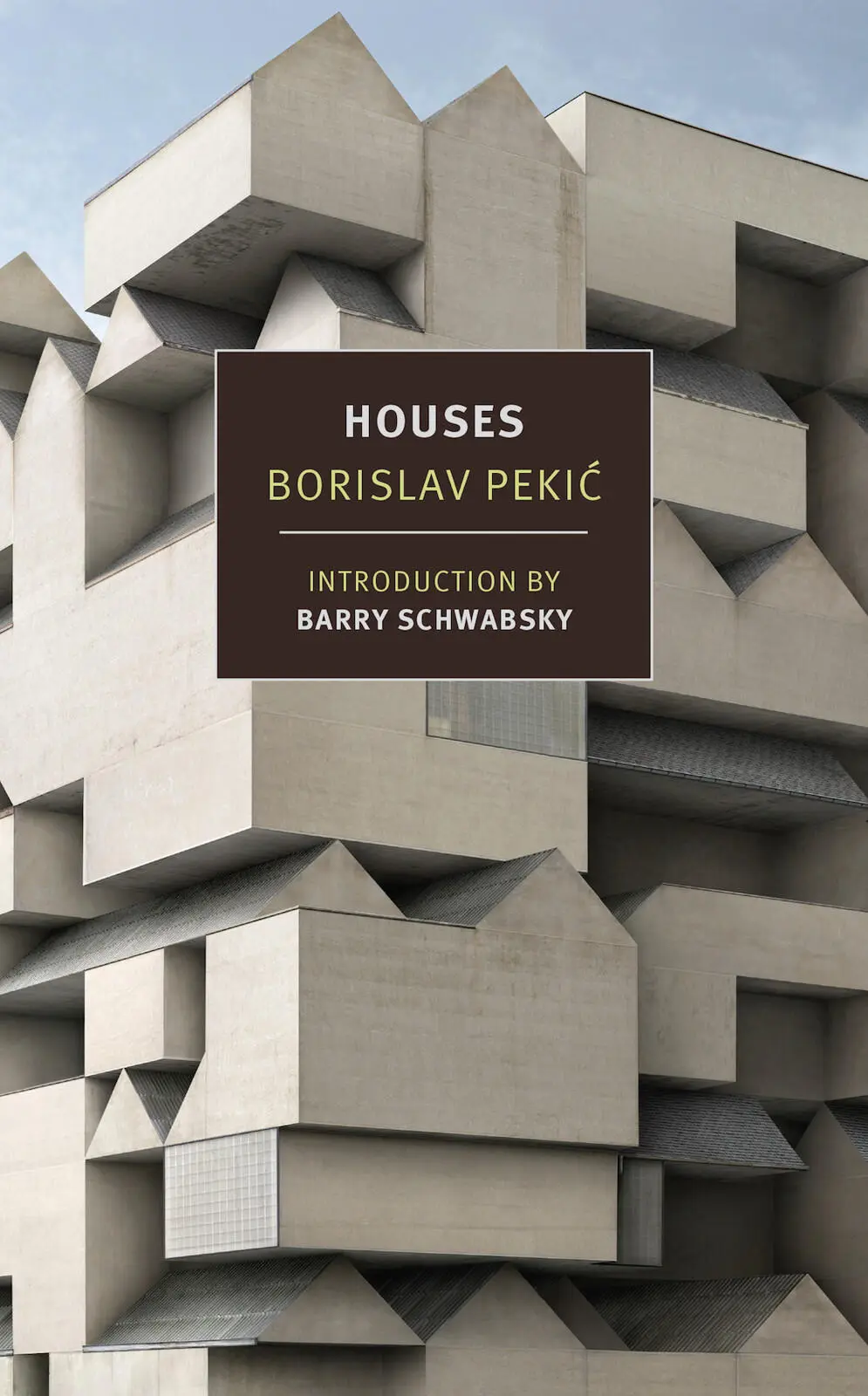
- Название:Houses
- Автор:
- Издательство:NYRB Classics
- Жанр:
- Год:2016
- ISBN:нет данных
- Рейтинг книги:4 / 5. Голосов: 1
-
Избранное:Добавить в избранное
- Отзывы:
-
Ваша оценка:
Houses: краткое содержание, описание и аннотация
Предлагаем к чтению аннотацию, описание, краткое содержание или предисловие (зависит от того, что написал сам автор книги «Houses»). Если вы не нашли необходимую информацию о книге — напишите в комментариях, мы постараемся отыскать её.
Bon vivant, Francophile, visionary, Negoyan spent the first half of his life building houses he loved and even gave names to — Juliana, Christina, Agatha — making his hometown of Belgrade into a modern city to be proud of. The second half of his life, after World War II and the Nazi occupation, he has spent in one of those houses, being looked after by his wife and a nurse, in hiding. Now, on the last day of his life, Negoyan has decided to go out at last to see what he has wrought.
Negoyan is one of the great characters in modern fiction, a charming monster of selfishness and self-delusion. And for all his failings, his life poses a question for the rest of us: Where in the modern world is there a home except in illusion?
Houses — читать онлайн бесплатно полную книгу (весь текст) целиком
Ниже представлен текст книги, разбитый по страницам. Система сохранения места последней прочитанной страницы, позволяет с удобством читать онлайн бесплатно книгу «Houses», без необходимости каждый раз заново искать на чём Вы остановились. Поставьте закладку, и сможете в любой момент перейти на страницу, на которой закончили чтение.
Интервал:
Закладка:
And now for the explanation due Isidor. It was true that, indignant at the chaotic state of Efimia’s building site, I went to see Constantine, and that I upbraided him and a quarrel broke out. But it’s a base lie that Constantine was seriously ill. He was in bed, perhaps with a temperature, but it was only an attack of the flu. Certainly he seemed basically healthy to me, enough at least to visit the site nearby. “Somehow I haven’t felt my best,” he said, and I asked him, “Shall I get someone else?” “No,” he said, “I’ll soon be better.” I answered caustically, “I can’t wait till you get better — I haven’t the time or the money!” Had I realized how ill he was, of course I would have been more considerate, though I do think I would still have taken him to task. I would have rebuked a dying man, had the fate of my houses depended on him! And then the scaffolding — why hide it? — was in perfect order. According to the commission’s findings, all its bolts were in place, all its points were solid. Yes, the scaffolding was in perfect order.
•
Constantine is dead. My son also: perhaps because what I wanted wasn’t a son but an heir. Ownership is maintained by inheritance. If you have no future you can have no past either. Katarina wanted a child — how she wanted one! — but I myself, because of my obligations toward my houses, could think only of an heir. Haven’t I said that I won’t write about that?
And is there any purpose in writing at all, any sense in speaking out? Do words have any purpose if nothing more can be done for my houses? Quite recently — for how long I can’t say, but that recently is measured in hours — an unusual dejection has come over me, an indifference, an apathy. Ostensibly, as a businessman with a sense of reality, I evolved it from the conviction of an inevitable upheaval; but it could be that my mental paralysis has no connection with that at all, but originated of its own accord on the backs of the accounts and receipts, among the words concerned with my past. In ignorance of its causes, there can be no treatment. At first I suspected that my discontent — for that is what it is — had arisen from the fact that my assets couldn’t bear serious comparisons with the magnificent palaces, mansions, and castles that I had seen in my travels through Europe. But I was consoled by the fact that size, or rather volume, was never a crucial factor in building; some miniature Chinese pagodas are more beautiful than ill-proportioned emperors’ palaces. As everybody knows, a dwarf has all the attributes of a normal full-grown man. As for a soul, all my houses possessed a soul; on this count my mind is at rest.
But did I have a soul?
Without the slightest equivocation I can declare that I loved my houses more faithfully than any houseowner; that my devotion didn’t lapse even when they brought me no revenue; that I didn’t have an official relationship with my possessions, but a spiritual one of the purest kind; and that I sacrificed for them all that time which others would have squandered on social life and for their own enjoyment. And what was that if not a soul — a soul in action?
No, the sources of my discontent have to be sought elsewhere. They are certainly to be found here somewhere, perhaps close by me; I can feel them like an elusive word on the tip of the tongue.
It has long been dark; bent over my manuscript, I can see a pitch-black, empty sky in which the transparent reflections of the street lamps shine, and maybe even those of fires. Perhaps Belgrade is already alight. Now the fires are burning only in the suburbs, but at dawn they’ll reach the roofs of Senjak, Topčidersko Brdo, and finally our Kosančićev Venac. I have no idea what time it is. My watch has stopped. It no longer seems important to know the time. Nothing seems important anymore.
Morning must be a long way off. I don’t feel cold yet. When I start feeling cold I’ll know it’s getting light. From down below on the river comes the wail of a steamer’s siren. Probably they’re bringing in reinforcements from the provincial garrisons: the Bolsheviks have barricaded the roads, so troops are being transported by water. But what sort of troops are they? Probably peasant riffraff, ready and willing turncoats! It was wrong to allow the workers’ suburbs to encircle the city; our cities are made for civil war and for massacres: the business center with its shops and offices, then a defensive ring of urban residents, and then the workers’ districts. The latter are encircled in turn by upper-class villas, beyond which lurk the peasants. Everyone lives behind everyone else in concentric rings: rows of the rich alternate with rows of paupers as far as the eye can see. So is it really surprising that instead of houses they put up barricades? Who knows if they’ve already occupied the radio station?
The printing presses may be in their hands already; they’ll be issuing proclamations by tomorrow. And then the creaking of wheels in the distance, and the locomotive, that moving scaffold of the steppe snaking back and forth with its dead load, and its bell on the top of a squat pole, ringing, ringing.
But nothing can be heard from the street; probably my hearing isn’t good enough, or the fighting is still some way off. But if they’re fighting around the barracks at Topčider, my Sophia is there; they must be encrusting her with bullets. That doesn’t matter, I can claim damages. If only they don’t set her on fire. If they’re up there on the hill, they’ll never reach Kosančićev Venac by dawn. Kosančićev Venac has no strategic significance. They’ll take it when the expropriation starts, when they come to drag us from our beds and batter us to death in the ditches. It’s a good thing Katarina’s not here. They wouldn’t touch her, but she’d be humiliated, and she’d have to watch; and if she tried to defend me, she’d suffer my fate, too. Poor Katarina, your life with me can’t have been easy. I don’t know of a single woman for whom things worked out well with the Negovans. It’s been especially hard for you since I retired, when you had to take on my business affairs and work with the houses you hated. And before that, when we lost our son, little Isidor.
I’ve pulled down the blinds. I won’t raise them again. I’ve no reason to look out the window. From now on my attention must be directed toward the door. Toward the door and this will. I have only Emilian’s legacy to make. I have no idea what to leave him. What can you leave to someone who will share your fate? Things are very black for the clergy, particularly high church dignitaries. And for possessors. And for army officers. If George were alive, they would certainly have killed him, but he died in good time. And if he were alive, he would have stayed at home up there on Lamartine Street. Mlle. Foucault would have gone on knitting in the armchair, while son bien aimé et courageux général pored intently over the map of Belgrade, spread out on the dining table and held down at all four corners with coffee cups and little plates with biscuits on them — there might even have been some cognac in one of those cups. With the help of little poles, he would have moved government forces with irreproachable tactics, and finally won a textbook victory over the rebels at the very moment when, smashing down the double-paneled doors, they’d break into his staff headquarters. Lead soldiers and officers, little flags made of prewar toilet paper, clockwork tanks, cardboard fortifications, storm troops of tinfoil-models, nothing but models! Mlle. Foucault was only a model too. And for George I, his own brother, was a comical, old-fashioned, worn-out model which (together with my houses) could be ignored in his exemplary military operations. Houses could be razed to the ground and we could be taken as hostages, or we could be dragooned into digging trenches if we were unfortunate enough to be his compatriots. For George, I was a model made of expendable material which he threw into the wastepaper basket once its uselessness annoyed him. Or was it the other way around? I had consigned him to the wastepaper basket. Who can tell after all these years?
Читать дальшеИнтервал:
Закладка:
Похожие книги на «Houses»
Представляем Вашему вниманию похожие книги на «Houses» списком для выбора. Мы отобрали схожую по названию и смыслу литературу в надежде предоставить читателям больше вариантов отыскать новые, интересные, ещё непрочитанные произведения.





Обсуждение, отзывы о книге «Houses» и просто собственные мнения читателей. Оставьте ваши комментарии, напишите, что Вы думаете о произведении, его смысле или главных героях. Укажите что конкретно понравилось, а что нет, и почему Вы так считаете.