Borislav Pekic - Houses
Здесь есть возможность читать онлайн «Borislav Pekic - Houses» весь текст электронной книги совершенно бесплатно (целиком полную версию без сокращений). В некоторых случаях можно слушать аудио, скачать через торрент в формате fb2 и присутствует краткое содержание. Год выпуска: 2016, Издательство: NYRB Classics, Жанр: Современная проза, на английском языке. Описание произведения, (предисловие) а так же отзывы посетителей доступны на портале библиотеки ЛибКат.
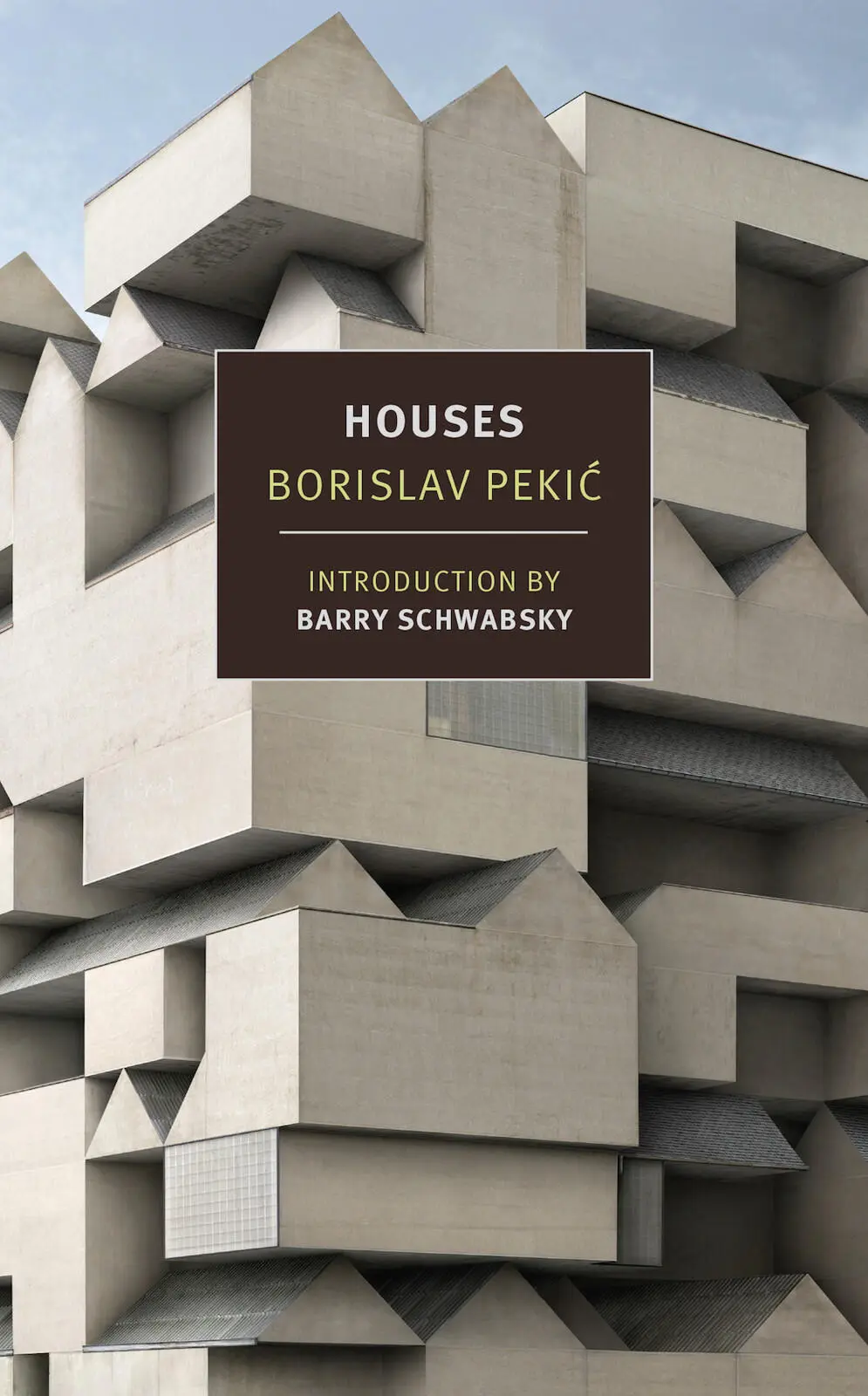
- Название:Houses
- Автор:
- Издательство:NYRB Classics
- Жанр:
- Год:2016
- ISBN:нет данных
- Рейтинг книги:4 / 5. Голосов: 1
-
Избранное:Добавить в избранное
- Отзывы:
-
Ваша оценка:
Houses: краткое содержание, описание и аннотация
Предлагаем к чтению аннотацию, описание, краткое содержание или предисловие (зависит от того, что написал сам автор книги «Houses»). Если вы не нашли необходимую информацию о книге — напишите в комментариях, мы постараемся отыскать её.
Bon vivant, Francophile, visionary, Negoyan spent the first half of his life building houses he loved and even gave names to — Juliana, Christina, Agatha — making his hometown of Belgrade into a modern city to be proud of. The second half of his life, after World War II and the Nazi occupation, he has spent in one of those houses, being looked after by his wife and a nurse, in hiding. Now, on the last day of his life, Negoyan has decided to go out at last to see what he has wrought.
Negoyan is one of the great characters in modern fiction, a charming monster of selfishness and self-delusion. And for all his failings, his life poses a question for the rest of us: Where in the modern world is there a home except in illusion?
Houses — читать онлайн бесплатно полную книгу (весь текст) целиком
Ниже представлен текст книги, разбитый по страницам. Система сохранения места последней прочитанной страницы, позволяет с удобством читать онлайн бесплатно книгу «Houses», без необходимости каждый раз заново искать на чём Вы остановились. Поставьте закладку, и сможете в любой момент перейти на страницу, на которой закончили чтение.
Интервал:
Закладка:
Our last conversation took place in my study last October. He had come to show me photographs of his monument before the official opening. Though I haven’t seen him since, several days after that I received a letter from him, apparently written right after our meeting:
Dear Uncle Arsénie,
I don’t think you’ll be surprised at my departure. Our last conversation at Kosančićev Venac will explain my action. Don’t take it badly that I didn’t come see you before leaving. I felt that we said good-by during our talk. Please pay my respects to Aunt Katarina. Very affectionately,
Isidor
Isidor had sat in the chair in which I am now writing this will. I was in my Chippendale armchair, at my lookout post by the half-open window. I felt cold even though Katarina had put a blanket around my knees. It was drizzling, and the rain and dampness covered the double glass wall through which, with the help of my binoculars, I was watching an empty building site in the New Township.
Isidor had spread the photographs of his monument across his brief case and was looking at them closely. From there, in the gray, cold, watery light, the pictures looked like celluloid X-ray plates, dark patches crisscrossed with a network of transparent canals. He had already shown me the first twelve. There were eight more.
I must say at once that the monument was truly magnificent. But — and I hope Isidor will forgive my honesty — there was scarcely anything human about it. Nor again was there anything divine. It was quite beyond my understanding — magnificent and incomprehensible. Possibly he was expressing some ancient forms.
I asked Isidor if he had had any news of his father recently.
“None.”
“And your mother, how is she?”
“The same as ever.”
“Not getting any better?”
“No.”
“What do the doctors say?”
“Keep waiting.”
“Is there any hope?”
“A little.”
“Do you visit her?”
“Every day.”
“Does she recognize you?”
“Sometimes she seems to, but often she doesn’t. I also get the impression that she thinks it would harm me if she did.”
“Does she speak at all?”
“A few words.”
“What do you do with her?”
“I sit and wait for her to say something.”
He gathered the photographs together again and laid them out on the table as if dealing a game of patience, a game he was never going to finish. “I sit and wait for her to speak. And when at last she says something, I don’t understand her.”
“What does she say?”
“Hours pass and then she says, ‘table,’ ‘glass,’ ‘letter,’ ‘tree.’ As if she came from another world and is trying to learn our language.”
“Angelina used to be a great lady, Isidor.”
He stared at the photographs as if unable to recognize them. Again he gathered them together in a pile and laid them out in a new pattern.
“When did you say the opening is?”
“October twenty-sixth.”
“I’m sure there’ll be a lot of people. Katarina says they’re going to hold a military parade, and afterward fireworks and a national celebration. I’d like to be there, but I can’t stand crowds. Will His Majesty be coming?”
“Probably.”
“You’ve become famous, Isidor. I want you to know how happy that makes me, and how proud I am of you. The Negovans are a mighty breed, eh?”
“Indeed they are.” Then he asked, “Do you remember that Le Corbusier church, Uncle?”
“Which one? The one in Brittany?”
“Yes, the one in Brittany.”
How could I not remember it? It wasn’t distinguished by excessive piety. It looked like a home for the mentally ill.
“Why is it,” he asked, “that his church looks completely different from each side? Other buildings have different aspects, but their façades proceed one from another; when we look at them from one point, we can easily predict what they’ll look like from another. Why is it that when you stand in front of the north face of the Le Corbusier church, you can’t describe the south side, or any side?”
“I told you the building is deranged. It’s like someone mentally ill whose actions you can’t foresee.”
“Her four faces represent four different artistic entities, don’t they? Each façade is planometric in nature, and not a part of the structure.”
“That church does not exist.”
“The church exists, but the building doesn’t. Only its appearance exists. You can go inside a hollow beech tree, but you don’t call it a building. Something unreal can’t produce something real. Those walls don’t exist as architectural elements, and no linking of them can give form to that internal space with which we identify architecture.”
“So?”
“Because that space isn’t there — in the architectural sense, of course, since in reality it does exist — there is no architecture either.”
“In the case of that church?”
“In all cases. Architecture does not exist.”
“ Merde! That means my houses aren’t there either?”
“That’s right.”
“But they do exist! I love them! And I’ve always considered my houses first-class architectural works.”
“You are wrong. We are both wrong. Everything on the basis of which we call architecture artistic belongs to other more authentic arts.”
“All right, in the final analysis it doesn’t matter to me whether or not my houses are artistic works. They’re buildings. And what buildings! Architectural pearls!”
“But Uncle, buildings aren’t architecture . If what can be seen is art, then it isn’t architecture. And if what can’t be seen — emptiness, a system of hollow spaces and nothing more — if that again isn’t architecture, then architecture doesn’t exist, at least it doesn’t exist yet !”
Suddenly I was struck — horrified — by the thought that Isidor was passionately asserting that his work has been for nothing, or at best a mere illusion. I asked him frankly what he thought his work to date had encompassed. He answered dryly:
“Myself.”
“Yourself?”
“Yes, myself. I agreed to work on the monuments in the hope that I’d achieve true architecture. It was an experiment in the direction of art. But at the building site I at last grasped why I hadn’t succeeded yet and never would: I’d been working on myself! I hadn’t been looking for architecture, but for myself. I hadn’t built anything, I’d demolished myself. Here, look!”
He moved his armchair closer to mine and placed a photograph of his monument in such a position that the window softly and slantingly illuminated its surface; then he presented proofs taken from his own work to justify his shatteringly disappointing revelation. I have neither the strength nor the will power to repeat them here, all the more so since his “proofs” only in a roundabout way correspond with my recollections. As the photographs of the monument silently succeeded one another on the carpet, Isidor’s argument followed them right up to sunset, interrupted only twice: by Katarina’s return, and by the coffee she brought us.
After he had exhausted them all, he began to gather up the pictures from the desk and the floor. I asked him to leave copies for me, and he said that he would; they were of no further interest to him.
“Well, time to go.”
“What are you going to do?”
He stood in the doorway, his shoulder against the jamb, tall and dark like an elegant tree which had been uprooted. He smiled.
“The same as my father! I’m going away.”
And he left. In front of me are the photographs of the monument, alongside the enlargements of my houses. I can sense a certain kinship between them, but I don’t know yet where it lurks. I hadn’t thought of it earlier, but now I’ll take some account of it. I must do my very best for my houses and also take care of Isidor, in the reasoned hope that both will profit: the houses will acquire a most reliable defender, while Isidor will find in them his life’s causa finalis . With this in mind:
Читать дальшеИнтервал:
Закладка:
Похожие книги на «Houses»
Представляем Вашему вниманию похожие книги на «Houses» списком для выбора. Мы отобрали схожую по названию и смыслу литературу в надежде предоставить читателям больше вариантов отыскать новые, интересные, ещё непрочитанные произведения.





Обсуждение, отзывы о книге «Houses» и просто собственные мнения читателей. Оставьте ваши комментарии, напишите, что Вы думаете о произведении, его смысле или главных героях. Укажите что конкретно понравилось, а что нет, и почему Вы так считаете.