Borislav Pekic - Houses
Здесь есть возможность читать онлайн «Borislav Pekic - Houses» весь текст электронной книги совершенно бесплатно (целиком полную версию без сокращений). В некоторых случаях можно слушать аудио, скачать через торрент в формате fb2 и присутствует краткое содержание. Год выпуска: 2016, Издательство: NYRB Classics, Жанр: Современная проза, на английском языке. Описание произведения, (предисловие) а так же отзывы посетителей доступны на портале библиотеки ЛибКат.
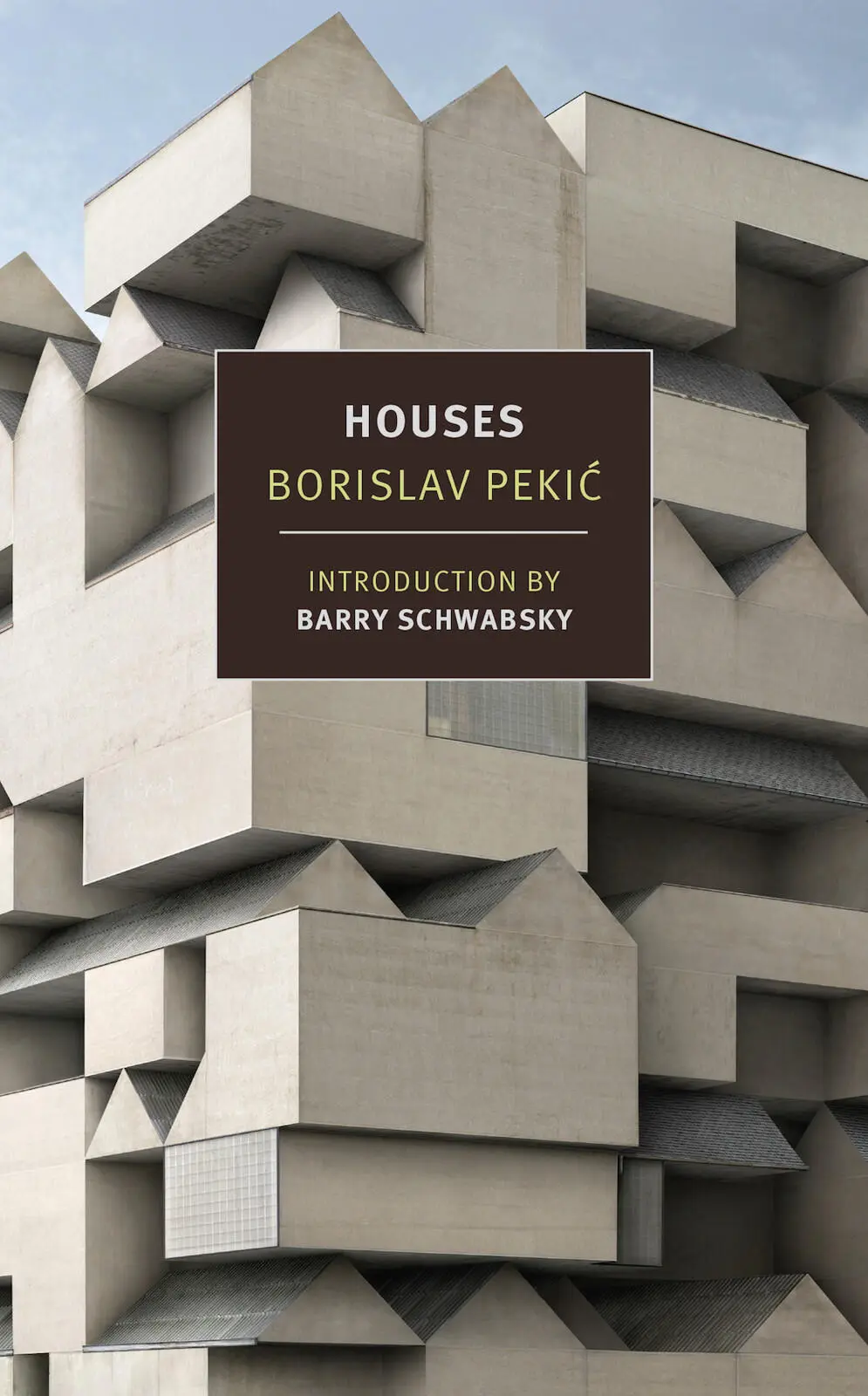
- Название:Houses
- Автор:
- Издательство:NYRB Classics
- Жанр:
- Год:2016
- ISBN:нет данных
- Рейтинг книги:4 / 5. Голосов: 1
-
Избранное:Добавить в избранное
- Отзывы:
-
Ваша оценка:
Houses: краткое содержание, описание и аннотация
Предлагаем к чтению аннотацию, описание, краткое содержание или предисловие (зависит от того, что написал сам автор книги «Houses»). Если вы не нашли необходимую информацию о книге — напишите в комментариях, мы постараемся отыскать её.
Bon vivant, Francophile, visionary, Negoyan spent the first half of his life building houses he loved and even gave names to — Juliana, Christina, Agatha — making his hometown of Belgrade into a modern city to be proud of. The second half of his life, after World War II and the Nazi occupation, he has spent in one of those houses, being looked after by his wife and a nurse, in hiding. Now, on the last day of his life, Negoyan has decided to go out at last to see what he has wrought.
Negoyan is one of the great characters in modern fiction, a charming monster of selfishness and self-delusion. And for all his failings, his life poses a question for the rest of us: Where in the modern world is there a home except in illusion?
Houses — читать онлайн бесплатно полную книгу (весь текст) целиком
Ниже представлен текст книги, разбитый по страницам. Система сохранения места последней прочитанной страницы, позволяет с удобством читать онлайн бесплатно книгу «Houses», без необходимости каждый раз заново искать на чём Вы остановились. Поставьте закладку, и сможете в любой момент перейти на страницу, на которой закончили чтение.
Интервал:
Закладка:
•
Article 10 . I incontestably determine that after my death Mr. Isidor J. Negovan, an architectural engineer of Krunska Street, shall be given the lasting ownership of all houses belonging to me except for those disposed of in individual legacies, and except for the house in Kosančićev Venac, which I bequeath to my wife as set forth later. In addition to my library the bequest includes everything in any way associated with the houses: records, photographs, dossiers, account books, correspondence, and models.
•
Article 11 . The testator of course hopes that what now seems certain to him will not come to pass, and that no hindrance will impede this testament, or any conditions attached to it. But in causa , if in fact this testament cannot be carried out in any way, then I ask Mr. Isidor Negovan to use all the means in his power to keep in his possession the photographs, models, and documents of my houses, and if he be allowed the opportunity, to care for those houses as if they were his own kin. And further, if things do in fact turn out badly, I leave to him the charge of remembering in his blackest hour that once before, under the name of Nago, the Negovans lost all their possessions and were scattered to the four corners of the earth; that they started once again from nothing and by their stubbornness and ability again attained the uppermost heights of commercial, social, and political life; that although more than two hundred years have elapsed from that first downward plunge of our breed, and although it has twice more to date been repeated, we are now once again in a position from which many people have tried to dislodge us.
After all this, and despite the fatherly sentiments that I feel toward my nephew, I cannot shake off the conviction that this last instruction would have much greater sense if I could leave it to the conscience of my own son. But I don’t have a son. I did once, but that will be the only episode of this story which, long buried, I will not disturb.
And so, instead of speaking of my son, I shall offer my adopted son the last explanation I owe him, concerning Fedor’s insinuations that I was the cause of his uncle Constantine’s accident. But first I shall relate the spectacle which Constantine’s funeral degenerated into.
Coming to the end of his oration, the Vice-President of the Builders Association, Mr. Arsenijević, gave up his place on the rostrum as planned. The very fact that Constantine’s family had no objections to me, the employer of the deceased, showing my respect for him, is evidence enough of the groundlessness of Fedor’s incriminations. But more of this later.
I don’t believe that Mr. Arsenijević provoked the misunderstanding on purpose; probably he was carried away by his subject. Even so, in conjunction with Fedor’s incessant mutterings and interruptions, Arsenijević’s lapse initiated the scandalous scene beside the open grave. Enumerating Constantine’s virtues as a builder, Arsenijević, himself a builder, ventured to say that the artistic abilities of the greatly mourned deceased would have attained still greater expression, had he not been frustrated and fettered by the miserly small-mindedness of the property owner for whom he had built his houses.
Such an injustice I could not overlook. It was well known that during the two building seasons prior to his death, Constantine had worked almost exclusively for me. Proceeding in my turn to the rostrum, I declared first that I couldn’t compete with the esteemed previous speaker in honoring the deceased, since my posthumous respect as his business partner was of a different, less conventional nature. That respect, I said, by force of unpleasant circumstances for which I was not in the least responsible, had to be supplemented by an explanation which, superficially, was perhaps not very flattering to the deceased, but which was nonetheless necessary to preserve his illustrious memory. That explanation, I said, must refer to another vocation without which the builder’s reputation could not have been merited: the vocation of property owner. For if this vocation is unworthy — and a moment earlier I had heard something to this effect — how could the vocation of builder be worthy, a vocation that only serves it and is subordinate to it? To defend the vocation of property owner was in effect to defend the building trade, and therefore our own dear deceased and departed, from accusations that they served usury, cupidity, and the selfish interests of an antisocial coterie.
Complete silence reigned over the mound; only the raindrops sprinkled like glass on the silk bellies of the umbrellas. Looking back, I recognize in it the silence of amazement, but at the time I took it for attention to my words, which gave me still greater encouragement.
“Ladies and gentlemen, is there a single person among you who thinks that I’ve built my houses haphazardly, or that in doing so I’ve frustrated and fettered the builder’s capabilities? Always I’ve known what and for whom I was building! I carried out complete scientific surveys, took every factor into consideration: the future tenants, the dimensions of the human living space, the parameters of heating, the effect of color…!”
Probably it was Fedor who shouted out: “Who are we mourning here — Arsénie or Constantine?” But I didn’t let myself be interrupted.
“And I had to calculate all those factors myself, gentlemen. Who could I have learned from? Could I have copied the Turkish Beys’ houses, or the three-room Serbian ones? Only in 1892 did we bring in piped water, and electricity barely a year later! And our streets were first macadamized only in 1886!”
Someone from behind tugged sharply at my sleeve. The umbrella, which up to then had been held over my head, was removed abruptly, so that rain began to soak my hat. But my allotted time wasn’t up yet, so I proceeded to sum up what I had to say about the late Constantine.
“When family homes in Paris, Vienna, and Budapest were adorned with gold, silver, silk, brocade, and elegant wood, what was there in our backward country? Here, we property owners were obliged to create everything! Property owners, ladies and gentlemen, among whom the late Constantine occupied a preeminent—”
“—role of victim of your greed!” cried Fedor Negovan, at which point events began to get out of hand.
“What does that mean?” I shouted.
“It means that I’ve got something to say about it, too!” And the impudent scoundrel shouldered me away from the rostrum.
“I demand that the order of this ceremony be adhered to!”
“And I demand,” yelled Fedor at the rostrum, “that this man here”—he pointed at me—“tell us if it’s true that at the time of the accident Constantine Negovan was ill! And if it’s true that he visited the site where Constantine was building a house for him, and was dissatisfied with the progress of the work. And if it’s true that—”
“Gentlemen! Ushers!” I shouted, as I and others tried to get the troublemaker away from the rostrum.
“Is it true, I ask this man, that he went straight from the site to Constantine’s house and accused him of negligence, so that a violent quarrel broke out and Constantine, pressured by him, rushed off in a high fever to the building site and passed out on the scaffolding!”
I cried out that this was calumny, that the accident occurred because the scaffolding hadn’t been erected according to regulations. But Fedor, now struggling with the grave-diggers, went on asserting that Constantine had passed out because of anxiety due to my malicious attack on him. In the general pushing and jostling, one of us stumbled and jarred the coffin from its low bier. As it slithered down the mound with a rumble, its lid fell off — why it wasn’t nailed down was never established — and Constantine’s swollen body sprang out of its violet satin-padded resting place like a jack-in-the-box, covered to the waist in its shroud. It was as if, by stretching out his black-gloved fist, he wanted one last time to touch the earth with which he had worked so long, before being committed to it forever.
Читать дальшеИнтервал:
Закладка:
Похожие книги на «Houses»
Представляем Вашему вниманию похожие книги на «Houses» списком для выбора. Мы отобрали схожую по названию и смыслу литературу в надежде предоставить читателям больше вариантов отыскать новые, интересные, ещё непрочитанные произведения.





Обсуждение, отзывы о книге «Houses» и просто собственные мнения читателей. Оставьте ваши комментарии, напишите, что Вы думаете о произведении, его смысле или главных героях. Укажите что конкретно понравилось, а что нет, и почему Вы так считаете.