Lojze Kovačič - Newcomers
Здесь есть возможность читать онлайн «Lojze Kovačič - Newcomers» весь текст электронной книги совершенно бесплатно (целиком полную версию без сокращений). В некоторых случаях можно слушать аудио, скачать через торрент в формате fb2 и присутствует краткое содержание. Год выпуска: 2016, Издательство: Archipelago, Жанр: Современная проза, на английском языке. Описание произведения, (предисловие) а так же отзывы посетителей доступны на портале библиотеки ЛибКат.
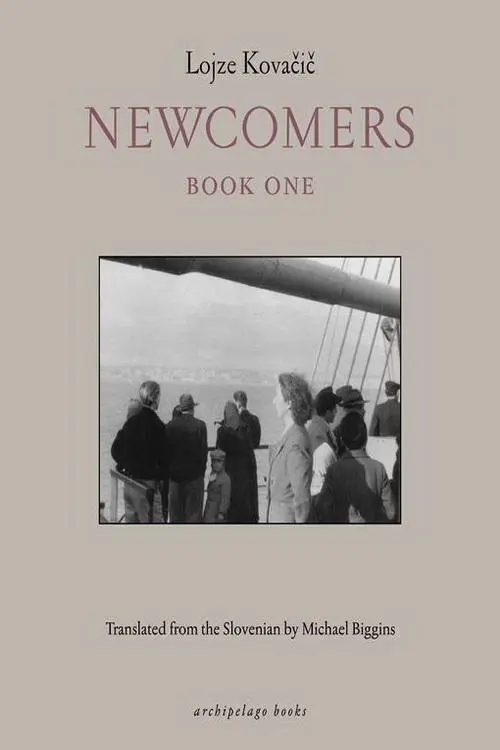
- Название:Newcomers
- Автор:
- Издательство:Archipelago
- Жанр:
- Год:2016
- ISBN:нет данных
- Рейтинг книги:3 / 5. Голосов: 1
-
Избранное:Добавить в избранное
- Отзывы:
-
Ваша оценка:
Newcomers: краткое содержание, описание и аннотация
Предлагаем к чтению аннотацию, описание, краткое содержание или предисловие (зависит от того, что написал сам автор книги «Newcomers»). Если вы не нашли необходимую информацию о книге — напишите в комментариях, мы постараемся отыскать её.
Kovačič meticulously, boldly, and sincerely portrays the objective, everyday world; the style is clear and direct. Told from the point of view of a child, one memory is interrupted by fragments and visions of another. Some are innocent and tender, while others are miserable and ruthless, resulting in a profound and heart-wrenching description of a period torn apart by conflict, reflected in the author's powerful and innovative command of language.
Newcomers — читать онлайн бесплатно полную книгу (весь текст) целиком
Ниже представлен текст книги, разбитый по страницам. Система сохранения места последней прочитанной страницы, позволяет с удобством читать онлайн бесплатно книгу «Newcomers», без необходимости каждый раз заново искать на чём Вы остановились. Поставьте закладку, и сможете в любой момент перейти на страницу, на которой закончили чтение.
Интервал:
Закладка:
We reached the little railroad station where we had arrived several weeks before. There were train cars standing there. Big, red ones. Tenders, as they were called. But for me they were circus paintings on a big canvas, cars made of red chewing gum … When we went down into town, the buildings scattered around amid the stones of the paved town square, which was full of sewage puddles, horse droppings, cow pies, hay-carts and pigpens, were just country buildings. Not city buildings at all, these were tiny and quiet and you could practically see through them. The town hall was a building with a tower, but it was lifeless, without any guard houses or police cars in front. The little shops here had dirty windows, half-blind rummage stores. I was no longer interested in produce stores as I’d been in Basel … with whole mountains of oranges and valleys of spinach on little bleachers … but the bakery, instead, with its sesame and poppy buns and loaves of white bread. The barbershop with its white-clad barbers, wigs and bottles in the display window full of scents and ointments, none of which had any trace of earthy dirtiness, mud or the unpleasantness of nature … The pharmacy with its medicines in jars and gold bust of the first doctor in ancient Greece … The general store. Its display window had bottles and glasses full of unwrapped candies and a stack of small, faded chocolate bars in dismal, monochromatic wrappers. That was the clearest possible proof that everything had really changed … that it was all just a pale reflection …
I was learning the language. My cousins Ciril and Ivan, and occasionally Stanka, too, taught me the song “Little Sunshine on Little Mountains” … They pointed to the soft blue peak that rose up over the black forest on the far side of the Krka. Those were the “bountains.” Atop them lived a shepherd who got married to a skinny girl, who was all bones when she hugged him, a fat girl, who melted on him, and a very short girl, who got lost in his bed. All of them resembled various peasant women, young or old, whom you could see walking around the village. But most of all they resembled the crazy woman from the cabin, who was all of these things at once … she had a big rear end, skinny legs and she was short … The worst thing was when Vati went looking for work in town and he wasn’t at home. When I went out and said, “gut mornink! gott villink! gut day!” my cousins would laugh. This wasn’t a pleasant laughter, I noticed that right away … It shook them so hard that they practically bounced up to the roof. “Zerspringt nur, kleine Mistviehe,” aI thought to myself. They ran into the house to get reinforcements for their laughter … Aunt Mica or Karel. If one of them so much as touches me, I’ll lose it … Two weeks, three weeks, five weeks went by … I wasn’t going to let them trick me, no way! I wasn’t yet capable of having a conversation … All I had to do was remember Ivan and Ciril’s sharpened sticks … the endless arguments between mother and Vati, every possible gossip and threat … all the mischief they could inflict on you with a word … and it passed. I was fully prepared. They weren’t going to get me to walk into their trap … I had a unique opportunity to keep quiet … to hide in a way. They thought I was sulking. Let them think that! In fact, I was unable to speak … Karel dug a big, deep pit near the cross to hide food. I helped him send foodstuffs down on a pulley. A barrel of cabbage. A crate of apples. A case of meat. A box of flour. A tin of lard. He laid straw and boards over all of it. “Krieg! Krieg!” bhe repeated, “There’s going to be a war!” he said, encouraging me. “Zers koink to pea a vor!” I repeated. I turned around in the pit to face Ciril and made a sign on my forehead that meant “he’s nuts” … I ran off as fast as I could. But that afternoon I was already tending Liska at the far end of the pasture. I could see mother and uncle in the doorway of Karel’s short house — her wearing white, him in black. It would have been impossible to imagine two more remote opposites. I knew they were never going to be able to understand each other … From morning to night mother would only lament. And she would cry, which made me feel sorry for her. “Ich fühle mich so wie in einem Kerker” cshe kept repeating. On Sunday we rode in Jožef’s black and yellow carriage with the lanterns to Prečna for mass. When I got up I had to get a good wash using the bucket next to the well … Only Vati didn’t go with us, because he didn’t believe in God. And Aunt Mica on account of her legs. Each of us was supposed to pray an extra Our Father for her. The carriage was full of my female cousins decked out in their Sunday best. Bright-colored dresses, loose blouses, pink satin. I was allowed to sit on the driver’s box next to Jožef. He was nicer than Karel, probably because we didn’t live at his place. Once long ago Vati had sent some money for the church bell in Prečna. I was proud as it rang now and echoed through the hills, fields and forest … Its white walls rose high up over the people, and the church had just two ordinary windows without colored figures … The peasants sat dressed in black, baggy suits, the very best of their wardrobes … their heads and faces poking up out of them like dirt, and their lips were chapped. God wasn’t a silver-haired St. Nicholas … He sat on a cloud with a triangle behind his head and a geometrical nose … On Sundays Stanka was prettier than usual … Children had to stand at the rear … My lips practically touched the bronzed back of her neck as she sat in the pew … The temptation was great … Her hands as she prayed were beautiful, exquisitely bronzed … they had the same maturity as her face. Like something out of a fairy tale. The charm that passed over her face as she pronounced the words of the prayers, the way her nose twitched and her lips moved … It was pure witchcraft. It flooded me. I heard angels singing. Her slightest smile sent out waves … a pure magical force. I didn’t dare look at her anymore … And her hair, as the candles got lit. Black, violet blue! Damn! She was becoming a water sprite! Right here, for all to see. I looked around, but no one had noticed … But I also knew she could be mean … like Gritli … From that time we were mowing on the slopes above Kandija, when we played tag and she hit me with a bridle supposedly just in fun, but in fact swung it as hard as she could … Up above, on a kind of stove in the middle of the chuch, stood the priest, dressed in white … whenever the organ came in, the women would start singing like waves of thin voices. Banners hung from shiny metal poles … with saints, temples, St. John the Baptist with his shepherd’s staff on them. This was a different kind of God from the one I was used to. A peasant! A mower! A sower and driver!..
At that time Vati went to look for work in the biggest town, Ljubljana, where we had first arrived … Whenever he was away, we were alone. And that wasn’t good … Uncle Karel gave mother one less tablespoon of lard. She had to ask him specially for flour and potatoes. He forbade her to sew for my cousins: none of those girls was going to wear her city rags. “Niks schneiderei! Arbeiten!” dhe said. She had to chop up a whole mountain of carrots and turnips. I stood at the block and used a mallet — a block on a stick — to mix, crush, and strain the feed for the young piglets. Clunk! Clunk! Aunt Mica came out. “Barrel!” she said. “Carrots!.. Pigs!” Her red pustular face bunched up into cute wrinkles. Encouragingly. And if only she had been God knows how much nicer!.. “You pig! Your mother pig!..” I understood. And I almost slipped, but I managed to get a grip on myself. I just had to remember everything … recognize the words, that was the key, and pick your own fights … I opened my mouth … wide, I looked like something was about to come out … But nothing came …
Читать дальшеИнтервал:
Закладка:
Похожие книги на «Newcomers»
Представляем Вашему вниманию похожие книги на «Newcomers» списком для выбора. Мы отобрали схожую по названию и смыслу литературу в надежде предоставить читателям больше вариантов отыскать новые, интересные, ещё непрочитанные произведения.




Обсуждение, отзывы о книге «Newcomers» и просто собственные мнения читателей. Оставьте ваши комментарии, напишите, что Вы думаете о произведении, его смысле или главных героях. Укажите что конкретно понравилось, а что нет, и почему Вы так считаете.