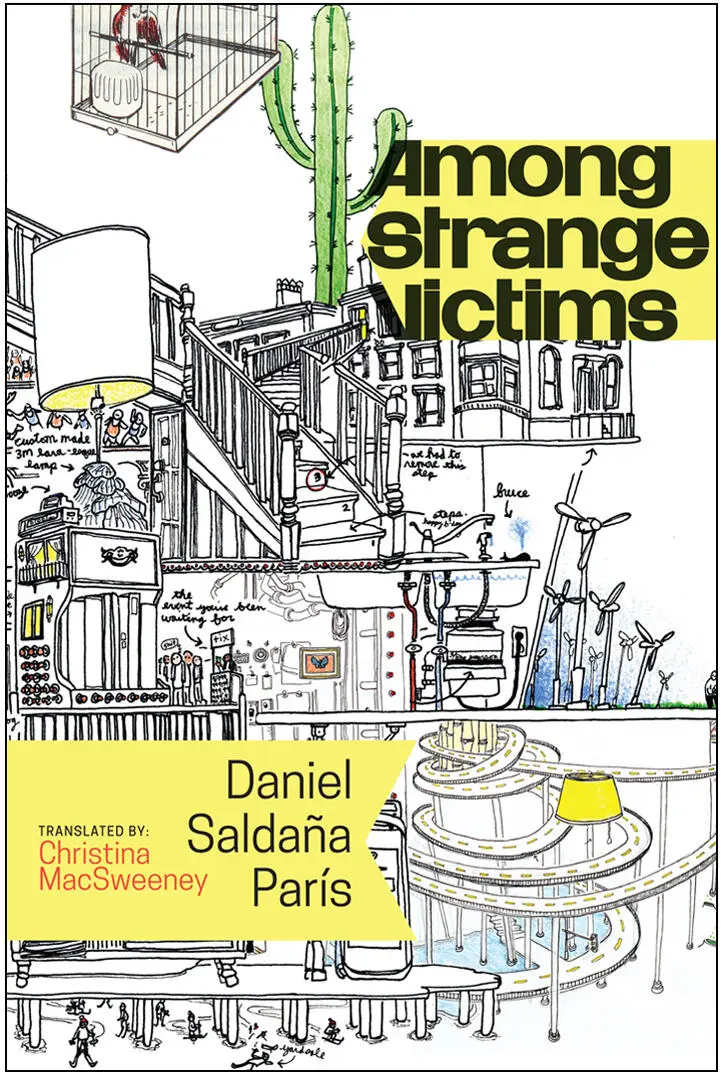
Daniel Saldaña París - Among Strange Victims
Здесь есть возможность читать онлайн «Daniel Saldaña París - Among Strange Victims» весь текст электронной книги совершенно бесплатно (целиком полную версию без сокращений). В некоторых случаях можно слушать аудио, скачать через торрент в формате fb2 и присутствует краткое содержание. Год выпуска: 2016, Издательство: Coffee House Press, Жанр: Современная проза, на английском языке. Описание произведения, (предисловие) а так же отзывы посетителей доступны на портале библиотеки ЛибКат.
- Название:Among Strange Victims
- Автор:
- Издательство:Coffee House Press
- Жанр:
- Год:2016
- ISBN:нет данных
- Рейтинг книги:3 / 5. Голосов: 1
-
Избранное:Добавить в избранное
- Отзывы:
-
Ваша оценка:
Among Strange Victims: краткое содержание, описание и аннотация
Предлагаем к чтению аннотацию, описание, краткое содержание или предисловие (зависит от того, что написал сам автор книги «Among Strange Victims»). Если вы не нашли необходимую информацию о книге — напишите в комментариях, мы постараемся отыскать её.
is a psychedelic ode to the pleasures of not measuring up.
Daniel Saldaña París
Mexico20: New Voices, Old Traditions
Among Strange Victims
Among Strange Victims — читать онлайн бесплатно полную книгу (весь текст) целиком
Ниже представлен текст книги, разбитый по страницам. Система сохранения места последней прочитанной страницы, позволяет с удобством читать онлайн бесплатно книгу «Among Strange Victims», без необходимости каждый раз заново искать на чём Вы остановились. Поставьте закладку, и сможете в любой момент перейти на страницу, на которой закончили чтение.
Интервал:
Закладка:
In that same year of 1985, Marcelo Valente enrolled simultaneously in philosophy and art history. He buried his nose in books and threw himself into the Byzantine discussions on the neo-Kantians with a devotion only equivalent to that he felt for Glutamato Ye-Yé, a rock group of the counterculture Movida Madrileña whose extreme levels of absurdity (“There’s a Man in My Fridge” is the title of one of their most notorious songs) helped him survive the dose of rationalism he was subjected to morning noon and night. He hung around with a number of completely unrelated groups: his school friends, in whose company he experimented with cocaine and bisexuality, the fundamental adornments of the era; his fellow students in philosophy, with whom he shared a naïve desire to change the world by means of the exhaustive analysis of the works of the Frankfurt School; and, finally, other university students in art history, of whom he really only knew two: a sometime girlfriend called Sixi — Remedios in real life, though no one called her by that name — and Guillermo, a misfit cousin two years older than himself, who seemed predestined to sell soft drugs for the rest of his life, a destiny he would fulfill with singular diligence until it landed him in prison seven years later.
In 1989, Professor Velásquez had a son with a girlfriend he had met through a distant cousin. At the time the child was born, they had just moved to an apartment in Copilco overlooking the University City. She taught math in a secondary school, and Velásquez had become closely involved in editing a magazine that earned him fame but no money. Two years later, she took their son back to her hometown of Toluca, and Velásquez decided not to protest since he had confirmed that, as a father, his performance was pretty poor. He had continued to see his son every couple of weeks until he was offered the research position in Los Girasoles; after that, they only met during holidays, and with increasingly less frequency.
While this was going on, Marcelo Valente finished his two undergraduate degrees in record time — though with unspectacular grades — and, having dazzled the wealthy faction of his family, went to London — partly sponsored by an aunt — for a whole summer with another, also sometime, girlfriend called Lucía.
Marcelo and Velásquez could spend hours like that, analyzing from year to year the tenuous coincidences in their lives and happily laughing at the differences.
After wiping the plates of his three servings of salad with a piece of stale bread, Marcelo would return to Puerta del Aire. Velásquez had introduced him to someone from the university’s administrative department who was anxious to sell his car, and Marcelo bought it, convinced he could resell it with equal ease at the end of his sabbatical year. So now he had a car.
Back at his house, he dedicated himself to light reading — war novels for the most part — that he found in the only non-university bookstore in Los Girasoles. He had brought very few belongings with him, and the only books he had were related to his research, so he would have to wait for his next trip to DF to stock up on his bibliographic resources and even a couple of box sets to kill time. After reading for a while, he’d begin to feel irritated by his surroundings, the ugliness of the furniture, and would set out again—“I’ll be back later, Don Jacinto,” he’d call to the guard — on a drive along the four central streets of Los Girasoles. In the only café that merited the name, he had become a familiar face since his second day, and it was there he sat to leaf through the local newspaper and ignore the indigenous people from other lands offering him multicolored craft items.
The waiter was a lean, diligent man who liked to discover the tastes and manias of his regular customers. He already knew he should serve Marcelo an espresso with just a drop of milk and not bring sugar or sweetener or anything similar. He also had to bring the newspaper from the bar, if it was available, and if not promise he would be the next customer to get it. Sometimes, but only if Marcelo requested it, the waiter served a glass of mineral water with the espresso, but that only happened on very hot days.
Marcelo always greeted the waiter by name and gave a substantial tip when he left the terrace to take a couple of turns around the square with its pavilion. From the café, the professor could be seen taking that ritual, circular walk and then disappearing down one of the streets leading to another, smaller square, only to reappear after a short time in his noisy car, which had been left in a public parking lot two blocks away. He sometimes stopped off at the supermarket on the road to Puerta del Aire. This was, to cut a long story short, his average day.
Later on, Marcelo planned to visit the nearby towns on the weekends. The nearest was Nueva Francia, which appeared in the newspapers every three or four days, together with the words narco or shoot-out. In the last six months, Nueva Francia had changed its mayor three or four times. Killed, arrested, or politically ousted, the mayors who left the post were never again mentioned in the press or during conversations on public transportation. An omnivorous silence devoured the names of those defunct functionaries, a silence that passed with giant steps through the ranks of the dwindling population. One day, three beheaded corpses. Another, five individuals tied at the wrists, showing signs of torture. Yet another, a soldier, with his hands cut off, lying at the roadside.
Given these reports, Marcelo postponed the moment of getting to know Nueva Francia and, for the time being, contented himself with visiting the smallest, most distant towns that were featured in the Globetrotter’s Guide he had brought with him from Madrid. While driving, he listened to Glutamato Ye-Yé on the car stereo, recalling the good times of the eighties and thinking nostalgically of all the women he had been with. Those uncultivated plains, those winding roads pitted with potholes were perfect for remembering the most important moments of his life, to the rhythm of an outdated style of pure rock that gratified the deepest depths of his memory.
“The only thing missing here,” Marcelo would say to himself, “is a woman to help me get through this sabbatical year.” The female staff members Velásquez introduced him to — all flat-chested — had looked at him with an eagerness that put Marcelo on his guard: just as in a cartoon, he believed he saw gold rings and wedding dresses in their black eyes, plus European passports and a life far distant from their offices in Los Girasoles and the executions in Nueva Francia. They were calculating women, academics who delivered their classes any old way and published articles in second-rate journals to gain points and so receive federal bonuses for top-class research. Marcelo knew them because they were the same the world over: in the Inalienably Autonomous University of Madrid, in the University of Buenos Aires, in the Pontifical University of Anywhere At All. It wasn’t just the women, of course; in terms of calculation and mediocrity, there was no possible discrimination: all the researchers were of equal worth. But now Marcelo was polishing up his misogyny because it was the women who looked at him with lascivious desire, drawing an inelegant equivalence between the foreignness of the newcomer and the social redemption of his hypothetical partner.
No. Marcelo needed a different woman, a Mexican with an air of extreme wisdom who would show him the paths of the national mystique and force him to part with his first-world prejudices. An intense, implacable woman who wouldn’t allow him to be distracted from his principal mission: to write a book on Foret in Mexico, or rather on the sudden, inexplicable disappearance of Foret in Mexico, on disappearance as the absolute aesthetic experience of the avant-garde — in the sense, that is, of Paul Virilio, but more frivolously. A woman who would open doors for him and explain the codes of conduct in this barren place, who would carry him away from Puerta del Aire to a cool, shady, wooden house in some grove, in some oasis that would isolate him from all the surrounding hostility.
Читать дальшеИнтервал:
Закладка:
Похожие книги на «Among Strange Victims»
Представляем Вашему вниманию похожие книги на «Among Strange Victims» списком для выбора. Мы отобрали схожую по названию и смыслу литературу в надежде предоставить читателям больше вариантов отыскать новые, интересные, ещё непрочитанные произведения.







Обсуждение, отзывы о книге «Among Strange Victims» и просто собственные мнения читателей. Оставьте ваши комментарии, напишите, что Вы думаете о произведении, его смысле или главных героях. Укажите что конкретно понравилось, а что нет, и почему Вы так считаете.