John Powys - Rodmoor
Здесь есть возможность читать онлайн «John Powys - Rodmoor» весь текст электронной книги совершенно бесплатно (целиком полную версию без сокращений). В некоторых случаях можно слушать аудио, скачать через торрент в формате fb2 и присутствует краткое содержание. Год выпуска: 2008, Издательство: Faber and Faber, Жанр: Современная проза, на английском языке. Описание произведения, (предисловие) а так же отзывы посетителей доступны на портале библиотеки ЛибКат.
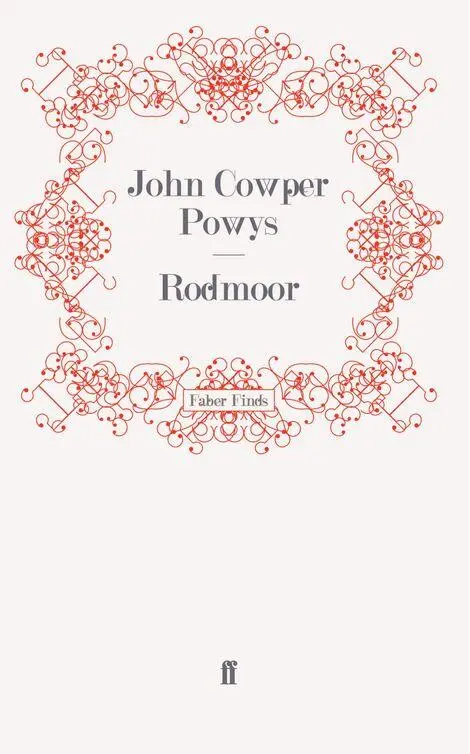
- Название:Rodmoor
- Автор:
- Издательство:Faber and Faber
- Жанр:
- Год:2008
- ISBN:нет данных
- Рейтинг книги:5 / 5. Голосов: 1
-
Избранное:Добавить в избранное
- Отзывы:
-
Ваша оценка:
Rodmoor: краткое содержание, описание и аннотация
Предлагаем к чтению аннотацию, описание, краткое содержание или предисловие (зависит от того, что написал сам автор книги «Rodmoor»). Если вы не нашли необходимую информацию о книге — напишите в комментариях, мы постараемся отыскать её.
This was Powys second novel, published in 1916. It deploys a rich and memorable cast of characters.
Rodmoor — читать онлайн бесплатно полную книгу (весь текст) целиком
Ниже представлен текст книги, разбитый по страницам. Система сохранения места последней прочитанной страницы, позволяет с удобством читать онлайн бесплатно книгу «Rodmoor», без необходимости каждый раз заново искать на чём Вы остановились. Поставьте закладку, и сможете в любой момент перейти на страницу, на которой закончили чтение.
Интервал:
Закладка:
In her own mind, as the weeks slipped by and their names had already been coupled twice in the Sunday services, Nance was taking thought as to what, in solid reality, she intended to do with this child-man of hers when the great moment came. She must move from their present lodging. That seemed certain. It also seemed certain that Linda would have still to go on living with her. Any other arrangement than that was obviously unthinkable. But where should they live? And could she, with the money at present at her disposal, support three people?
A solution was found to both these problems by Mr. Traherne. There happened to exist in Rodmoor, as in many other old decaying boroughs on the east coast, certain official positions the practical service of which was almost extinct but whose local prestige and financial emoluments, such as they were, lingered on unaffected by the change of conditions. The relentless encroachments of the sea upon the land were mainly responsible for this. In certain almost uninhabited villages there existed official persons whose real raison d’être lay with the submerged foundations of former human habitations, deep at the bottom of the waters.
It was, indeed, one of the essential peculiarities of life upon those strange sea-banks this sense of living on the edge, as it were, of the wave-drowned graves of one’s fathers. It may have been the half-conscious knowledge of this, bred in their flesh and blood from infancy, that gave to the natives of those places so many unusual and unattractive qualities. Other abodes of men rest securely upon the immemorial roots of the past, roots that lie, layer beneath layer, in rich historic continuity endowing present usages and customs with the consecration of unbroken tradition. But in the villages of that coast all this is different. Tradition remains, handed down from generation to generation, but the physical continuity is broken. The east-coast dwellers resemble certain of the stellar bodies in the celestial spaces, they retain their identity and their names but they are driven, in slow perpetual movement, to change their physical position. In scriptural phrase, they have no “abiding-place” nor can they continue “in one stay.”
The fishing boats of the present generation set their brown sails to cross the water where, some hundreds of years before, an earlier generation walked their cobbled streets. The storm-buoys rock and ring and the boat lanterns burn their wavering signals over the drowned foundations that once supported Town-Hall and church tower, Market place and Village Tavern. It is this slow, century-delayed flight from the invading tide which so often produces in East Anglian coast towns the phenomenal existence of two parish churches, both it may be still in use, but the later and newer one following the heart of the community in its enforced retreat. Thus it is brought about in these singular localities that the very law of the gods, the law which utters to the elements the solemn “thus far and no further” is as a matter of fact, daily and momently, though with infinite slowness, broken and defied.
It is perhaps small wonder that among the counties of England these particular districts should have won for themselves a sinister reputation for impiety and perversity. Nothing so guards and establishes the virtue of a community than its sense of the presence in its midst of the ashes of its generations. Consciously and in a thousand pious usages it “worships its dead.” But East-Anglian coast-dwellers are not permitted this privilege. Their “Lares and Penates” have been invaded and submerged. The fires upon their altars have been drowned and over the graves of their fathers the godless tides ebb and flow without reverence. Fishes swim where once children were led to the font and where lovers were wedded the wild cormorant mocks the sea-horses with its disconsolate cry. It is easy to be believed that the remote descendants of human beings who actually walked and bartered and loved and philosophized on spots of ground now tangled with seaweed and sea-drift, and with fathoms of moaning and whispering water above them, should come in their hour to depart in a measure from the stable and kindly laws of human integrity! With the ground thus literally moving —though in age-long process— under their feet , how should they be as faithful as other tribes of men to what is permanent in human institution?
There was perhaps a certain congruity in the fact that now, after all these ages of tidal malice, it was in the interests of so singular an alien as Sorio — one whose very philosophy was the philosophy of “destruction”—that this lingering on of offices, whose service had been sea-drowned, remained as characteristic of the place. But this is precisely what did occur.
There was in Rodmoor a local official, appointed by the local town council, whose title, “The Warden of the Fishes,” carried the mind back to a time when the borough, much larger then, had been a considerable centre of the fishing industry. This office, tenable for life, carried with it very few actual duties now but it ensured a secure though small emolument and, what was more important, the occupancy, free of rent, of one of the most picturesque houses in the place, an old pre-Elizabethan dwelling of incommodious size but of romantic appearance, standing at the edge of the harbour.
The last incumbent of this quaint and historic office, whose duties were so little onerous that they could be performed by a very old and very feeble man, was a notable character of the village called John Peewit Swinebitter, whose chief glory was not attained until the close of his mortal days, which ended under the table in the Admiral’s Head after a surfeit of the very fish of which he was “warden” washed down by too copious libations of Keith-Radipole ale.
Since Mr. Swinebitter’s decease in June, there had gone on all through July and August, a desperate rivalry between two town factions as to the choosing of his successor and it was Mr. Traherne’s inspired notion to take advantage of this division to secure the post for Nance’s prospective husband.
Sorio, though of foreign blood, was by birth and nationality English and moreover he had picked up, during his stay in Rodmoor, quite as much familiarity with the ways and habits of fish as were necessary for that easy post. If, at any unforeseen crisis, more scientific and intimate knowledge was required than was at his disposal, there was always Dr. Raughty, a past master in all such matters, to whom he could apply. It was Mr. Traherne’s business to wheedle the local rivals into relinquishing their struggle in favour of one who was outside the contention and when this was accomplished the remaining obstacles in the way of the appointment were not hard to surmount. Luckily for the conspirators, Brand Renshaw, though the largest local landowner and a Justice of the Peace, was not on the Rodmoor council.
So skillfully did Mr. Traherne handle the matter and so cautious and reserved was Nance that it was not till after the final reading of their bans in the church on the marshes and the completion of the arrangements for their marriage at the end of the following week, that even Baltazar Stork became aware of what was in the wind.
Sorio himself had been extremely surprised at this unexpected favour shown him by the local tradesmen. He had brooded so long upon his morbid delusion of universal persecution that it seemed incredible to him, in the few interviews which he had with these people, that they should treat him in so courteous and kind a manner. As a matter of fact, so fierce and obstinate were their private dissensions, it was a genuine relief to them to deal with a person from outside; nor must it be forgotten that in the appointment of Nance’s husband to the coveted post they were doing honour to the memory of the bride’s father, Captain Herrick having been by far the most popular of all the visitors to Rodmoor in former times. Most of the older members of the council could well remember the affable sailor. Many of them had frequently gone out fishing with him in the days when there were more fish and rarer fish to be caught than there were at present — those “old days” in fact which, in most remote villages, are associated with stuffed wonders in tavern parlours and with the quips and quirks of half-legendary heroes of Sport and Drink.
Читать дальшеИнтервал:
Закладка:
Похожие книги на «Rodmoor»
Представляем Вашему вниманию похожие книги на «Rodmoor» списком для выбора. Мы отобрали схожую по названию и смыслу литературу в надежде предоставить читателям больше вариантов отыскать новые, интересные, ещё непрочитанные произведения.







Обсуждение, отзывы о книге «Rodmoor» и просто собственные мнения читателей. Оставьте ваши комментарии, напишите, что Вы думаете о произведении, его смысле или главных героях. Укажите что конкретно понравилось, а что нет, и почему Вы так считаете.