John Powys - Rodmoor
Здесь есть возможность читать онлайн «John Powys - Rodmoor» весь текст электронной книги совершенно бесплатно (целиком полную версию без сокращений). В некоторых случаях можно слушать аудио, скачать через торрент в формате fb2 и присутствует краткое содержание. Год выпуска: 2008, Издательство: Faber and Faber, Жанр: Современная проза, на английском языке. Описание произведения, (предисловие) а так же отзывы посетителей доступны на портале библиотеки ЛибКат.
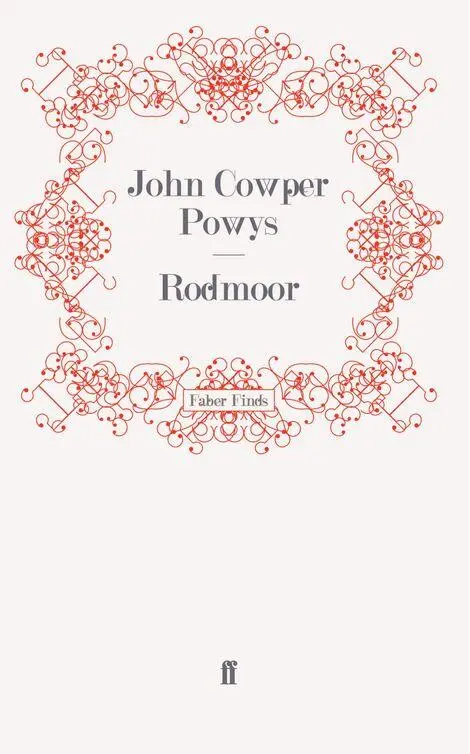
- Название:Rodmoor
- Автор:
- Издательство:Faber and Faber
- Жанр:
- Год:2008
- ISBN:нет данных
- Рейтинг книги:5 / 5. Голосов: 1
-
Избранное:Добавить в избранное
- Отзывы:
-
Ваша оценка:
Rodmoor: краткое содержание, описание и аннотация
Предлагаем к чтению аннотацию, описание, краткое содержание или предисловие (зависит от того, что написал сам автор книги «Rodmoor»). Если вы не нашли необходимую информацию о книге — напишите в комментариях, мы постараемся отыскать её.
This was Powys second novel, published in 1916. It deploys a rich and memorable cast of characters.
Rodmoor — читать онлайн бесплатно полную книгу (весь текст) целиком
Ниже представлен текст книги, разбитый по страницам. Система сохранения места последней прочитанной страницы, позволяет с удобством читать онлайн бесплатно книгу «Rodmoor», без необходимости каждый раз заново искать на чём Вы остановились. Поставьте закладку, и сможете в любой момент перейти на страницу, на которой закончили чтение.
Интервал:
Закладка:
“Shall we kneel down?” she said. Linda began trembling a little but with simple and girlish docility, free from any kind of embarrassment, she knelt at the other’s side.
“We mustn’t pray for the dead,” whispered Mrs. Renshaw. “He,” she meant Mr. Traherne, “tells us to in his sermons, but it hurts me when he does for we’ve been taught that all that is wrong — wrong and contrary to our simple faith! We mustn’t forget the Martyrs — must we, Linda?”
But Linda’s mind was far from the martyrs. It was occupied entirely with the thing that lay buried before them, under that newly disturbed earth.
“But we can pray to God that His will be done, on earth, even as it is in Heaven,” murmured Mrs. Renshaw.
She was silent after that and the younger and the elder woman knelt side by side with bowed heads. Then in a low whisper Mrs. Renshaw spoke again.
“There are some lines I should like to say to you, dear, if you’ll let me. I copied them out last week. They were at the end of a book of poetry that I found in Philippa’s room. She must have just bought it or had it given to her. I didn’t think she cared any more for poetry. The pages weren’t cut and I didn’t like to cut them without her leave but I copied this out from the end. It was the last in the book.”
She hesitated a moment while Linda remained motionless at her side, trembling still a little and watching the movements of a Peacock butterfly which was then sharing with the wasps their interest in the ancient honeyjar.
Mrs. Renshaw then repeated the following lines in a clear exquisitely modulated voice which went drifting away over surrounding marshes.
“For even the purest delight may pall,
And power must fail and the pride must fall,
And the love of the dearest friends grow small,
But the glory of the Lord is all in all.”
Her voice sank. A slight gust of wind made the trees above them sigh softly as though the words of the kneeling woman were in harmony with the inarticulate heart of the earth.
Linda stopped trembling. A sweet indescribable calm began slowly to pervade her. Gently, like a child, she slipped her hand into her companion’s.
“Do you remember the Forty-third Psalm, Linda?” Mrs. Renshaw continued and her clear dramatic voice, with a power of feeling equal to that of any great actress, once more rose upon the air.
“Our heart is not turned back, neither have our steps declined from thy way.
Though thou hast sore broken us, in the place of dragons, and covered us with the shadow of death.”
Once more she was silent but with a slight veering of the wind, the sound of the waves beyond the sand-dunes came to them with pitiless distinctness. It seemed to mock — this voice of the earth’s antagonist — mock, in triumphant derision, the forlorn hope which that solemn invocation had roused in the girl’s heart. But in contending against Mrs. Renshaw’s knowledge of the Psalms even the North Sea had met its match. With her pale face uplifted and a wild light in her eyes, she continued to utter the old melodious incantations with their constant references to a Power more formidable than “all thy waves and storms.” She might have been one of the early converts to the faith that came from the sacred Desert, wrestling in spiritual ecstasy with the gods and powers of those heathen waters.
Either by one of the fortunate coincidences which sometimes interrupt even the irony of nature or, as Mrs. Renshaw would herself have maintained, by a direct answer to her prayer, the weathercock on the church tower swung round again. North-east it swung, then north-north-east, then due north. And finally, even while she was uttering her last antiphony, it pointed to north-west, the quarter most alien and antagonistic to the Rodmoor sea, the portion of the horizon from which blew the wind of the great fens.
In a country like East Anglia so peculiarly at the mercy of the elements, every one of the winds has its own peculiar burden and brings with it something healing and restorative or baleful and malefic. The east wind here is, in a paramount sense, the evil wind, the accomplice and confederate of the salt deep, the blighter of hopes, the herald of disaster. The north-west wind, on the contrary, is the wind that brings the sense of inland spaces, the smell of warm, wet earth and the fragrance of leaf mould in sweet breathing woods. It is the wind that fills the rivers and the wells and brings the fresh purifying rain. It is a wind full of memories and its heart is strong with the power of ancient love, revived even out of graves and sepulchres. To those sensitive to finer and rarer earth influences among the dwellers by the east coast there may be caught sometimes upon the north-west wind the feeling of pine woods and moorland heather. For it comes from the opposite side of the great plain, from Brandon Heath and even beyond and it finds nothing in the wide fen country to intercept it or break the rush of its sea-ward passage.
Thus, when the two women rose finally to their feet it was to be met by a cool, healing breath which, as it bowed the ranks of the hollyhocks and rustled through the trees, had in it a delicious odour of inland brooks and the coming of pure rain.
“Listen to me, child,” said Mrs. Renshaw as they passed out of the churchyard, “I want to say this to you. You mustn’t think that God allows any intercourse between the living and the dead. That is a wicked invention of our own sinful hearts. It is a temptation, darling — a temptation of the devil — and we must struggle against it. Whenever we feel it we must struggle against it and pray. It is perfectly right for you to think gently and forgivingly of poor Miss Doorm. It were wrong to think otherwise. But you mustn’t think of her as anywhere near us or about us now. She’s in the hands of God and in the mercy of God and we must leave her there. Do you hear what I’m saying, Linda? Do you understand me? Anything else is wrong and evil. We are all sinners together and we are all in the same merciful hands.”
Never was the exorcising of powers hurtful to humanity more effective. Linda bowed her head at her words and then raising it freely, walked with a lighter step than for seven long days. She wished in her heart that she had the courage to talk to Mrs. Renshaw about an anxiety much more earthly, much less easy to be healed, than the influence of Rachel Doorm, alive or dead, but so immense was her relief at that moment to be free from the haunting phantom that had been pulling her towards that mound in the churchyard that she found it in her heart to be hopeful and reckless even though she knew that, whatever happened, there was bound to be pain and trouble in store for her in the not far distant future.
XXIII WARDEN OF THE FISHES
IT will be found not altogether devoid of a strange substratum of truth, though fantastic enough in the superficial utterance, the statement that there are certain climacteric seasons in the history of places when, if events of importance are looming upon the horizon, they are especially liable to fall. Such a season with regard to Rodmoor, or at least with regard to the persons we are most concerned with there, may be said to have arrived with the beginning of Autumn and with the month of October.
The first weeks of this month were at any rate full of exciting and fatal interest to Nance. Something in the change of the weather, for the rains had come in earnest now, affected Sorio in a marked degree. His whole being seemed to undergo some curious disintegrating process as difficult to analyze as the actual force in Nature which was at that very time causing the fall of the leaves. We may be allowed to draw at least this much from Sorio’s own theory of the universal impulse to self-destruction — the possible presence, that is to say, of something positive and active, if not personal and conscious, in the processes of natural decadence. Life, when it corrupts and disintegrates; life when it finally falls away and becomes what we call death, does so sometimes, or seems to do so, with a vehemence and impetuosity which makes it difficult not to feel the pressure of some half-conscious “will to perish” in the thing thus plunging towards dissolution. The brilliant colour which many flowers assume when they approach decease bears out this theory. It is what the poet calls a “lightning before death” and the rich tints of the autumn foliage as well as the phosphorescent glories — only repulsive to our human senses in fatal association — of physical mortality itself, are symbols, if not more than symbols, of the same splendid rushing upon nothingness.
Читать дальшеИнтервал:
Закладка:
Похожие книги на «Rodmoor»
Представляем Вашему вниманию похожие книги на «Rodmoor» списком для выбора. Мы отобрали схожую по названию и смыслу литературу в надежде предоставить читателям больше вариантов отыскать новые, интересные, ещё непрочитанные произведения.






Обсуждение, отзывы о книге «Rodmoor» и просто собственные мнения читателей. Оставьте ваши комментарии, напишите, что Вы думаете о произведении, его смысле или главных героях. Укажите что конкретно понравилось, а что нет, и почему Вы так считаете.