John Powys - Rodmoor
Здесь есть возможность читать онлайн «John Powys - Rodmoor» весь текст электронной книги совершенно бесплатно (целиком полную версию без сокращений). В некоторых случаях можно слушать аудио, скачать через торрент в формате fb2 и присутствует краткое содержание. Год выпуска: 2008, Издательство: Faber and Faber, Жанр: Современная проза, на английском языке. Описание произведения, (предисловие) а так же отзывы посетителей доступны на портале библиотеки ЛибКат.
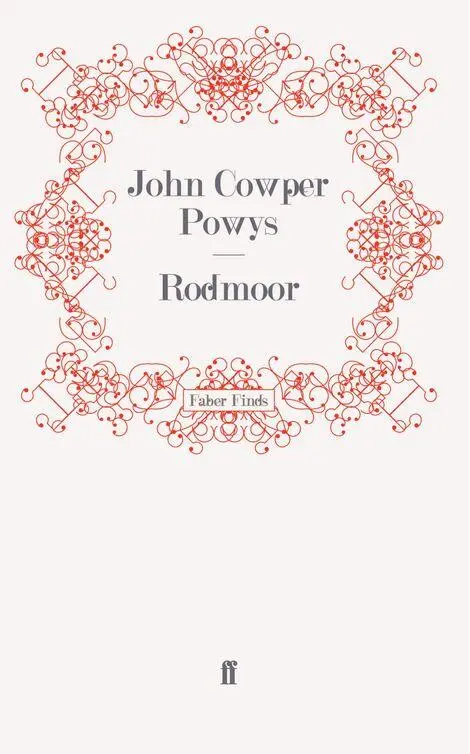
- Название:Rodmoor
- Автор:
- Издательство:Faber and Faber
- Жанр:
- Год:2008
- ISBN:нет данных
- Рейтинг книги:5 / 5. Голосов: 1
-
Избранное:Добавить в избранное
- Отзывы:
-
Ваша оценка:
Rodmoor: краткое содержание, описание и аннотация
Предлагаем к чтению аннотацию, описание, краткое содержание или предисловие (зависит от того, что написал сам автор книги «Rodmoor»). Если вы не нашли необходимую информацию о книге — напишите в комментариях, мы постараемся отыскать её.
This was Powys second novel, published in 1916. It deploys a rich and memorable cast of characters.
Rodmoor — читать онлайн бесплатно полную книгу (весь текст) целиком
Ниже представлен текст книги, разбитый по страницам. Система сохранения места последней прочитанной страницы, позволяет с удобством читать онлайн бесплатно книгу «Rodmoor», без необходимости каждый раз заново искать на чём Вы остановились. Поставьте закладку, и сможете в любой момент перейти на страницу, на которой закончили чтение.
Интервал:
Закладка:
But at that moment Nance appeared, walking rapidly with bent head, up the narrow street. Baltazar looked at her with a gleam of hatred in his sea-coloured eyes. She came to rob him of one of the most exquisite pleasures of his life, the pleasure of reducing this strong creature to humiliated submissiveness and then petting and cajoling him back into self-respect. The knowledge that he left Sorio in her hands in this particular mood of deprecatory helplessness, remorseful and gentle and like a wild beast beaten into docility, caused him the most acute pain. With poisonous antagonism under his urbane greeting he watched furtively the quick glance she threw at Adrian and the way her eyes lingered upon his, feeling her way into his mood. He cast about for some element of discord that he could evoke and leave behind with them to spoil the girl’s triumph for he knew well that Adrian was now, after what had just occurred, in the frame of mind most adapted of all to the influence of feminine sympathy. Nance, however, did not give him an opportunity for this.
“Come on,” she said, “we’ve only just time to catch the three o’clock train. Come on! Good-bye for a while, Mr. Stork. I’ll bring him back safe to you, sooner or later. Come on, Adrian, we really must be quick!”
They went off together and Baltazar wandered slowly back across the green. He felt for the moment so lonely that even his hatred drifted away and sank to nothingness under the inflowing wave of bitter universal isolation. As he approached his cottage he stopped stone-still with his eyes on the ground and his hands behind his back. Elegantly dressed in pleasant summer clothes, his slight graceful figure, easy bearing, and delicate features, gave without doubt to the casual bystanders who observed him, an impression of unmitigated well-being. As a matter of fact, had that discerning historic personage who is reported to have exclaimed after an interview with Jonathan Swift, “there goes the unhappiest man who ever lived,” exercised his insight now, he might have modified his conclusion in favour of Baltazar Stork.
It would certainly have required more than ordinary discernment to touch the tip of the iron wedge that was being driven just then into this graceful person’s brain. Looking casually into the man’s face one would have seen nothing perhaps but a dreamy, pensive smile — a smile a little bitter maybe, and self-mocking but with no particularly sinister import. A deeper glance, however, would have disclosed a curious compression of the lines about the mouth and a sort of indrawing of the lips as if Mr. Stork were about to emit the sound of whistling. Below the smiling surface of the eyes, too, there might have been seen a sort of under-flicker of shuddering pain as if, without any kind of anæsthetic, Mr. Stork were undergoing some serious operation. The colour had deserted his cheeks as if whatever it was he was enduring the endurance of it had already exhausted his physical energies. Passing him by, as we have remarked, casually and hastily, one might have said to oneself—“Ah! a handsome fellow chuckling there over some pleasant matter!” but coming close up to him one would have instinctively stretched out a hand, so definitely would it then have appeared that, whatever his expression meant, he was on the point of fainting. It was perhaps a fortunate accident that, at this particular moment as he stood motionless, a small boy of his acquaintance, the son of one of the Rodmoor fishermen, came up to him and asked whether he had heard of the great catch there had been that day.
“There’s a sight o’ fish still there, Mister,” the boy remarked, “some of them monstrous great flounders and a heap of Satans such as squirts ink out of their bellies!”
Baltazar’s twisted lips gave a genuine smile now. A look of extraordinary tenderness came into his face.
“Ah, Tony, my boy,” he said, “so there are fish down there, are there? Well, let’s go and see! You take me, will you? And I’ll make those fellows give you some for supper.”
They walked together across the green and down the street. Baltazar’s hand remained upon the child’s shoulder and he listened as he walked, to his chatter; but all the while his mind visualized an immense, empty plain — a plain of steely-blue ice under a grey sky — and in the center of this plain a bottomless crevasse, also of steely-blue ice, and on the edge of this crevasse, gradually relinquishing their hold from exhaustion, two human hands. This image kept blending itself as they walked with all the little things which his eyes fell upon. It blent with the cakes in the confectioner’s window. It blent with the satiny blouses, far too expensive for any local purchaser, in Miss Pontifex’s shop. It blent with the criss-cross lines of the brick-work varied with flint of the house where Dr. Raughty lived. It blent with their first glimpse of the waters of the harbour, seen between two ramshackle houses with gable roofs. Nor when they finally found themselves standing with a little crowd of men and boys round a circle of fish-baskets upon the shore did it fail to associate itself both with the blue expanse of waveless sea stretched before them and with the tangled mass of sea shells, seaweed and sea creatures which lay exposed to the sunlight, many-coloured and glistening as the deeper folds of the nets which had drawn them from the deep were explored and dragged forward.
Meanwhile Adrian and Nance, having safely caught their train, were being carried with the leisurely steadiness of a local line, from Rodmoor to Mundham. Jammed tightly into a crowded compartment full of Saturday marketers, they had little opportunity during the short journey to do more than look helplessly across their perspiring neighbours at the rising and falling of the telegraph wires against a background of blue sky. The peculiar manner in which, as a train carries one forward, these wires sink slowly downwards as if they were going to touch the earth and then leap up with an unexpected jerk as the next pole comes by, was a phenomenon that always had a singular fascination for Sorio. He associated it with his most childish recollections of railway travelling. Would the wires ever succeed in sinking out of sight before the next pole jerked them high up across the window again? That was the speculation that fascinated him even at this moment as he watched them across the brim of his companion’s brightly trimmed hat. There was something human in the attempts the things made to sink down, down, down and escape their allotted burden and there was certainly something very like the ways of Providence in the manner in which they were pulled up with a remorseless jolt to perform their duties once more.
Emerging with their fellow-passengers upon the Mundham platform both Sorio and Nance experienced a sense of happiness and relief. They had both been so long confined to the immediate surroundings of Rodmoor that this little excursion to the larger town assumed the proportions of a release from imprisonment. It is true that it was a release that Adrian might easily have procured for himself on any day; but more and more recently, in the abnormal tension of his nerves, he had lost initiative in these things. They wandered leisurely together into the town and Sorio amused himself by watching the demure and practical way in which his companion managed her various economic transactions in the shops which she entered. He could not help feeling a sense of envy as he observed the manner in which, without effort or strain, she achieved the precise objects she had in mind and arranged for the transportation of her purchases by the carrier’s cart that same evening.
He wondered vaguely whether all women were like this and whether, with their dearest and best-loved dead at home, or their own peace of mind permanently shattered by some passage of fatal emotion only some few hours before, they could always throw everything aside and bargain so keenly and shrewdly with the alert tradesmen. He supposed it was the working of some blind atavistic power in them, the mechanical result of ages of mental concentration. He was amused, too, to observe how, when in a time incredibly short she had done all she wanted, instead of rushing off blindly for the walk they had promised themselves past the old Abbey church and along the river’s bank, she shrewdly interpreted their physical necessities and carried him off to a little dairy shop to have tea and half-penny buns. Had he been the cicerone of their day’s outing he would have plunged off straight for the Abbey church and the river fields, leaving their shopping to the end and dooming them to bad temper and irritable nerves from sheer bodily exhaustion. Never had Nance looked more desirable or attractive as, with heightened colour and little girlish jests, she poured out his tea for him in the small shop-parlour and swallowed half-penny buns with the avidity of a child.
Читать дальшеИнтервал:
Закладка:
Похожие книги на «Rodmoor»
Представляем Вашему вниманию похожие книги на «Rodmoor» списком для выбора. Мы отобрали схожую по названию и смыслу литературу в надежде предоставить читателям больше вариантов отыскать новые, интересные, ещё непрочитанные произведения.






Обсуждение, отзывы о книге «Rodmoor» и просто собственные мнения читателей. Оставьте ваши комментарии, напишите, что Вы думаете о произведении, его смысле или главных героях. Укажите что конкретно понравилось, а что нет, и почему Вы так считаете.