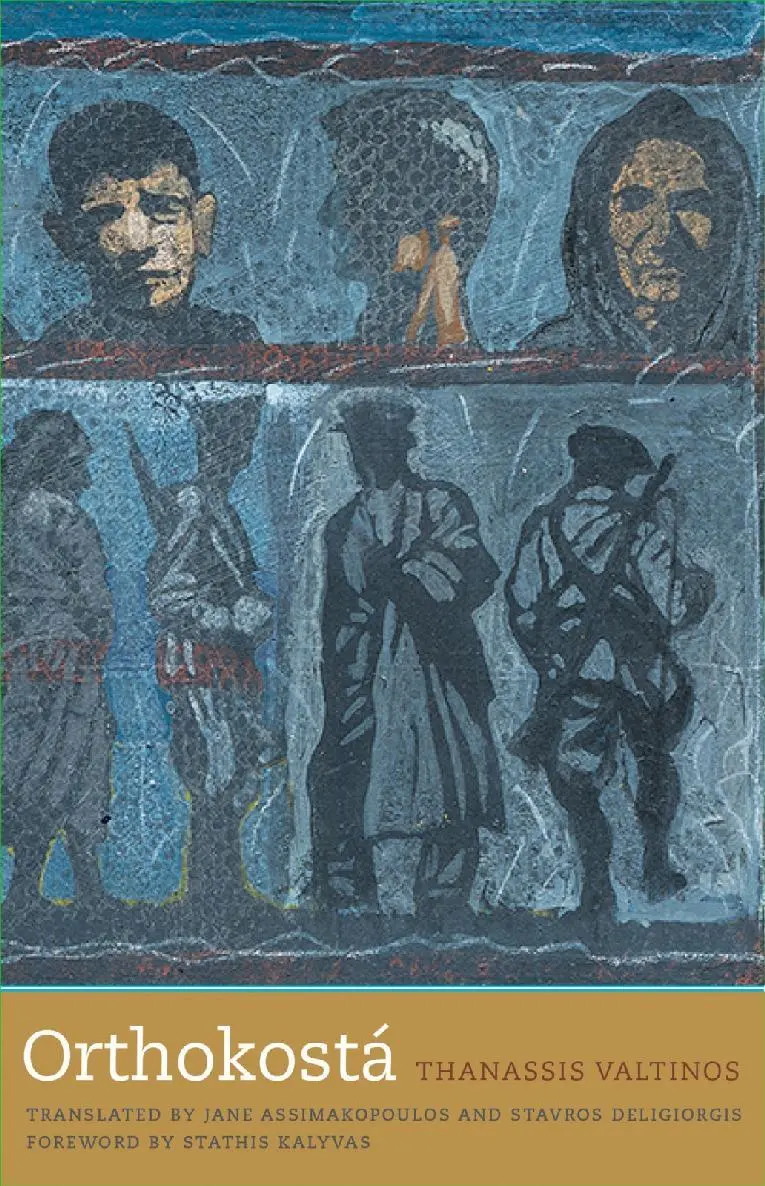
Thanassis Valtinos - Orthokostá
Здесь есть возможность читать онлайн «Thanassis Valtinos - Orthokostá» весь текст электронной книги совершенно бесплатно (целиком полную версию без сокращений). В некоторых случаях можно слушать аудио, скачать через торрент в формате fb2 и присутствует краткое содержание. Год выпуска: 2016, Издательство: Yale University Press, Жанр: Современная проза, на английском языке. Описание произведения, (предисловие) а так же отзывы посетителей доступны на портале библиотеки ЛибКат.
- Название:Orthokostá
- Автор:
- Издательство:Yale University Press
- Жанр:
- Год:2016
- ISBN:нет данных
- Рейтинг книги:5 / 5. Голосов: 1
-
Избранное:Добавить в избранное
- Отзывы:
-
Ваша оценка:
Orthokostá: краткое содержание, описание и аннотация
Предлагаем к чтению аннотацию, описание, краткое содержание или предисловие (зависит от того, что написал сам автор книги «Orthokostá»). Если вы не нашли необходимую информацию о книге — напишите в комментариях, мы постараемся отыскать её.
defied standard interpretations of the Greek Civil War. Through the documentary-style testimonies of multiple narrators, among them the previously unheard voices of right-wing collaborationists, Valtinos provides a powerful, nuanced interpretation of events during the later years of Nazi occupation and the early stages of the nation’s Civil War. His fictionalized chronicle gives participants, victims, and innocent bystanders equal opportunity to bear witness to such events as the burning of Valtinos’s home village, the detention and execution of combatants and civilians in the monastery of Orthokostá, and the revenge killings that ensued.
As a transforming work of literature, this book redefined established methods of fiction; as a work of revisionist history, it changed the way Greece understands its own past. Now, through this masterful translation of
, English-language readers have full access to the tremendous vitality of Valtinos’s work and to the divisive Civil War experiences that continue to echo in Greek politics and events today.
Orthokostá — читать онлайн бесплатно полную книгу (весь текст) целиком
Ниже представлен текст книги, разбитый по страницам. Система сохранения места последней прочитанной страницы, позволяет с удобством читать онлайн бесплатно книгу «Orthokostá», без необходимости каждый раз заново искать на чём Вы остановились. Поставьте закладку, и сможете в любой момент перейти на страницу, на которой закончили чтение.
Интервал:
Закладка:
— He was in the Organization. And as soon as he left, that’s when they turned against us.
— Hold on a minute. Kóstas was in the Organization?
— Yes. As a noncombatant. Not as a rebel. And when they realized that he didn’t want to stay with them, they began turning against us.
— I didn’t know that.
— They took Kóstas to perform an execution. They’d brought someone from some other village there, name of Nestorídis. They took him up to Zygós. And then Kapetán Kléarhos said to him, Braílas, let’s see what you’re made of. If you’re a fighter. He had a.45-caliber pistol. Hey, what did you just say, he tells him. Me kill people? What did you say? Is this what our struggle is about? Well, anyway. Kóstas got up and left, and they killed that man just like that, those horrid little rebels. He came back and he tells us, Tonight you’re leaving, it’s finished here. You’re leaving tonight. Imagine, telling me to leave that night. With my money, with my store, with my things. You get the picture. And I’ll take you there. He knew his way around and everything. But he stayed behind, in resistance to those rebels to collect some money, to take care of some business. And after that he got up and left. He came and joined us. Two months later. They didn’t manage to turn him into an executioner, and he became their worst nightmare. Because that was their method. To project an image of power, an image of strength. But of course the others did the same, now didn’t they? Absolutely. What else can I tell you?
Chapter 15
That was in 1946. Around then. Ten or so men come down here. I hadn’t fixed the house yet, it was just a shack. And right when I moved in there, I hear tap-tap-tap on the door. I grab a rifle I had. Who’s there, I say. Nighttime. Who’s there? It’s me, Mítsos. It was Mítsos Fotiás. What are you doing down here in Karátoula at this hour, Mítsos? Is that you, Loukás? It’s me. What do you want? He says, Listen, we’re looking for Panayótis Laganás. You know, Verémis. And why would you men be looking for him, I tell them. Well, anyway. I moved to the side and I knocked on my brother Tássos’s door. He opened it. Tássos, it’s me. He opened the door. I tell him, Listen, they’re looking for your brother-in-law Panayótis. But they have no right doing what they have in mind, I say. I tell them, Panayótis doesn’t live here, let’s go to his house. We went there, we knock on the door. Maria was there. She opened up. They want Panayótis. But even if he’s here, they can’t take him. Maria opened the door. Those men wanted to search through his storage trunk. I tell them, Hey, what do you think you’re doing here? Get the heck out before we all get killed in here. And they left. Mítsos Fotiás and Vasílis Kólias, who was still just a kid, God rest his soul. The men from Kastrí tried to get them to take revenge on the men from Karátoula. From Karátoula. And they saw I was strongly against that. For no reason, how should I put it, out of spite. And the next day they gave me a good talking-to. Why was I resisting them? Because Panayótis was in charge, EAM had forced him into it. Shame on you men, I tell them. But Nikólas was the head man then. Konofáos. Who it was that sent them I don’t know. But he was the leader. He and the Trýfonos brothers.
— Don’t go naming people and things, Loukás. It might stir up trouble again.
— Yeah, all right. But that’s the truth.
— It’s the truth, but why should people hear it from you?
— Yep, no reason at all. I’m done talking.
Chapter 16
Tzímis Boínis says to me, We have to take part in the Resistance and work for our country. I agreed immediately. The meetings were held in Ayios Vlásis. Beginning of 1943, in March. I called my friends, we went. Hotblooded men. We went to the country chapel. We asked where to find arms. It’s easy, Magoúlis tells us. Tzímis Boínis and Níkos Magoúlis. Seems they were the ones in charge. We knew they were Communists. But we didn’t know what communism was. They tell us, About the arms, it will all be taken care of. The next evening we went: Thanásis Kosmás, Tákis Pantazís, Mihális Tatoúlis. Lots of men. So we went, we were mostly concerned about getting arms. They tell us, We’ll take care of that. They’ll bring us arms, there will be drops by the British. On the third night, Tzímis Boínis says, We’ll also be working for the Party. What party, we say. We’ll be working for the Organization. For EAM, says Magoúlis. That’s what we’ll call the Organization. At the time we still hadn’t heard anything about it. And the party meant the Communist Party. We’ll try and bring in as many men as we can. Each of us will bring in two, three, ten men. As many as he can. I listened to this carefully. We left, I was upset. The next night I didn’t go. The other men went. They tell me, Antónis, you didn’t come. I tell them, No. I came for the Resistance. Not for the Party. When they took over in Kastrí, when they were in complete control, they arrested me. That was the reason. They came to my house at night. They tell me, We’re going to Mángas’s place. That’s where they had their headquarters. Langadianós’s brother was there. There were two of them. I don’t remember the other one. They took me to Mángas’s place. They already had a lot of men there, from Kastrí. And a few from Ayiasofiá. The next day they marched us over to Ayios Pétros. And from Ayios Pétros to Kastánitsa. A few men at a time, so we wouldn’t suspect anything. So we wouldn’t put up a fight. From Kastánitsa to Prastós. And finally to Orthokostá. To the monastery. And that’s where they interrogated us. The charge had already been prepared. We had been linked to Trípolis. To the Battalions that were being organized then. In April of 1944. I say to one of them, You’re in control everywhere and you bring us here. Why didn’t you interrogate us in Kastrí? And find us guilty, and hang us from the village plane tree? That’s exactly what I told him. He stood there, a man named Tóyias from Mesorráhi. He gave me a punch on the back of my neck. I’d never fainted before that. Everything went dark. Then he whacks me again in the face. That was all the beating I got. I don’t know about the others. The other prisoners. There were about a hundred of us, maybe more. The camp commander was Tóyias. There was someone else from Kastrí, Stratís Karadímas. The Braílas woman’s nephew. Later they said he was the one who killed her. And someone from Oriá, Goudontínos’s brother. Níkos. They were our guards. Fifteen of them all together. There were also five or six monks, we never saw them, they stayed somewhere separate. For a month they held us there. Then the cleanup operations began on Mount Parnon. They began letting a lot of men go. They freed them a few at a time. They kept us until the end, thirty-two of us. They took us up to the mountains, up near Ayios Vasíleios. Where a battle took place later on, in 1948. With LOK 1troops. They took us up to a riverbed, a closed-in space. Good place for a detention camp. We stayed out there in the countryside for three days. It was summer. We had Panayótis Polítis there with his clarinet. He played for us sometimes. Iraklís’s brother. We had Braílas’s mother there, still alive then, we had Maraskés from Roúvali. We had Themistoklís Anagnostákos. They were all executed. We had Thanásis Kosmás, and Vanghélis Koutsoúmbis. Vanghélis was a butcher from Oriá, our savior. We stayed there three days, we could hear the gunfire in the distance. The sporadic gunfire of an army on the march. Thanásis had been a cobbler on Mount Parnon. He could speak some Tsakónikan. 2It was July, ten o’clock at night, we’d gone to bed. We heard footsteps approaching. Army boots. It was Balís and Alímonos. Balís was a big-name kapetánios. Alímonos was an executioner. The most fearsome. They called him the Butcher. Did you hear them, Thanásis Kósmas says to me. Did you hear them? Whispering to me under the blanket. They were speaking Tsakónikan. What did they say, Thanásis? They said that the Germans are coming so they’re going to kill us all. That’s what they said. They’ll kill us and they’ll leave. Five minutes later they start shouting, Get your blankets and get up, we’re striking camp. And since you don’t know these parts at all, our men will take you out. Three at a time to slip through the German noose. We were in the front. These men here, says Balís. Take them and go down to the ravine. He showed them the place himself. Two rebels take us, me, Thanásis Kosmás, and Vanghélis Koutsoúmbis. It was dark out, no paths to walk on. They took us down there. They told us to stop. No one said anything. They were very anxious, those two, we could tell. We waited for some time. Finally they tell us, Stay right here. No one’s leaving. We’ll go back and see why the others are taking so long. And they went back. Then Koutsoúmbis says, I’m leaving. I’m a butcher, I know every inch of this terrain. There’s no road here. And he got up first. Thanásis got up and followed him. I was still hesitant. Don’t be stupid, they tell me, come with us. And I went. What happened after that we heard from Kalabákas. He died last year. Yiánnis Kalabákas. They said he was Alímonos’s koumbáros. No one knows. They took two more groups of three men down to the gully. And they began killing them. He dropped down and hid himself under Braílas’s mother’s skirts, pretended to be dead. Meanwhile, they were counting them up, one, two, three, etc. How many they’d killed. They figured out we were missing. Sons of bitches, their chief says to them, where are the rest of them? And they went looking all over trying to pick up our tracks. All that took place in that ravine, and Kalabákas told us about it two or three years later. But we had cleared out. Koutsoúmbis had taken us somewhere up high. He knew those parts well. Because he bought animals for slaughter from there. We spent our first night just outside of Kastánitsa, in the potato fields of someone named Kontoyiánnis. There was a shack in the middle of the fields. Kontoyiánnis was one of us, Koutsoúmbis knew him. We made our way to the shack. We went in, there was a rebel with a gun inside. As soon as he saw us he ran out. They had killed an ox somewhere, and he had a piece of that meat with him. He left it behind and cleared out. A little while later we saw Kontoyiánnis coming. We went outside. He’d come to water his potatoes. We ask him, Where should we go? He tells us, The Battalions are right above us, they’ve been there three days now. The Sparta Battalions. They had come around looking for a big pot to cook in. Go and find them. And he came with us. Up there to the company of those Security Battalions. It was the administrative division. They had captured fifty men or so and they had them roped together until they could determine whether or not they were rebels. They had captured Sioútos, Goudontínos’s brother, with his gun, his beret, all his things. Níkos Sioútos. Our guard in Orthokostá. And they were going to execute him. The captain takes us in front of him. He tells us, You’re not to speak. He asks him, Do you know these men? Yes I do. Where did you have them? In the detention camp. And why did you have them there? Because they were reactionaries. Then he let us free. They gave us cigarettes, they gave us food. We went off to get some sleep. There was a big rock off to the side, we slept there, like logs. Around three in the morning we hear shots, bam bam boom . We hear shouting. The rebel got away, he’s gone. We get up in a hurry. The officers come over, the captain and his staff. What happened? The rebel got away. He jumped down from the rock and ran off. From the big rock. We were sleeping off to the side, the guard was up above us, so was the rebel. It’s hard enough to jump with your hands free, says the captain. Even harder with them tied. This here’s a very high rock. So you men from his village must have untied him. He accuses us of untying him. And he sends us to the Germans. It was morning now. The Germans were higher up on a different peak. They had put up barbed-wire fences and they put all the men to be executed in there. They close us up in there. At about eleven we see the captain, running up the hill with his cap in his hand. He comes up to us, Listen you men, he says, all out of breath. That’s how we learned about Níkos Sioútos’s death. A German patrol killed him that night, with his hands tied behind him. Thank God I got here in time, said the captain. Or I’d have you on my conscience too. Then he went to the Germans and they let us free again. From there they took us to Aráhova. Meanwhile they had captured a big fish from Kynouría. The kingfish. Dr. Koúkos from Ayios Vasíleios. He wasn’t a combatant, he was a civilian. The cleanup operations were over, the so-called big blockade. They brought Dr. Koúkos down to Aráhova, a man from Corinth arrives. A meek, quiet man. Silent but very strong. Doctor, he says to him. I was there. I didn’t want to see all that but I did. My wife So-and-So, he says to him, the teacher at Kosmás, Kynouría, who killed her? You put her on trial and you killed her. Weren’t you the judge? With dates, particulars, everything. I’ve no idea, says Koúkos. A six-month-old child, he says, Doctor, who killed it? I don’t know if your wife was pregnant or if she had a six-month-old child. She was against them and they took her and killed her. And she was that man’s wife. I wish I hadn’t seen all that. At any rate, he hit him. He fell down. He pulled him back up and kept trying to find out who had condemned his wife to death and why. And he hit him again. Over and over. Until the Germans arrived and pulled the doctor away from him. And they sent the man away, so he wouldn’t finish off the doctor. A terrible beating. The Germans got rid of him, they sent him away. I don’t know if Dr. Koúkos died after that, I don’t know what became of him. I don’t know the rest of his story. We left. They let us go. And we split up there. Thanásis and Koutsoúmbis went to Trípolis. The Battalions followed. I left for the village. I went down to Yídas’s inn, and I arrived at Ayios Panteleímonas. Just below there Tákis Bínis’s mother-in-law was watering her vegetable plots. Tsakíris’s wife. She was bent over, she was redirecting the water with her hands. She didn’t have a shovel. I go stand over her. Good morning, Aunt Kásia, I say to her. It was morning. She stands up, she sees me. Good morning, she says, dumbfounded. And then she says, You’re alive. Yesterday they held the ninth-day memorial for you. I went to the village. I went to my house. I stayed there for two or three days. But there was still reason to be afraid. The rebels had started to show up again. My sisters tell me, Get out of here. I left and went down to Argos. We had an uncle there, our cousins were there. They all stood by me. How many months was it? Almost a year. The Germans left. The December Uprising began. Everyone was now heading for Athens. Papadóngonas’s cannons passed through. The ELAS Reserve troops came through. I met Panayótis Gagás in a kafeneío. Panayótis was a leftist. He’d gotten out of Haïdári. He was lucky. I was in Argos when the rebels first came there. We heard the church bells. The bells of the Virgin of the Clock tower. All the way from the castle you could hear it: The victors are coming. Panayótis Gagás says to me, Antónis, I know where the tide is heading. . The ideal system of government has arrived. Panayótis said that. I left. The December Uprising was over now. The ELAS troops were starting to collapse, the British were driving them away. They began coming through Argos again. One night it was raining heavily. At a certain moment I hear Thanásis Drínis shouting. Marínos. Marínos Aryirákis. He was calling my uncle. I was asleep in one of the rooms in the front. I recognized his voice, he stuttered. Marínos. Marínos Aryirákis. Everyone else woke up too. I tell them, He belongs to ELAS. He was in Athens and now he’s on his way back. He may be coming after me. My cousins tell me, go hide. Eighteen-, nineteen-year-old boys. My uncle says, Take the carriage out to the yard. They had a carriage, to go around their fields. Take it out, let it get wet, and you can hide underneath. Their house was big, it had a walled-in yard. The boys went down to open the stable, they dragged the carriage outside. I lay down underneath it. The rain was coming down in buckets. The man went inside. He wanted to sleep there, that’s what he wanted. Marínos, my friend, he says to my uncle. Can I stay here? OK, you can stay. They made up a bed for him in one of the rooms. He was out like a light. Started snoring straight off. My cousins come in. Hotblooded boys. Let’s kill him, they say. Let’s kill him and bury him in the garden. I tell them, He left his buddies behind. He left his comrades and he told them where he would stay. And tomorrow they’ll come after us, and kill us all. He slept, and he left the next morning. He left them an army of lice and went on his way. Because they’d given him clean clothes to wear. I stayed a few more weeks in Argos. Then I went back to the village. Things calmed down for a while. But not for long. I owe my life to Vanghélis Koutsoúmbis.
Читать дальшеИнтервал:
Закладка:
Похожие книги на «Orthokostá»
Представляем Вашему вниманию похожие книги на «Orthokostá» списком для выбора. Мы отобрали схожую по названию и смыслу литературу в надежде предоставить читателям больше вариантов отыскать новые, интересные, ещё непрочитанные произведения.


Обсуждение, отзывы о книге «Orthokostá» и просто собственные мнения читателей. Оставьте ваши комментарии, напишите, что Вы думаете о произведении, его смысле или главных героях. Укажите что конкретно понравилось, а что нет, и почему Вы так считаете.