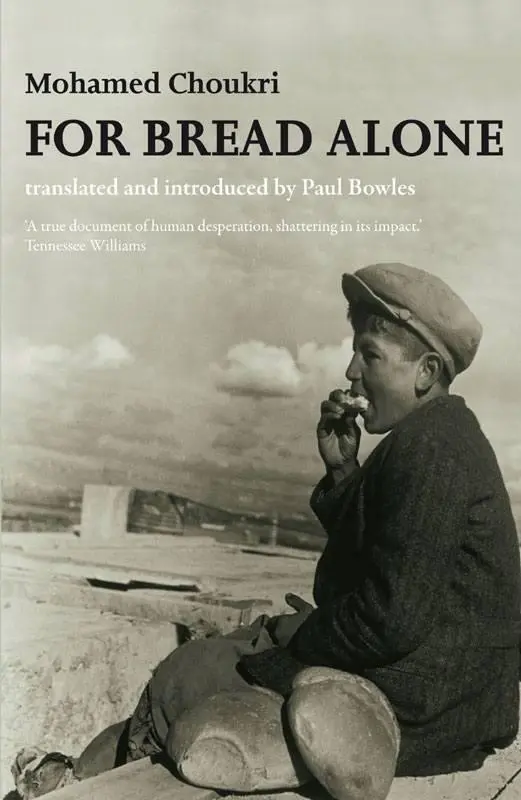
Mohamed Choukri - For Bread Alone
Здесь есть возможность читать онлайн «Mohamed Choukri - For Bread Alone» весь текст электронной книги совершенно бесплатно (целиком полную версию без сокращений). В некоторых случаях можно слушать аудио, скачать через торрент в формате fb2 и присутствует краткое содержание. Год выпуска: 2012, Издательство: Telegram Books, Жанр: Современная проза, на английском языке. Описание произведения, (предисловие) а так же отзывы посетителей доступны на портале библиотеки ЛибКат.
- Название:For Bread Alone
- Автор:
- Издательство:Telegram Books
- Жанр:
- Год:2012
- ISBN:нет данных
- Рейтинг книги:5 / 5. Голосов: 1
-
Избранное:Добавить в избранное
- Отзывы:
-
Ваша оценка:
For Bread Alone: краткое содержание, описание и аннотация
Предлагаем к чтению аннотацию, описание, краткое содержание или предисловие (зависит от того, что написал сам автор книги «For Bread Alone»). Если вы не нашли необходимую информацию о книге — напишите в комментариях, мы постараемся отыскать её.
On moving to another province Mohamed learns how to charm and steal, and discovers the joys of drugs, sex and alcohol. Proud, insolent and afraid of no-one, Mohamed returns to Tangiers, where he is caught up in the violence of the 1952 independence riots. During a short spell in a filthy Moroccan jail, a fellow inmate kindles Mohamed's life-altering love of poetry.
The book itself was banned in Arab countries for its sexual explicitness. Dar al-Saqi was the first publishing house to publish it in Arabic in 1982, thirty years after it was written, though many translations came out before the Arabic version.
Translated by
.
Mohamed Choukri Paul Bowles
The Sheltering Sky
For Bread Alone
The story of Choukri's life is continued in
.
For Bread Alone — читать онлайн бесплатно полную книгу (весь текст) целиком
Ниже представлен текст книги, разбитый по страницам. Система сохранения места последней прочитанной страницы, позволяет с удобством читать онлайн бесплатно книгу «For Bread Alone», без необходимости каждый раз заново искать на чём Вы остановились. Поставьте закладку, и сможете в любой момент перейти на страницу, на которой закончили чтение.
Интервал:
Закладка:
I was thinking that in the face of that locked door we were equally powerless, she and I. She’s Qaabil’s girl. And I’m his cargador , but one he still doesn’t trust. The idea came to me to go over and break down the door, but that would ruin everything: my friendship with el Kebdani, my affair with Sallafa, and the possibility of working for Qaabil and perhaps becoming as trusted a cargador as el Kebdani.
What are you thinking about? That’s enough thinking! Open the bottle.
I picked up the corkscrew.
I’ve got something to say to you, she went on.
I looked at her. What’s that?
Why don’t we leave Tangier? Run away together?
I looked harder at her. Where to?
Anywhere. Casablanca, for instance.
I thought of saying: What about your hair and eyebrows? But I was afraid of hurting her, so I said: And what would we do there?
Anything. All sorts of things.
I opened the bottle.
I’m not a skilled worker in anything, I said. And what would you do in a place like Casablanca?
I can do any kind of work, she declared.
I filled both glasses.
I could work as a maid with a French family, for instance. I have a friend named Fadila. She went to Casablanca. And in no time at all she found a job with a French family.
At this point I remembered what el Kebdani had told me the night before about how Sallafa became whenever she was separated from Bouchra. What about Bouchra? I asked her.
Oh, she’ll go with us too.
Is this girl out of her mind? I thought.
I see, I said brusquely.
She’s all right, objected Sallafa. What’s the matter with her? Don’t you think she’s all right?
I stared at her.
I didn’t say anything against her. I just asked you.
You don’t know her yet, she told me. When you get to know her, she’ll be just like your sister.
The way she is for you, I said to myself. I passed one of the glasses to her. She took it, and then held it out to my lips for me to drink from. At the same time, she directed the glass I held in my hands to her own lips. We drank slowly, our arms hooked. If I had broken down the door and gone out, I should not have had the pleasure of this moment. Never before had I drunk in this fashion with anyone. The expression in her half-closed eyes, plus a slight movement which she made towards me, said clearly that she wanted my lips. She began to give me, little by little, all the wine that was in her mouth. That also was something I had not experienced before. I am discovering all kinds of new things. This time it was I who led her into the bedroom.
We were already back in the sala when I heard the key turn in the lock. Farid el Atrache was singing: When will you return, love of my soul? Sallafa had been sitting pensively, listening, neither happy nor sad. I understand her only when she is laughing or quarrelling. It had been good in bed, better than yesterday, or so it seemed to me. Who knows what’s passing through her head at this minute? Perhaps she’s annoyed because I gave her no precise answer when she made her suggestion that we run away together to Casablanca. I watched el Kebdani come in, carrying a basket of food from the market. He seemed tired and depressed.
Ah, Qaabil! You’re back? I cried. He stared at me, and I began to stammer apologies.
I’m sorry. I was thinking of something else. What’s the news?
The news is bad. Terrible!
What? Kheir, insha’Allah!
He set the basket down in front of Sallafa.
Here. Qaabil says to fry all the fish.
She glared at him. Is this a time to be bringing back food for lunch? she demanded.
We were busy setting up a job.
I don’t care what you were busy doing. One of you could have brought the stuff back long ago.
Has something happened, or what? I asked el Kebdani.
It’s all clear now, he said. It was the Spaniards who engineered the riots. They hired the mob and brought it in from outside.
Ah, so what they said about el Merouani at the Café Chato was true, then.
Maybe. Who knows? All we know is that the Spanish started it.
I see! They used the anniversary as an excuse to start things, and then they used the Moroccans as pawns.
It looks that way.
That’s very bad.
We know dozens of people were killed, and yet only six or seven funeral processions have gone through the Zoco Chico on the way to the mosque.
And all the other bodies?
They must be hiding them so the public won’t see how many there are. Most of the ones who were killed are from out of town. That’s why it’s so easy for them to bury them in secret.
I thought for a moment. Then I said: Are they letting people walk freely around the city?
Yes, but there are guards everywhere. It’ll probably go on like this for several days. The soldiers are working hand-in-hand with the police. They search anybody they think looks suspicious, and take whoever they want to headquarters for a grilling.
Where’s Qaabil?
He went to his father’s house. Hasn’t Bouchra come back yet?
Not yet, Sallafa said. Why don’t you go and get her? She may be afraid to come back alone, with all the police and soldiers in the street. Go on, Kebdani, she coaxed.
I don’t know where her mother lives, he said.
In Dar el Baroud, near the Café Makina.
But I don’t know the house.
Ask anybody down there. There are always children playing in the street. They all know her.
Wait a while. She’ll be along. I tell you there’s nobody in the street to ask. In times like this nobody goes out unless he has to. And as for children playing in the street, I didn’t catch sight of one anywhere all morning.
Khlass! she cried. Come on! Life has suddenly changed? It’s the end of the world? Just say you don’t want to go. That would be enough.
That’s not true, he began.
Don’t try to talk!
After a moment she went on, but as if speaking to herself: I know what I’m going to do. I swear, if you find me still around here you can spit on me. You can piss on me!
Everything’s all set, he told me. Expect to work tonight. There’ll be three other cargadores going with us, and we’ll be using two cars, one to hold the stuff and the other for the men. I’ll be bringing the stuff in from the ship in a rowboat. You’ll be on the shore with the other three, and you’ll carry it up from the beach to the car. You’ll need all your strength, because you’ve got to move fast the whole time. And you’ll need your nerve. The Customs men may be there on the shore somewhere, or stop us at the edge of town. If that happens, you’re to do whatever either Qaabil or his partner tells you. You’ll meet his partner. The secret police could come up while you’re emptying the stuff out of the car, once you get to town. I like to tell you right out. The job is dangerous. It’s a job where anything can happen. They may shoot at us. You understand that?
Yes. I understand.
Sometimes the leader is able to bribe them. But usually they can’t get together on the amount, and that’s when the trouble begins. That’s the point when things begin to get rough.
How rough?
I mean they shoot it out.
So Qaabil has a pistol, I thought. That’s something to know. I must be very careful with Sallafa. What was there to stop him from firing on us both if he found us in bed together?
Has Qaabil got a gun? I asked him.
Ah! That’s none of your business. I’m just telling you what may happen. It doesn’t matter one way or the other to you and me whether Qaabil and his partner have guns or not. You understand?
I was just asking.
I tell you things I couldn’t tell any other cargador , he said.
I know. And thanks.
Читать дальшеИнтервал:
Закладка:
Похожие книги на «For Bread Alone»
Представляем Вашему вниманию похожие книги на «For Bread Alone» списком для выбора. Мы отобрали схожую по названию и смыслу литературу в надежде предоставить читателям больше вариантов отыскать новые, интересные, ещё непрочитанные произведения.












Обсуждение, отзывы о книге «For Bread Alone» и просто собственные мнения читателей. Оставьте ваши комментарии, напишите, что Вы думаете о произведении, его смысле или главных героях. Укажите что конкретно понравилось, а что нет, и почему Вы так считаете.