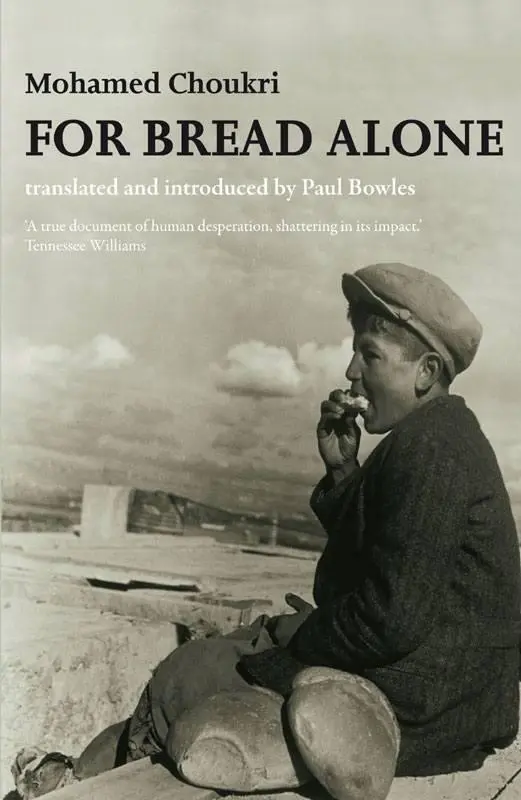
Mohamed Choukri - For Bread Alone
Здесь есть возможность читать онлайн «Mohamed Choukri - For Bread Alone» весь текст электронной книги совершенно бесплатно (целиком полную версию без сокращений). В некоторых случаях можно слушать аудио, скачать через торрент в формате fb2 и присутствует краткое содержание. Год выпуска: 2012, Издательство: Telegram Books, Жанр: Современная проза, на английском языке. Описание произведения, (предисловие) а так же отзывы посетителей доступны на портале библиотеки ЛибКат.
- Название:For Bread Alone
- Автор:
- Издательство:Telegram Books
- Жанр:
- Год:2012
- ISBN:нет данных
- Рейтинг книги:5 / 5. Голосов: 1
-
Избранное:Добавить в избранное
- Отзывы:
-
Ваша оценка:
For Bread Alone: краткое содержание, описание и аннотация
Предлагаем к чтению аннотацию, описание, краткое содержание или предисловие (зависит от того, что написал сам автор книги «For Bread Alone»). Если вы не нашли необходимую информацию о книге — напишите в комментариях, мы постараемся отыскать её.
On moving to another province Mohamed learns how to charm and steal, and discovers the joys of drugs, sex and alcohol. Proud, insolent and afraid of no-one, Mohamed returns to Tangiers, where he is caught up in the violence of the 1952 independence riots. During a short spell in a filthy Moroccan jail, a fellow inmate kindles Mohamed's life-altering love of poetry.
The book itself was banned in Arab countries for its sexual explicitness. Dar al-Saqi was the first publishing house to publish it in Arabic in 1982, thirty years after it was written, though many translations came out before the Arabic version.
Translated by
.
Mohamed Choukri Paul Bowles
The Sheltering Sky
For Bread Alone
The story of Choukri's life is continued in
.
For Bread Alone — читать онлайн бесплатно полную книгу (весь текст) целиком
Ниже представлен текст книги, разбитый по страницам. Система сохранения места последней прочитанной страницы, позволяет с удобством читать онлайн бесплатно книгу «For Bread Alone», без необходимости каждый раз заново искать на чём Вы остановились. Поставьте закладку, и сможете в любой момент перейти на страницу, на которой закончили чтение.
Интервал:
Закладка:
People run and shout. The rapid gunfire comes closer.
A Moroccan youth tried to crawl in with us. We pushed him away. Find another place! Yes, get out of here! There’s no room here for you.
Or stay out there where you are until they shoot you, I added.
Three other youths halted in their flight and stood still near us. The two taller ones helped the shorter one climb up onto the roof of a shop. Once he was up there, he looked around quickly and called down: Let’s get out of here fast!
The continuous gunfire was louder. A cry, and there is the thump of a body falling to the pavement.
They’ve got another, I said.
I’m listening and watching, he told me.
A policeman appeared, carrying a machine-gun. As he passed, the short youth uttered a cry, and leapt down on top of him from the roof. We both raised our heads above the booth. The policeman is lying face down, with the young man on top of him, hammering his head with his fist as if he were pounding a nail.
Do you know who that policeman is? said el Kebdani.
No.
That’s Inspector Barcia. His father’s Moroccan and his mother Spanish.
The youth rose and picked up the machine-gun that lay a few feet away. Jerkily he turned it this way and that, trying to understand how it worked. But it was no use. He had no idea.
The Inspector lay there unconscious.
Suddenly the young man raised the machine-gun with both hands above his head and, uttering an oath, threw it to the ground with all his might.
Inaal dinek!
Then another policeman appeared, firing one shot after another. The short youth spun around, crying out. The policeman fired again, this time hitting him in the belly. He fell and rolled into the gutter.
He got it in the back and front, I said.
I’m watching.
I’ve never seen a man shot before, I said. Only in the movies.
Well, now you’re seeing it before your eyes, said el Kebdani.
They must be killing people like this all over town.
What do you expect them to do?
El Kebdani’s forehead was covered with sweat.
Keep calm, I told him.
What are you talking about? he demanded. I don’t need your advice.
You’re trembling, though, I said.
I’m not trembling, he whispered furiously. Can’t you shut up? Do you want them to spill our guts here, like that one out there?
What a coward you are, I murmured.
All right. I’m a coward. But shut up.
A third policeman came into view, shooting one shot into the air. He helped the other one lift the Inspector from the ground where he had been lying. The other picked up the machine-gun and put the Inspector’s cap on his head for him. How do you feel? he asked him.
I’m all right. Just dizzy.
I got that dog, the policeman told him.
They walked over to the youth. One of them moved him with his foot. Then they turned and began to run down the hill towards the Zoco Chico.
Let’s get out of here, whispered el Kebdani.
Where to?
Anywhere. If they find us in here we’re finished.
There was the sound of more shots approaching.
Come on. Fast, he said.
I climbed out first. Look! The boy’s moving. He’s still alive!
Hurry! El Kebdani pulled me by the arm. Do you want them to get us too?
We saw the three policemen running down the Siaghines. And we ran down the Calle el Mansour. Halfway down the hill el Kebdani stopped. Wait a minute. I’ve got to piss.
I felt the need, too. As we stood there leaning against the door of a shop, people came running by. Ahead of us in the Saqqaya we saw a young man lurching along, leaning heavily to the right under the weight of the bag he was carrying. We’re in luck, said el Kebdani. Here’s Qaabil. We’ll go with him up to his shack at Sidi Bouknadel.
El Kebdani had often spoken about Qaabil and how he had worked for him as a cargador .
Is that the smuggler you told me about? I said. The one who has so much money?
That’s the one. He’s got enough to bury you and me from head to foot.
He doesn’t look as if he had a hundred pesetas in the world, I told him.
The little square was empty of people. Occasionally a few men ran across it in one direction or another.
Qaabil! cried el Kebdani.
Qaabil stopped walking and set the bag down on the pavement.
Where are you going? el Kebdani asked him.
To the shack. Come on with me. Sallafa’s there with Bouchra. I’ve shaved the dirty bitch’s hair and eyebrows.
Qaabil and I carried the bag between us as we climbed the steps in the direction of Amrah.
What’s going on? el Kebdani asked him.
I don’t know. When I came out of the bodega there was a lot of running around. I didn’t see anything more.
Didn’t you hear the shots?
I heard a few, but they were a long way off, and I couldn’t find out what was happening.
The police are shooting at the Moroccans, said el Kebdani.
What for?
It’s the thirtieth of March.
And what are the Moroccans fighting with? asked Qaabil.
Rocks. What do you expect them to fight with?
Are there many dead?
They’re shooting at everybody they see, if he’s a Moroccan.
A voice from behind us shouted: Clear the way!
A man was carrying a wounded friend on his back, while a third walked behind.
Who’s the friend with you? Qaabil asked el Kebdani. What does he do?
He used to sell soup and fish in the street, and he worked at a restaurant in the Zoco de Fuera.
Qaabil’s shack was built at the very edge of the high cliffs above the Sidi Bouknadel beach. One of its doors opened onto the cliff. The other gave onto an alley that led downward in the direction of Amrah. It was a real smuggler’s shack.
When we went in, Sallafa was groaning a song of Farid el Atrache’s: Forget him who forgets you, and don’t regret his loss . Her hair and eyebrows had been cleanly shaved with a razor, so that now she looked like a handsome boy. She wore a lightweight, black and white striped zigdoun . Bouchra was stretched out on the divan in a red and gold brocade caftan with a gauzy dfin over it. She had a sebsi in her hand. The girls put me in mind of the three days I had spent with Abdeslam and Sebtaoui at Sida Aziza’s house, back in Tetuan. I had a thousand pesetas in my pocket at that time, I thought. And today, holes in my pockets and no work.
A tajine of fish and potatoes sat on the taifor , ready to be served. Sallafa brought us the tas with a kettle of water and a cake of soap, so we could wash our hands. She nearly lost her balance while she was pouring the water for el Kebdani. When my turn came she smiled at me. She poured, smiled, and poured again, holding the kettle unsteadily. When she got to Qaabil she began to laugh. He seemed annoyed with her, and pulled the kettle away from her, crying: Let go of that, you dirty whore!
Always talking about your mother, she said.
He made as if to slap her. El Kebdani intervened, taking up the kettle and beginning to pour the water over Qaabil’s hands.
The next time I won’t just cut off your hair and eyebrows. I’ll drop you off the cliff out there.
Try it if you dare, she told him. Just try it, and we’ll see who goes over the cliff.
Aren’t you two ever going to stop? Bouchra cried.
The tajine was excellent, and very heavily spiced. We sat around the table afterwards, until five in the afternoon, mainly talking about the trouble in the streets as we drank our wine, smoked our kif , and listened to old records by Om Kaltoum.
I had already fallen asleep on the divan, when el Kebdani called out my name sharply. Mohamed! We’re going out. Stay here with the two girls until we get back. Go back to sleep if you like.
Читать дальшеИнтервал:
Закладка:
Похожие книги на «For Bread Alone»
Представляем Вашему вниманию похожие книги на «For Bread Alone» списком для выбора. Мы отобрали схожую по названию и смыслу литературу в надежде предоставить читателям больше вариантов отыскать новые, интересные, ещё непрочитанные произведения.












Обсуждение, отзывы о книге «For Bread Alone» и просто собственные мнения читателей. Оставьте ваши комментарии, напишите, что Вы думаете о произведении, его смысле или главных героях. Укажите что конкретно понравилось, а что нет, и почему Вы так считаете.