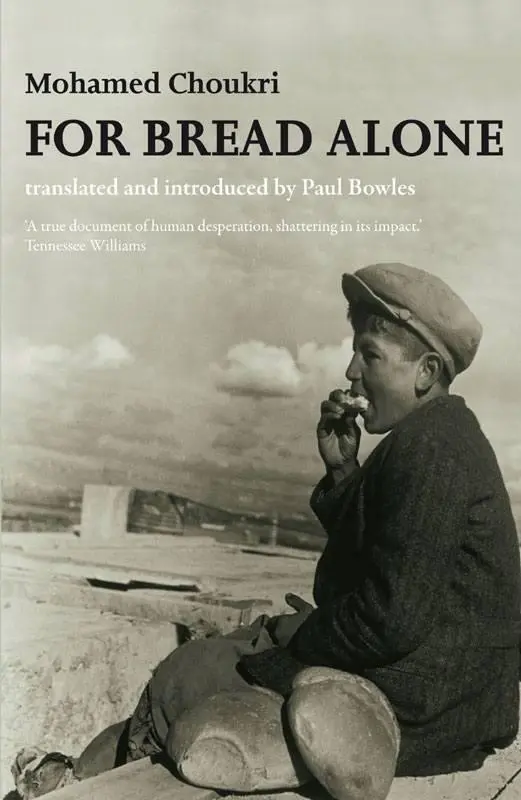
Mohamed Choukri - For Bread Alone
Здесь есть возможность читать онлайн «Mohamed Choukri - For Bread Alone» весь текст электронной книги совершенно бесплатно (целиком полную версию без сокращений). В некоторых случаях можно слушать аудио, скачать через торрент в формате fb2 и присутствует краткое содержание. Год выпуска: 2012, Издательство: Telegram Books, Жанр: Современная проза, на английском языке. Описание произведения, (предисловие) а так же отзывы посетителей доступны на портале библиотеки ЛибКат.
- Название:For Bread Alone
- Автор:
- Издательство:Telegram Books
- Жанр:
- Год:2012
- ISBN:нет данных
- Рейтинг книги:5 / 5. Голосов: 1
-
Избранное:Добавить в избранное
- Отзывы:
-
Ваша оценка:
For Bread Alone: краткое содержание, описание и аннотация
Предлагаем к чтению аннотацию, описание, краткое содержание или предисловие (зависит от того, что написал сам автор книги «For Bread Alone»). Если вы не нашли необходимую информацию о книге — напишите в комментариях, мы постараемся отыскать её.
On moving to another province Mohamed learns how to charm and steal, and discovers the joys of drugs, sex and alcohol. Proud, insolent and afraid of no-one, Mohamed returns to Tangiers, where he is caught up in the violence of the 1952 independence riots. During a short spell in a filthy Moroccan jail, a fellow inmate kindles Mohamed's life-altering love of poetry.
The book itself was banned in Arab countries for its sexual explicitness. Dar al-Saqi was the first publishing house to publish it in Arabic in 1982, thirty years after it was written, though many translations came out before the Arabic version.
Translated by
.
Mohamed Choukri Paul Bowles
The Sheltering Sky
For Bread Alone
The story of Choukri's life is continued in
.
For Bread Alone — читать онлайн бесплатно полную книгу (весь текст) целиком
Ниже представлен текст книги, разбитый по страницам. Система сохранения места последней прочитанной страницы, позволяет с удобством читать онлайн бесплатно книгу «For Bread Alone», без необходимости каждый раз заново искать на чём Вы остановились. Поставьте закладку, и сможете в любой момент перейти на страницу, на которой закончили чтение.
Интервал:
Закладка:
That’s just how I feel, too, I said silently to the maniac.
I wish I knew why I hate you so much, he went on. Now go out to the stall. Don’t let the kids steal from Khemou.
I was trembling as I went back down the stairs. I don’t want to be late to the cinema.
He’s tired. He’s been working very hard with me at the stall. She puts him off. Which is why I do not hate her as I do him.
I tiptoe carefully up to the roof. He is quiet now because he is filling his mouth. He eats like an animal. I tie the rope with which I am going to escape, and look behind me. His ghost is standing there.
Where are you going, damn you? Stay where you are.
Without hesitation I leapt out and caught hold of the thick electric cables that were strung along the street. I heard him yelling. His hands reach out into the emptiness to strangle me. I thought to myself: I knew all along this was going to happen. My intuition didn’t play me false.
You wait, you son of a whore!
Then he was not there. I looked down. It made me a little dizzy.
He’ll go out of the house and try to catch me as I fall, I thought. Then he’ll grind me to a pulp. He’s very bad tonight.
I breathed deeply, shut my eyes, and let myself drop, landing on top of a pile of stones and rubbish. As I ran my foot hit something alive and round.
My head! Who’s that? Grab him! Stop thief! Help!
Everything rolls and slides under my bare feet. I can tell the difference between melons or watermelons and human heads only when I hear someone cry out under my feet.
The night-watchman came towards me. Hey, you! Stop! Come here! The old Spaniard danced about as he shook his club at me. Come here, boy! Come here, damn you!
I turned to the left, hearing the watchman’s whistle. Someone’s ghost was running desperately behind me. Five or six figures moved in the background, gesticulating and pointing. I could hear their faint cries in the quiet street. I slowed down, but I was afraid one of them might take another alley, cut me off, and be standing there ahead of me, waiting. And it might be my accursed father. Again I began to run as fast as I could. I’ll keep running until I fall, I thought. Until I drop like a balloon that’s had a pin stuck into it.
In the cinema I lit a cigarette. From time to time I rubbed my bleeding feet with the tips of my fingers. I imagined my father coming towards me to seize my neck with his two powerful hands. He has become the villain in the film. As if I were breaking a feather between my fingers, I pulled the imaginary trigger. My father dies. The lead is cooling off in his heart and brain. And the blood runs from him as it runs, from the villain on the screen. His legs quiver for the last time. I see my father trembling as my hands tremble when I sit down to eat at his table. The man is dead now. My father is dead. This is the way I’ve always wanted to kill him.
From the cinema I walked to the Feddane and sat down on one of the stone benches. Many of them were occupied by visitors from the country, now asleep. There were also men from other cities who were passing through, and people who merely did not want to sleep at home, like me. Boys, youths and old men were sleeping all over the ground and on the benches like fish stranded on a beach. Every little while another arrived and lay down. He would move about for a bit in the spot he had chosen, getting himself comfortable, and then he would be quiet.
I had seventy-five pesetas on me, and I wanted to hide them. But where?
I folded the notes tightly and, taking care to see that no one was watching, buried them in the dirt behind my bench beside a rose-bush.
I slept. My father was chasing me. I felt a hand moving softly in my pocket, but I did not move. My eyes were half-open. It was a man, much older than I. I’ll let him look, unless he wants to do more than look. That would be another story. I changed my position so he could go through all my pockets. He stopped searching. I waited for him to start again, but he walked away. I catnapped and had reveries for the rest of the night. One dream finishes in Tetuan and another begins in Tangier. Still in Tetuan, but already in Tangier.
7
Already in Tangier, asleep again in a park. I had arrived that evening.
I awoke in a fright. The boy was shaking me by the shoulder and talking to me. Get up! Get up! A raid! The police are coming.
I felt in my back trouser pockets. The sixty pesetas were gone. As we ran, I said: They stole my money.
How much was it?
Sixty pesetas.
We slowed down. You’re lucky, he said.
We were both panting. What do you mean, lucky?
They didn’t rape you. When there are two or three of them, if they don’t find anything on you, they rape you.
What’s sixty pesetas? I thought. My arse is worth a lot more than that.
We were in the neighbourhood of the graveyard at Bou Araqia.
Where are we going?
Follow me and don’t talk. There’s nothing to worry about.
We walked into the world of silence. This was where my little brother Abdelqader had been buried after my father had killed him. When my father dies I’ll go to his grave and piss on it. I’ll make his tomb into a latrine.
We were walking over the graves, and we stopped in front of a walled-in family mausoleum. The boy leapt over the wall.
Jump. What are you waiting for?
I jumped. In a corner lay a pile of flattened cardboard boxes, and he began to spread them out on the ground.
Here’s your place, he told me. Then he made his own spot. I sat down and rested my elbows on my knees. Once he was comfortable, he said: Where are you from?
The Rif.
So you’re a Riffian, then?
That’s right.
And where are your people?
In Tetuan.
You all live there?
That’s right. We used to live here in Tangier, but then we moved to Tetuan.
Did you run away?
Yes.
So did I.
Where are you from?
Djebel Habib.
He’s a Djibli, then, I said to myself. Why did you run away?
He began to search in his pockets.
My father’s wife threw me out.
And your mother?
She died. He pulled out two cigarette butts. Before offering me one, he said: Do you smoke?
Yes.
He handed me one of the butts. I sniffed at it. Virginia tobacco. He brought out a box of matches and lit it for me. I inhaled a deep breath of smoke, and let it out. A delicious feeling of peace descended upon me.
Do you know Tetuan well? I asked him.
Not very. I ran away and came here after only about two months.
What does your father do?
He’s a street porter. And yours?
Nothing. He was in the Spanish army and he deserted. They caught him and gave him two years. He hasn’t worked since he got out of jail.
Who works in your family?
My mother. She sells fruit and vegetables in Trancats.
And you? What did you do?
Sometimes I worked for her at the stall and sometimes I had other work.
Why did you run away?
Because my father was always beating me up. Sometimes he’d hang me upside down from the branch of a tree and beat me with his soldier’s belt. That was when we lived in Aïn Khabbès.
My father beat me every time his wife told him to.
And what do you do here? I asked him.
I’m a street porter. What else do you expect me to do? After a moment of silence he said: I’m tired. I’m going to sleep.
It was about one in the afternoon when I went down to the port. I felt very weak. At one of the waterfront cafés I asked for a glass of water. Nearby was a stand that sold bean soup. Only one peseta, and I could have a bowl. But where to find the peseta? My life is not worth even one peseta now. After a few minutes of walking in the strong sun I began to feel sharp pains in my stomach. This sun will drive me crazy. I picked up a small fish that lay on the pavement, and smelled it.
Читать дальшеИнтервал:
Закладка:
Похожие книги на «For Bread Alone»
Представляем Вашему вниманию похожие книги на «For Bread Alone» списком для выбора. Мы отобрали схожую по названию и смыслу литературу в надежде предоставить читателям больше вариантов отыскать новые, интересные, ещё непрочитанные произведения.











Обсуждение, отзывы о книге «For Bread Alone» и просто собственные мнения читателей. Оставьте ваши комментарии, напишите, что Вы думаете о произведении, его смысле или главных героях. Укажите что конкретно понравилось, а что нет, и почему Вы так считаете.