Rafik Schami - Damascus Nights
Здесь есть возможность читать онлайн «Rafik Schami - Damascus Nights» весь текст электронной книги совершенно бесплатно (целиком полную версию без сокращений). В некоторых случаях можно слушать аудио, скачать через торрент в формате fb2 и присутствует краткое содержание. Год выпуска: 2011, Издательство: Interlink Books, Жанр: Современная проза, на английском языке. Описание произведения, (предисловие) а так же отзывы посетителей доступны на портале библиотеки ЛибКат.
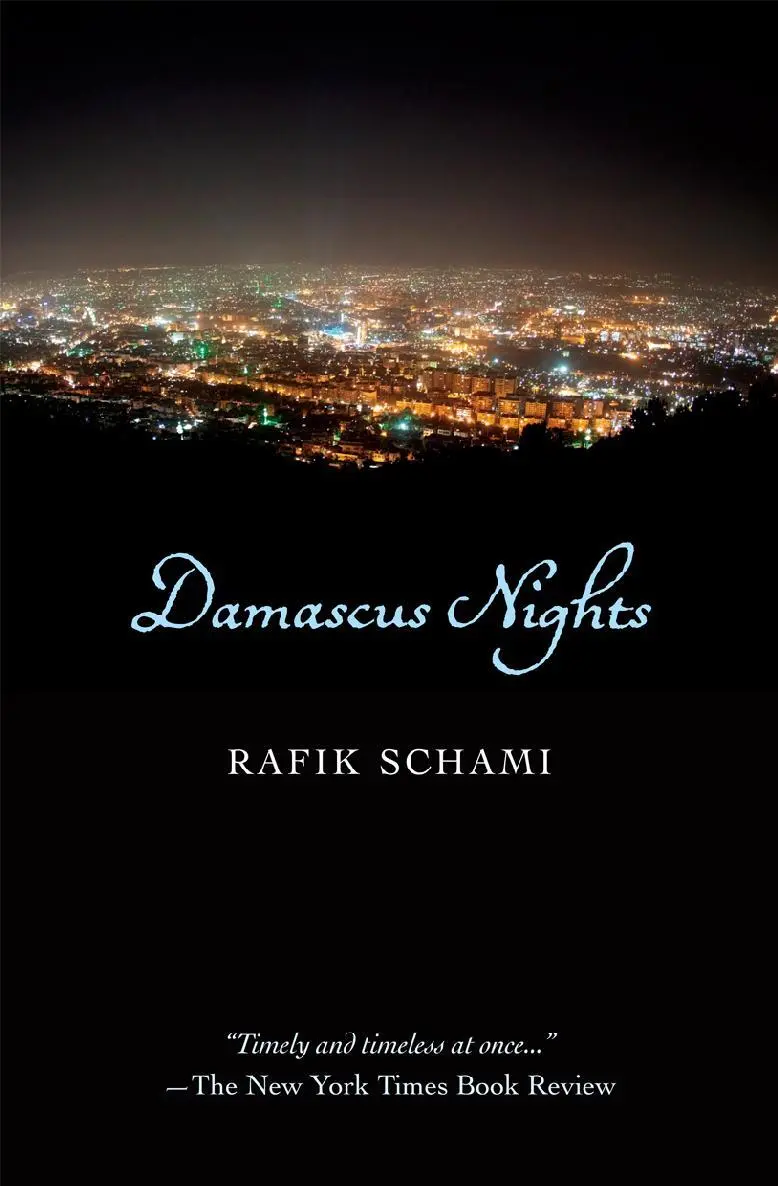
- Название:Damascus Nights
- Автор:
- Издательство:Interlink Books
- Жанр:
- Год:2011
- ISBN:нет данных
- Рейтинг книги:4 / 5. Голосов: 1
-
Избранное:Добавить в избранное
- Отзывы:
-
Ваша оценка:
Damascus Nights: краткое содержание, описание и аннотация
Предлагаем к чтению аннотацию, описание, краткое содержание или предисловие (зависит от того, что написал сам автор книги «Damascus Nights»). Если вы не нашли необходимую информацию о книге — напишите в комментариях, мы постараемся отыскать её.
Damascus Nights — читать онлайн бесплатно полную книгу (весь текст) целиком
Ниже представлен текст книги, разбитый по страницам. Система сохранения места последней прочитанной страницы, позволяет с удобством читать онлайн бесплатно книгу «Damascus Nights», без необходимости каждый раз заново искать на чём Вы остановились. Поставьте закладку, и сможете в любой момент перейти на страницу, на которой закончили чтение.
Интервал:
Закладка:
Fatma just shut her ears, took out her tin of tobacco, and carefully rolled a very thin cigarette.
Suddenly her mother was at her side, a midwife named Leila, who during her lifetime was known and feared. People said the most amazing things about her magical hands, with which she had brought many of the neighborhood children into the world. But the things they said about her magical stories were even more extraordinary.
No one dared make an enemy of her, for not only could Leila interpret dreams and stars, she was also adept at concocting poisons. Her unknown origins seemed spooky, mysterious, and her sudden disappearance even more so: for no one had laid eyes on her since the day of her daughter Fatma's wedding — it was as if she had dissolved into thin air. Only Fatma knew more, but she guarded this knowledge as her innermost secret.
"Daughter," this wise woman had told her when they parted, "you should know I'm not one of you. I put up with Damascus for eighteen years, until you grew up. And now you have found a good companion — Ali has a good heart. But don't forget: if you want him to listen to you, talk to him now, tell him all your stories, for men understand best while they are in love." Fatma's mother then walked away, ignoring all her daughter's pleas to wait just one more hour, until Ali returned from the mosque, to tell him goodbye. "Why goodbye?" asked the mother. "I'm leaving you behind. You are a part of my soul," she added, kissed her daughter, and left.
But Fatma couldn't bring herself to tell Ali any stories — neither on that first night nor in the next few days, nor in the days and years that followed. Ali seemed to her a little hard of hearing, and he rarely ever spoke, not even during their first night. She felt how much he loved her and how much he desired her. But he never said so. In general, he only said what was absolutely necessary, and that succinctly and quietly.
Fatma looked at the crabby old men snapping away at each other. What a brouhaha these old grandfathers were making just because she wanted to tell a story! And her Ali. . the look on his face when she told him that morning that she could tell Salim not one but fifty stories! "Can you do it well enough?" he had asked her. "Why don't you first tell it to me, so that I can hear whether your story is worthy of my friends." That's right, "worthy"! He, who had no idea about telling anything, was acting like the master hakawati, wanting to test her, the daughter of Leila.
But it's also true that she herself had become less and less talkative over the years. While every new birth had brought new life into the house, instead of speaking more to each other, Fatma and Ali said less and less. Her sister, Rahima, reported the same thing, and her husband, unlike Ali, was the talkative type. Why is it that people tell fewer stories to each other the longer they're together, and not more? Fatma thought about it. Then she remembered her mother's words from fifty years before. 'That's it," Fatma whispered to herself, "married couples talk to each other less and less because they're no longer in love."
As a matter of fact, just a few years into the marriage, Fatma had even started to stammer whenever Ali came back from the shop — yet she spoke easily with children or neighbors. She was always afraid he would find her stories silly. It was different with Salim. Whenever he visited she never stuttered; she always knew how much he liked her stories.
Salim interrupted her thoughts to hand her some peppermint tea. She looked up, took the tea, and followed the quarrel with obvious disinterest. The faces of the old men were sour and severe.
"I'm going to drink my tea and go," said Fatma. "You must forgive me for saying that your reception is not worthy of my story. You can't tell anything to people with faces as twisted as yours." Fatma closed her eyes. "No!" she said very quietly. "By the soul of my mother, if you don't come right out and beg me for the story then I am going to leave."
Ali trembled: he had never heard Fatma use such a harsh tone. Salim, on the other hand, beamed, as if Fatma's words were a bouquet of a thousand and one flowers. He stood up and kissed her on the forehead. This was the first time the coachman had ever kissed her in over fifty years of friendship, and his cheeks glowed when Isam said, "Ah, if only I were Salim! If Fatma would accept a kiss like that from me I would be prepared to go for a year without saying a thing."
Ali smiled, relieved.
"Well… if it will help Salim, I have nothing against it," the minister — the chief dissenter — finally said, smiling. The teacher, the barber, and, lastly, Junis followed suit.
"Well let's get on with it," Isam bellowed.
"May all quarrels be damned in the grave. It's already half past nine," added Tuma.
Fatma declined to gloat over her victory, and in the ensuing moments just sipped her tea in peace and quiet.
"Tell us your story, please!" begged the barber.
"I will tell you all a beautiful story about the Egyptian witches," she said, and a shy smile briefly adorned her face.
"It's up to us, if I may observe," the teacher grumbled, "to decide whether it's beautiful or not."
"Would you be quiet!" Isam shouted at the teacher.
"I will tell it so that you may be cured, Salim, and so that it may give you joy. God grant a long and happy life. . only to him who listens well," Fatma continued. "Many many ages ago there was a very smart witch named Anum. She lived in ancient Egypt long before the first mummies and pyramids. She was the first woman allowed to study with the great priest Dudokhnet and learn alchemy, beer brewing, and papermaking. When the priest lay on his deathbed, he named Anum as his successor — For,' so he explained to the priests gathered around him, 'she alone will succeed in finding the philosophers stone—' "
"I know this story," the minister interrupted. "First the pharaoh refuses but then assigns Anum seven difficult tasks. And she solves all seven, right?"
"Yes," answered Fatma.
"And does she find the philosophers stone?" Isam wanted to know.
"Yes she finds it," the minister said. "And whoever so much as licks a particle of its dust becomes a genius, right? The pyramids were built by architects who swallowed a tiny pearl of it, no bigger than a lentil. The bees used to smear their honey everywhere before the Egyptians taught them to use wax for honeycombs and…"
Salim shook his head angrily and glared at the minister. Faris halted and turned to Fatma. "Oh, I beg your pardon! I interrupted you!"
"No matter," said Fatma, but the old coachman tasted gall in her voice. "Your Excellency may know this tale, and a hundred others, but no one on this earth has heard the following story, not even my Ali. So either listen or let me go home!"
"For God's sake!" the barber cried out. "Tell it, please, Fatma, tell it!"
"Once upon a time there was a young woman whose name was Leila. She herself was neither beautiful nor ugly, but her tongue was blessed, just like our Salim's tongue has always been and hopefully will soon be again.
"In any case, Leila lost her parents at a young age and from then on lived with her grandparents in a mountain village in the north of Yemen. Even as a little girl Leila loved hearing stories, and whatever she heard once she kept in her heart forever. Nothing in the world could make her forget a story. Well, while the other young women made themselves up every day and sauntered over to the village well, ever on the lookout for men, Leila's only interest was her stories. The strongest man in the village was less attractive to her than a tiny fable, and the most handsome man could not possess her heart even for the length of a brief anecdote. Leila spared no effort to hear a new tale, even if it meant days of travel across dangerous mountains and treacherous steppes.
Читать дальшеИнтервал:
Закладка:
Похожие книги на «Damascus Nights»
Представляем Вашему вниманию похожие книги на «Damascus Nights» списком для выбора. Мы отобрали схожую по названию и смыслу литературу в надежде предоставить читателям больше вариантов отыскать новые, интересные, ещё непрочитанные произведения.











Обсуждение, отзывы о книге «Damascus Nights» и просто собственные мнения читателей. Оставьте ваши комментарии, напишите, что Вы думаете о произведении, его смысле или главных героях. Укажите что конкретно понравилось, а что нет, и почему Вы так считаете.