Anne Korkeakivi - Shining Sea
Здесь есть возможность читать онлайн «Anne Korkeakivi - Shining Sea» весь текст электронной книги совершенно бесплатно (целиком полную версию без сокращений). В некоторых случаях можно слушать аудио, скачать через торрент в формате fb2 и присутствует краткое содержание. Год выпуска: 2016, Издательство: Little, Brown and Company, Жанр: Современная проза, на английском языке. Описание произведения, (предисловие) а так же отзывы посетителей доступны на портале библиотеки ЛибКат.
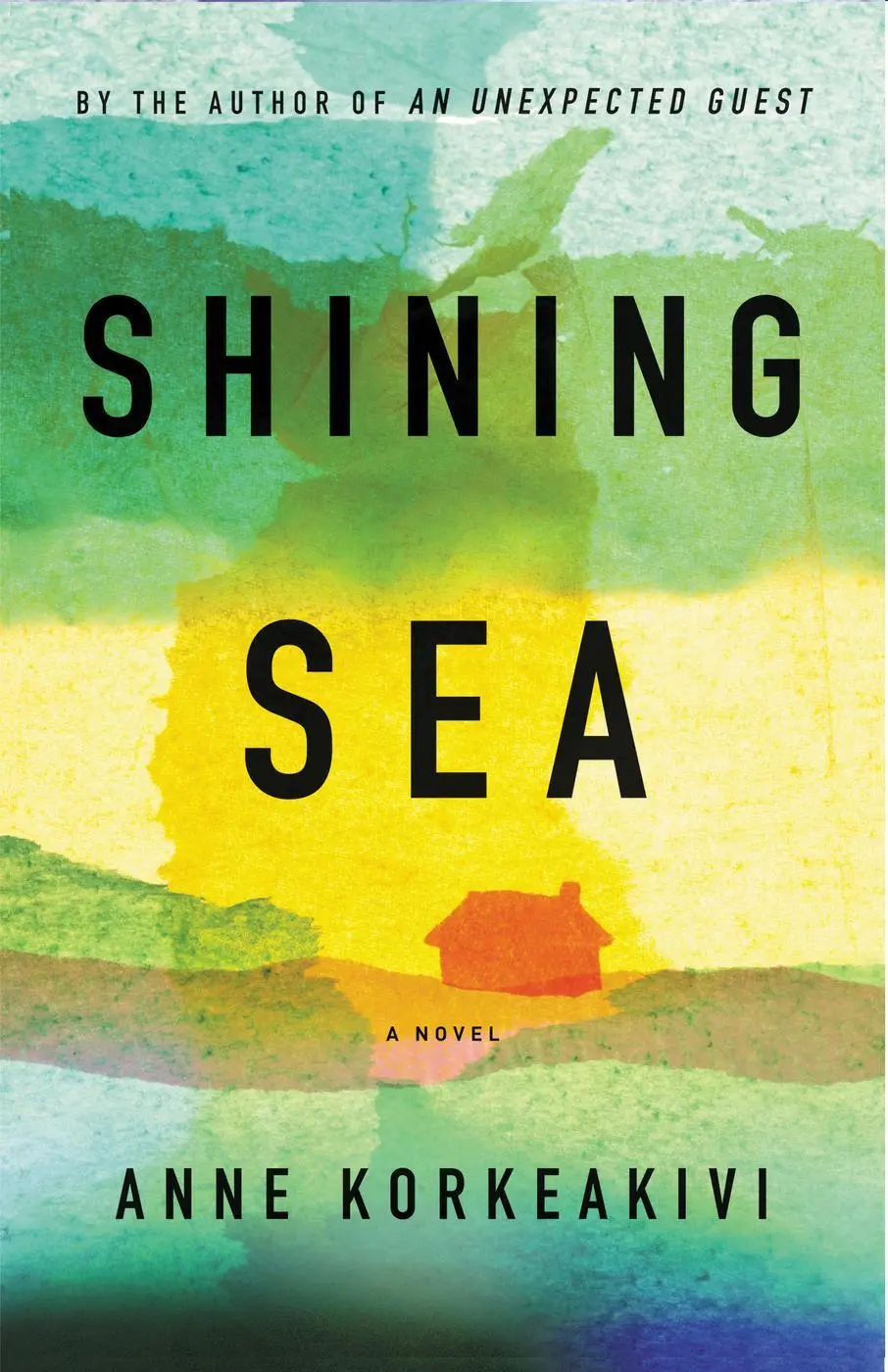
- Название:Shining Sea
- Автор:
- Издательство:Little, Brown and Company
- Жанр:
- Год:2016
- ISBN:нет данных
- Рейтинг книги:5 / 5. Голосов: 1
-
Избранное:Добавить в избранное
- Отзывы:
-
Ваша оценка:
Shining Sea: краткое содержание, описание и аннотация
Предлагаем к чтению аннотацию, описание, краткое содержание или предисловие (зависит от того, что написал сам автор книги «Shining Sea»). Если вы не нашли необходимую информацию о книге — напишите в комментариях, мы постараемся отыскать её.
Shining Sea — читать онлайн бесплатно полную книгу (весь текст) целиком
Ниже представлен текст книги, разбитый по страницам. Система сохранения места последней прочитанной страницы, позволяет с удобством читать онлайн бесплатно книгу «Shining Sea», без необходимости каждый раз заново искать на чём Вы остановились. Поставьте закладку, и сможете в любой момент перейти на страницу, на которой закончили чтение.
Интервал:
Закладка:
“I’ve heard of windsurfing,” he says. “I meant the guy.”
“De Rosnay? A Frenchman. Ghislaine’s family is friendly with his family. She’s been sailing with him. He took this mad ride alone over a great stretch of sea — he has the idea of windsurfing between hostile countries as a symbolic bridge between them. Sport, the arts — ways to find connections between people. I hear he’s planning to take on China and Korea next autumn. Ghislaine was explaining this, and I thought: Why not rowing?”
“But you said the idea came to you over breakfast this past December.”
“That’s when I figured out how precisely to use it. I was searching for Ghislaine’s number before my coffee was cold.”
Eamon appears in the doorway, filling it with his large frame. Drops of wet from his hair trickle down his neck.
“Your turn,” Rufus says. “Get in there and scrub.”
He pushes his chair back. Sports, the arts. Music, for example. Yes, a little bit of him is starting to feel proud to be part of this. Not just a body.
* * *
They wake later than usual the next day, sun filtering through the windows. This last stretch is one of the longest and most difficult, but after talking with locals and consulting his tide charts, Rufus had decided they wouldn’t leave until 8:00 a.m.
“We’ll be halfway into the ebb tide,” Rufus explains as they begin the now-familiar tasks of fastening their life jackets, settling onto their benches. “We’d have just tired ourselves out trying to fight our way across if we’d left earlier.”
He takes his accustomed place behind Ghislaine. His hands are still raw, and he fondles the end of his oar tenderly before committing himself to gripping.
They row in silence but for the sound of their oars dipping into the waters. The morning sun is soft, almost hazy. An inshore trawler passes them on its way back to the docks, its sides decorated with faded red buoys of different sizes. On its deck, a fisherman bends over nets full of prawn. Behind the helm, a second fisherman cups his hands and calls something out to them, but the words are lost between the cries of the seabirds. They raise their hands and wave.
“Are we goin’ to stop at Rathlin?” Katie asks.
“Do you know Rathlin?” Rufus says. “Have you been there?”
“No,” Katie says. “Just wonderin’.”
They row out of the trawler’s wake. “We’re going to keep to the west as much as possible, with Rathlin Island to our port side, to avoid the worst of the MacDonnell tidal race,” Rufus says. “Once we get past Rathlin, a flood stream will bring us back east, down into Ballycastle. We’ll cross those last six miles in a heartbeat.”
Before long, they’ve left the coast of Islay behind. Low-lying clouds have moved in, and the sky has darkened so much that even he, with his sharpshooter eyesight, has trouble making out anything beyond the shape of the island.
“Looks stormy,” Ghislaine says, her voice sounding tight.
Katie studies the sky. “Weather changes more quickly on the islands than a baby’s temperament.” She looks down at her hands. “This will be the first time for me.” Their oars trip-trip-trip through the water. “Where’er we land now, be it Rathlin or Ballycastle. That will be ma first time out of Scotland.”
“You’ve never even been to England?” Ghislaine says.
“I don’t know what’s so ‘even’ about it. You’d ne’er been to Iona, had you?”
“The Northern Irish are good people,” Rufus says, “when they aren’t killing each other. They aren’t so different from the people you’d meet in Scotland.”
“Not to the eyes of an Englishman,” Eamon mutters.
“They do talk quite a bit,” Rufus says. “Our friend Eamon here being something of an exception.”
A fine rain has begun to fall, a delicate whisper across his face. It feels fresh. He’s worked up a sweat, pulling against the sea. The water seems unusually heavy this morning, like a swirling, viscous pot of heated tar — something he once spent some time on a job stirring. At least the sea smells better, salty and green.
“Ma ma’s family,” Katie says, “were Irish Scots. Her grandfaither come to Glasgow, and met ma grandmaither while she was boardin’ for school.”
“Where’s your mother now?” he says. “Is she in Glasgow?” Katie’s situation has bothered him since the start of their trip. In a way, it’s been bothering him since he first saw her standing behind the counter in the general store, that stern round face, the strong black coffee in a pot before her. Maybe this crazy journey looks different to a seafarer like her father. But that doesn’t explain her being left to run the store.
Katie stares into the water. “On the island.”
Could he have met her mom? He thought he knew pretty much everyone out and about on the island. Or is she truly bedridden, as he initially thought? It’s hard to think of any other explanation for Katie’s independence. “What’s her name?”
“Muira,” she says moodily.
If he could just shove the question right back into his mouth.
Worse, he can’t even remember which one is Muira. He never could remember which one is Muira.
“She and ma da are taking a bit of a break, what’s all,” Katie says. “They had me when ma ma was barely seventeen. He says she’s going through a midlife crisis already now, cause she started grown-up life younger.” She sticks her chin out. “They’ll be back together, and she’ll be back at the shop. It’s just one of those stupid things grown-ups get up to.”
The clouds have gathered darker and deeper, like gray cotton batting in a giant’s hand. He scans the sea for anything. A bird, a shoreline. There’s nothing to be seen but shades of gray to one side and what looks like a curtain of black to the other.
“I’m sorry,” he says.
Katie doesn’t answer.
The first drops fall, small and uneven. The wind begins to pick up.
“Dirty weather,” Eamon says.
“This doesn’t look good,” Ghislaine says. She stops rowing long enough to pull the hood of her rain jacket over her hair. “Maybe we should head for the Kintyre peninsula. That’s the mainland over there, isn’t it?”
“Rathlin is equally close,” Rufus says. “Or at least it should be. It’s hard to see anything in this weather. Can you, Francis?”
He pulls his oars out of the water and this time takes a good look in every direction. In the distance, a bolt of lightning lights up a shadowless expanse of sea just for an instant, but nothing else. “No.”
“Okay. The compass says we’re headed straight for the western tip of Rathlin. We’ll miss the worst of the MacDonnell tidal race and find someplace to land there.”
It’s disconcerting rowing through the heavy mist, unable to see the various shorelines that have accompanied them at a distance throughout the journey. At least the rain remains tentative. Maybe the worst of the storm won’t pass by their corner of the Atlantic.
“Francis,” Rufus says. “You never told us where in America you grew up.”
He understands Rufus is trying to distract them from the possibility of being caught in the worst of the storm before they can get to Rathlin, but he can’t offer up his past for the purpose. “You never told us anything about your family.”
“That’s true. But Eamon knows them. Ghislaine has met them.”
“They’re very nice,” Ghislaine says.
Rufus laughs. “ You’re very nice.” After a few more strokes, Rufus adds, “My grandfather was in the trenches in France during the Great War. He came home with only one hand and half a heart.”
“Jesus,” Katie says. “How can you live with only half a heart?”
Читать дальшеИнтервал:
Закладка:
Похожие книги на «Shining Sea»
Представляем Вашему вниманию похожие книги на «Shining Sea» списком для выбора. Мы отобрали схожую по названию и смыслу литературу в надежде предоставить читателям больше вариантов отыскать новые, интересные, ещё непрочитанные произведения.








Обсуждение, отзывы о книге «Shining Sea» и просто собственные мнения читателей. Оставьте ваши комментарии, напишите, что Вы думаете о произведении, его смысле или главных героях. Укажите что конкретно понравилось, а что нет, и почему Вы так считаете.