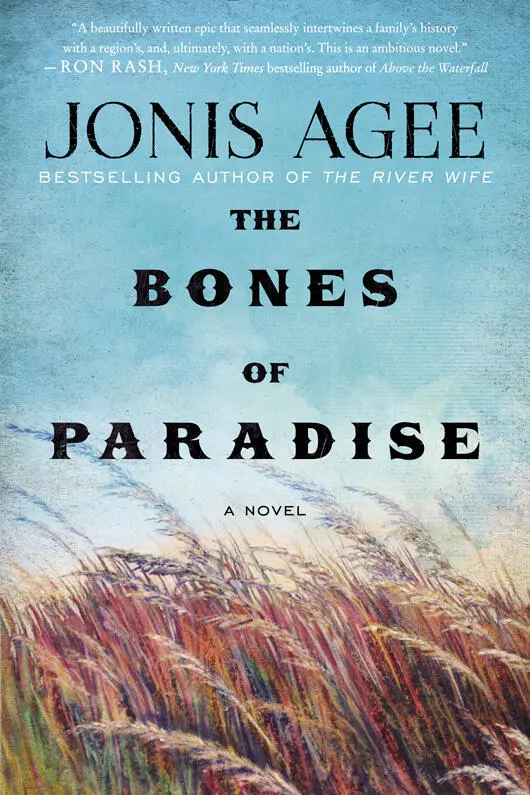
Jonis Agee - The Bones of Paradise
Здесь есть возможность читать онлайн «Jonis Agee - The Bones of Paradise» весь текст электронной книги совершенно бесплатно (целиком полную версию без сокращений). В некоторых случаях можно слушать аудио, скачать через торрент в формате fb2 и присутствует краткое содержание. Год выпуска: 2016, Издательство: William Morrow, Жанр: Современная проза, на английском языке. Описание произведения, (предисловие) а так же отзывы посетителей доступны на портале библиотеки ЛибКат.
- Название:The Bones of Paradise
- Автор:
- Издательство:William Morrow
- Жанр:
- Год:2016
- ISBN:нет данных
- Рейтинг книги:3 / 5. Голосов: 1
-
Избранное:Добавить в избранное
- Отзывы:
-
Ваша оценка:
The Bones of Paradise: краткое содержание, описание и аннотация
Предлагаем к чтению аннотацию, описание, краткое содержание или предисловие (зависит от того, что написал сам автор книги «The Bones of Paradise»). Если вы не нашли необходимую информацию о книге — напишите в комментариях, мы постараемся отыскать её.
returns with a multi-generational family saga, set in the unforgiving Nebraska Sandhills in the years following the massacre at Wounded Knee—an ambitious tale of history, vengeance, race, guilt, betrayal, family, and belonging, filled with a vivid cast of characters shaped by violence, love, and a desperate loyalty to the land. Ten years after the 7th Calvary massacred more than 200 Lakota men, women, and children at Wounded Knee, J. B. Bennett, a white rancher, and Star, a young Native American woman, are murdered in a remote meadow on J. B.’s land. The deaths bring together the scattered members of the Bennett family: his cunning and hard father, Drum; his estranged wife, Dulcinea; and his young sons, Cullen and Hayward. As the mystery of these twin deaths unfolds, the history of the dysfunctional Bennett’s and their damning secrets are revealed exposing the conflicted heart of a nation caught between past and future.
At the center of
are two remarkable women. Dulcinea, returned after bitter years of self-exile, yearns for redemption and the courage to mend her broken family and reclaim the land that is rightfully hers. Rose, scarred by the terrible slaughters that have decimated and dislocated her people, struggles to accept the death of her sister, Star, and refuses to rest until she is avenged.
A kaleidoscopic portrait of misfits, schemers, chancers, and dreamers, Jonis Agee’s bold new novel is a panorama of America at the dawn of a new century. A beautiful evocation of this magnificent, blood-soaked land—its sweeping prairies, seas of golden grass and sandy hills, all at the mercy of two unpredictable and terrifying forces, weather and lawlessness—and the durable men and women who dared to tame it. Intimate and epic,
is a remarkable achievement: a mystery, a tragedy, a romance, and an unflagging exploration of the beauty and brutality, tenderness and cruelty that defined the settling of the American west.
The Bones of Paradise — читать онлайн бесплатно полную книгу (весь текст) целиком
Ниже представлен текст книги, разбитый по страницам. Система сохранения места последней прочитанной страницы, позволяет с удобством читать онлайн бесплатно книгу «The Bones of Paradise», без необходимости каждый раз заново искать на чём Вы остановились. Поставьте закладку, и сможете в любой момент перейти на страницу, на которой закончили чтение.
Интервал:
Закладка:
Drum arrived at dusk one evening, standing in the stirrups so the horse’s jarring trot wouldn’t pound his back and hips. He courteously stopped and dismounted far enough from her tent and fire that she was not disturbed. But when he stood in front of her and let his eyes sweep her figure, she felt shame, as if she didn’t measure up.
“Here we are again,” he finally said with a slap of his reins across his palm. He sounded tired, and his wolf white-blue eyes glinted like mica as they took in her tent and her hobbled horse grazing nearby. “Having a time, aren’t ya? Picnic? Campout?”
She remained silent.
“Got nothing to say, do you. We’re going round the same ole mulberry bush.” He put his hand on the butt of his revolver. “You’re like a dog keeps coming back where it’s not wanted.” He slipped out the gun and let it hang in his hand between them.
She should have been afraid, but she wasn’t. “Where’s Cullen?”
“By God, I’ll burn this place down if you don’t keep away!” He raised the pistol and pointed it straight at her.
She shrugged and moved so close she could lift the gun he held and press the barrel against her heart. When she smiled, he shrank back, and the gun trembled in his hand. “You’re crazy.”
She raised her eyebrows and smiled again. “I’m going to have him back.”
“You’ll get nothing. I’ll finish off the lot before I let you touch any one of them.” He spit to the side, as if he could rid himself of the bitter taste. “You don’t care nothing about yourself, but your men are another matter. Keep that in mind. They might not get themselves kilt, but there’s a world of hurt they can be in unless you stay off Bennett land.”
That was the problem. She couldn’t be sure that Drum Bennett wouldn’t cripple his own to prove a point. He couldn’t kill her, it wasn’t in him to hurt a female for some reason, but males were another matter. As she watched him mount his horse and ride away, she thought it might be a relief to be done rather than continue living like a ghost, haunting the lives of loved ones, unable to reach out and touch them. Maybe she was going crazy. She packed up and left after that, hadn’t seen Cullen since.
The last time she saw J.B. was during the warm spell in March when she rode down to Babylon to arrange the surprise shipment she’d bought for her husband and sons. They met in the room that was always reserved for the Bennetts at the hotel. For once their argument was halfhearted and they ended seated side by side on the bed. She traced the lines on his forehead with a finger and teased him about his sore tooth. For the first time in years, there was playfulness between them instead of grief and sadness at the separation. He asked, “Can you forgive me?”
“When you bring Cullen home,” she said. Unlike the other times she’d made this request, he nodded. Then a spring blizzard came through and nobody could get out. April was cold and rainy, travel was hard. Finally May arrived, bright and fresh, and there was no more waiting. J.B. would bring her son home, she knew it.
He was especially busy this time of year with calving and culling, branding and fencing. Ten years ago, when they first separated, they sent coded telegrams, full of anger and threats and cajoling. That stopped after a while. God, she missed him. She couldn’t believe it was years now since she left. Years that old man had held her family hostage. This year, she vowed, this year she would put a stop to it. Soon as the Kentucky Thoroughbred horses she’d bought for her husband and boys arrived, she’d tell J.B. the whole story and let him deal with his father in his own way. She planned the horses as a gesture of hope to bring their family together again, to signify her return and . . . and she didn’t know what . . . She’d made the purchase on impulse and now it seemed foolish. She folded her arms and glanced out the window.
The American flag on the tall pole outside swayed in the wind as thin clouds skimmed the flat blue sky, causing waves of shadows to roll across the grass like the edge of a hand sweeping crumbs from a table. She walked over, unlatched the window, and turned back to the class. She wanted to invite them to climb outside and run through the new grass with her, as she would soon do on the ranch. She had felt a kind of wildness all morning, an anticipation. Something was coming toward her and she felt the urge to run.
“Mrs. Bennett?” A senior teacher poked her head in the doorway. Dulcinea turned and noticed the critical expression the woman wore that pulled her face into a narrow line like a ruler. “It’s time.”
Dulcinea nodded to the disappearing head, dropped her gaze to the patient faces of Lily and Willow and Billy Blue Horse and all the others. She beckoned to them. Each row rose and filed silently to the front of the room, where she shook their hands and gave each a little brown sack of penny candy she’d paid for out of her own pocket. Lily pulled out a cinnamon gumdrop and shyly licked it with the tip of her tongue before shoving the whole piece in her mouth, where it sat bulging in her cheek as she turned and skipped toward the door, then stopped and walked slowly, head down. Stone Road paused, hands at his sides, and refused to accept the small reward, until Billy Blue Horse tried to take the sack from her hand.
“Hestovatohkeo’o,” he said, nodding toward the older woman outside the window, who was yelling for the children to be quiet for the photographer’s picture.
“Maybe,” Dulcinea said. It wasn’t a bad description of the woman, at any rate.
Stone Road smiled and lifted the sack of candy in salute before he sauntered down the aisle, flipping some books open and slapping others shut. Dulcinea felt a sense of calm in her chest. The boy would be fine. He could survive without her or the school. She smiled as the children broke for the doors, shouting and laughing and shoving as they ran to meet the families gathered to take them home.
She turned away from the happy reunion, unable to stop the tears that filled her eyes. This was the cost of her bargain, and she wondered if it was only the scene outside that caused her unease. She surveyed the empty room one last time. Would she return next fall? She stuffed her pencil case and protractor, blackboard chalk and eraser, books and ruled paper, sketchbook and watercolors, scissors and colored paper in her flowered brocade satchel and pushed the chair against her desk. As she started down the row of student desks, she paused at one that bore the freshly carved outline of an elk with huge antlers and body and tiny legs. She knew whose it was, and she was glad to see him finally take the challenge she’d given them to draw what matters most. Little Elk had steadfastly refused to use the charcoal or pencils she gave him for anything except scribbling across the paper until all the white was extinguished. She might as well have given him the cheap lined graph paper he could buy at the trading post, instead of the quality drawing pads she’d ordered from Omaha. Next year, if she was still teaching, she’d offer him wood-carving tools, yet even as she thought it, she knew it probably wouldn’t happen.
“Mrs. Bennett? Dulcinea?” Rose stood in the doorway, arms hugging her chest as if it were February, not May.
“Rose.” Dulcinea peered into the hallway for Lily. The child was nowhere to be seen. Must be with her father, Some Horses. As she drew closer, Rose wouldn’t meet her eye. Her face seemed swollen and chalky.
“What is it?” Dulcinea reached out, but her friend dipped away. Dulcinea took a half step back, swung her satchel in front of her body, and held it with both hands while she waited.
“No one’s talked to you yet?” Rose lifted her head and searched Dulcinea’s face. Without waiting for an answer, she said, “They’re dead. Both of them.” Her tone was harsh. Dulcinea didn’t understand.
Читать дальшеИнтервал:
Закладка:
Похожие книги на «The Bones of Paradise»
Представляем Вашему вниманию похожие книги на «The Bones of Paradise» списком для выбора. Мы отобрали схожую по названию и смыслу литературу в надежде предоставить читателям больше вариантов отыскать новые, интересные, ещё непрочитанные произведения.




Обсуждение, отзывы о книге «The Bones of Paradise» и просто собственные мнения читателей. Оставьте ваши комментарии, напишите, что Вы думаете о произведении, его смысле или главных героях. Укажите что конкретно понравилось, а что нет, и почему Вы так считаете.