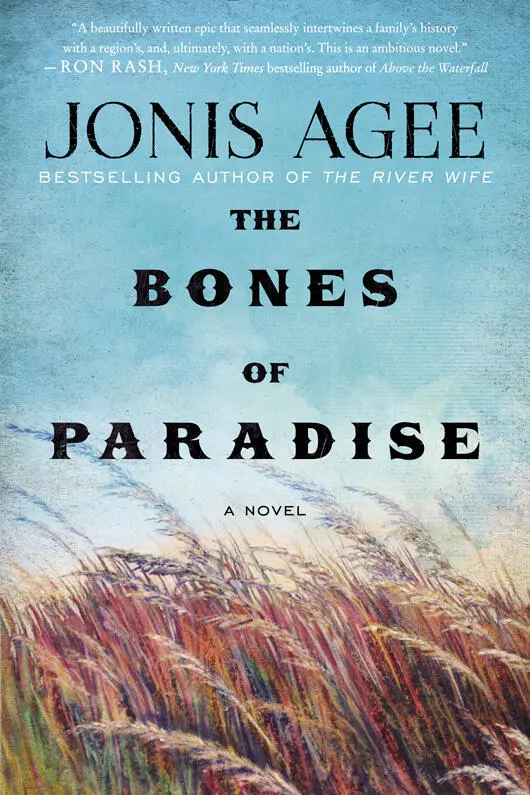
Jonis Agee - The Bones of Paradise
Здесь есть возможность читать онлайн «Jonis Agee - The Bones of Paradise» весь текст электронной книги совершенно бесплатно (целиком полную версию без сокращений). В некоторых случаях можно слушать аудио, скачать через торрент в формате fb2 и присутствует краткое содержание. Год выпуска: 2016, Издательство: William Morrow, Жанр: Современная проза, на английском языке. Описание произведения, (предисловие) а так же отзывы посетителей доступны на портале библиотеки ЛибКат.
- Название:The Bones of Paradise
- Автор:
- Издательство:William Morrow
- Жанр:
- Год:2016
- ISBN:нет данных
- Рейтинг книги:3 / 5. Голосов: 1
-
Избранное:Добавить в избранное
- Отзывы:
-
Ваша оценка:
The Bones of Paradise: краткое содержание, описание и аннотация
Предлагаем к чтению аннотацию, описание, краткое содержание или предисловие (зависит от того, что написал сам автор книги «The Bones of Paradise»). Если вы не нашли необходимую информацию о книге — напишите в комментариях, мы постараемся отыскать её.
returns with a multi-generational family saga, set in the unforgiving Nebraska Sandhills in the years following the massacre at Wounded Knee—an ambitious tale of history, vengeance, race, guilt, betrayal, family, and belonging, filled with a vivid cast of characters shaped by violence, love, and a desperate loyalty to the land. Ten years after the 7th Calvary massacred more than 200 Lakota men, women, and children at Wounded Knee, J. B. Bennett, a white rancher, and Star, a young Native American woman, are murdered in a remote meadow on J. B.’s land. The deaths bring together the scattered members of the Bennett family: his cunning and hard father, Drum; his estranged wife, Dulcinea; and his young sons, Cullen and Hayward. As the mystery of these twin deaths unfolds, the history of the dysfunctional Bennett’s and their damning secrets are revealed exposing the conflicted heart of a nation caught between past and future.
At the center of
are two remarkable women. Dulcinea, returned after bitter years of self-exile, yearns for redemption and the courage to mend her broken family and reclaim the land that is rightfully hers. Rose, scarred by the terrible slaughters that have decimated and dislocated her people, struggles to accept the death of her sister, Star, and refuses to rest until she is avenged.
A kaleidoscopic portrait of misfits, schemers, chancers, and dreamers, Jonis Agee’s bold new novel is a panorama of America at the dawn of a new century. A beautiful evocation of this magnificent, blood-soaked land—its sweeping prairies, seas of golden grass and sandy hills, all at the mercy of two unpredictable and terrifying forces, weather and lawlessness—and the durable men and women who dared to tame it. Intimate and epic,
is a remarkable achievement: a mystery, a tragedy, a romance, and an unflagging exploration of the beauty and brutality, tenderness and cruelty that defined the settling of the American west.
The Bones of Paradise — читать онлайн бесплатно полную книгу (весь текст) целиком
Ниже представлен текст книги, разбитый по страницам. Система сохранения места последней прочитанной страницы, позволяет с удобством читать онлайн бесплатно книгу «The Bones of Paradise», без необходимости каждый раз заново искать на чём Вы остановились. Поставьте закладку, и сможете в любой момент перейти на страницу, на которой закончили чтение.
Интервал:
Закладка:
CHAPTER SEVEN
Dulcinea Bennett closed Grimm’s Fairy Tales and smiled at the boys and girls sitting stiffly at attention at the wooden desks before her. A few wore fearful expressions as the result of one story after another in which mothers and fathers betrayed their children, or acted foolishly and lost them. The animals weren’t much better. She hated these stories. As she looked across the room, her eye caught on Lily, Rose’s daughter, whose small round face was filled with enthusiasm as she raised her hand, something that almost never happened among the Indian children at the Rosebud Reservation school.
Lily burst out, unable to contain herself. “Our spider is smarter than the one living with the flea in your story, Mrs. Bennett. Iktomi is powerful. He does things backwards to fool you. He can trick you, too.”
The other children glanced nervously at each other. The use of Lakota language was forbidden, and they must never speak of their old ways. Willow, a tall, reedy girl with bowed legs, leaned over and whispered to Lily, who blushed and dropped her eyes.
“What a wonderful creature! Can you tell me about any others?” Dulcinea glanced at Crooked Tail, seated next to last in the row by the door. He opened and closed his mouth indecisively, and his hand fluttered at his shoulder. When she nodded at him, he spoke so softly she had to move closer to hear.
“Rabbit Boy. Hero,” he said, his hand collapsing on the desk with a soft thump.
“ Wagnuka, red-headed woodpecker,” Sarah Sweetwater said. Dulcinea looked at the girl seated across from Crooked Tail. She had spent the entire year in silence, but now spoke clearly and confidently. Her large eyes made her thin face seem narrow and she kept her lips closed to hide the fact that her baby teeth had never fallen out and now crowded her larger ones. Her cousin, Lost Bird, had been adopted or bought by General Colby after Wounded Knee, depending on which story one believed. She was taken to Colby’s home in Beatrice, Nebraska, and raised by a white family. Sarah’s aunt never recovered from the shock of the killings at Wounded Knee or losing the child. This past summer, Mrs. Colby tried to enroll her adopted daughter with the Cheyenne River Agency for full tribal rights, including an allotment of land.
“Don’t forget kangi the crow and the turtle keya, ” Billy Blue Horse said in his distinct high, clipped voice.
“ Ptan and capa, ” a voice called out. It was the tiny, sickly Otter girl who sat in the front, as far from the windows as possible to stay warm. Dulcinea turned and smiled at her, and the girl said, “Wakan Tanka,” in an awed whisper, her face alight as she glanced shyly at the other children, who grew quiet, caution in their eyes. A couple of the oldest watched for Dulcinea’s reaction. She had heard the words before and knew they were sacred, a reference to the great mystery, the creating power of the Lakota people. She closed her eyes and nodded.
An angry male voice said, “Hestovatohkeo’o.” It was Stone Road, a fourteen-year-old who was held back for not learning his numbers and letters. He spent most days locked in the cloakroom or working in the kitchen, punishment for using Lakota or practicing his religion. The Indian agent had tried punishing the families of children like him by withholding food allocations and other supplies, but in his case it did no good. This was his last year in school. He was one of the children Dulcinea had tried to reach, to tutor privately, but it didn’t work. In a way, she was relieved he wouldn’t return in the fall.
“And who is that?” she asked in a tired voice.
“Double Face. The second one grows on the back of his head. Make eye contact, you die!” The boy smiled and opened his hands while the other children shifted uncomfortably and whispered to each other.
“Your fairy tales have anyone that powerful?” he demanded.
She was about to answer, then closed her mouth and looked at her students—dressed in plain cotton clothing, hair shorn, lacking ornament as if they had taken the vows of a strict Christian order—and shook her head. It was self-evident who had the power here. She recalled the supervisor’s warning last fall. She was hired to introduce them to white culture and teach them to be of service in white families.
“By six and seven, Indian children have stopped playing with toys and are considered adults, working as hard as any grown person. They don’t need coddling. Teach them how to be good citizens, how to follow rules, and about the consequences of poor decisions. And let’s hope they go home and teach their families so we stop having all this trouble.” The supervisor had looked out the window of the classroom at the bleak sweep of rolling hills nearly devoid of trees, with only the tall grasses and the empty mindless blue sky to relieve the eye. He wasn’t a bad man. Dulcinea had heard him called saintly for his Christian convictions. He had fought to keep the school open when whites wanted to empty the reservations after Wounded Knee. He’d ordered the doors locked during those dangerous times, and the children were unable to join their families at the Ghost Dance. Although he was praised, Dulcinea wondered at his strategy. She’d worked at the school for a year now, and suspected that much of what she was asked to teach the children was useless or worse.
She glanced at the gray walls neatly lined with pictures of happy white children playing with farm animals, baking cookies with their mother, decorating a Christmas tree, ironically drawing turkeys and Indians for Thanksgiving—calendar pictures from previous years. She had been instructed not to allow the students to express their tribal culture with Lakota language or customs, and under no circumstances to celebrate their primitive rituals or display their drawings or handicrafts unless they reflected white culture. It was a ridiculous order, and she spent the year afraid to violate it. Now, in ten minutes’ time she had undone the year, and felt relieved. It was the last day of school and she could feel the rising impatience in her charges, who sat twitching like horses under the burden of required stillness. When they returned in the fall, they would struggle to refrain from smiling, to maintain blank faces, and she would once again feel the weight of their obedience. Her friend Rose often hinted at the richness of Lakota life but was hesitant to reveal much. Dulcinea suspected that Rose met with the students secretly to share news of home and their culture. She had no real proof, though, except for Stone Road.
Dulcinea hadn’t seen Rose in more than a week. The woman had disappeared without a word, leaving the kitchen shorthanded. She was startled at how easily the other woman slipped away and by the hurt she felt. Rose was her only real friend since she had been forced to abandon her husband and sons.
Half-strangled by guilt and grief, she tried to live close enough that she could ride into the Sand Hills to watch over her family, Drum Bennett be damned. He always caught her, threatened her again, and she resolved to stay away, move to another town. Before long, it would begin again. A few times J.B. found her in the town and brought Hayward to spend time with his mother, which drove her wild with regret. When J.B. came alone, they fought for hours about Cullen and about her leaving, and then fell exhausted into bed to punish each other’s bodies, ending in silence side by side in her rented room like a long-married couple waiting for a train.
Only Drum would tell her about her son, and his stories were as dark and bitter as any the Brothers Grimm could conjure—injuries, accidents, misfortunes. These were the hallmarks of Cullen’s life, as far as she could tell. The last time Drum found her, she was waiting for a glimpse of Cullen out by the old line shack on Drum’s land. She knew her son went there to escape his grandfather’s tyranny. It was only a matter of time. She camped there for two weeks last August, fighting biting flies, heat, and loneliness. She spent the time training the little ranch horse she’d bought from the livery stable in Gordon. She wouldn’t give up this time, she vowed; she’d be there when Cullen arrived and they’d talk until they understood each other. Drum be damned.
Читать дальшеИнтервал:
Закладка:
Похожие книги на «The Bones of Paradise»
Представляем Вашему вниманию похожие книги на «The Bones of Paradise» списком для выбора. Мы отобрали схожую по названию и смыслу литературу в надежде предоставить читателям больше вариантов отыскать новые, интересные, ещё непрочитанные произведения.





Обсуждение, отзывы о книге «The Bones of Paradise» и просто собственные мнения читателей. Оставьте ваши комментарии, напишите, что Вы думаете о произведении, его смысле или главных героях. Укажите что конкретно понравилось, а что нет, и почему Вы так считаете.