Carmen Boullosa - Leaving Tabasco
Здесь есть возможность читать онлайн «Carmen Boullosa - Leaving Tabasco» весь текст электронной книги совершенно бесплатно (целиком полную версию без сокращений). В некоторых случаях можно слушать аудио, скачать через торрент в формате fb2 и присутствует краткое содержание. Год выпуска: 2002, Издательство: Grove Press, Жанр: Современная проза, на английском языке. Описание произведения, (предисловие) а так же отзывы посетителей доступны на портале библиотеки ЛибКат.
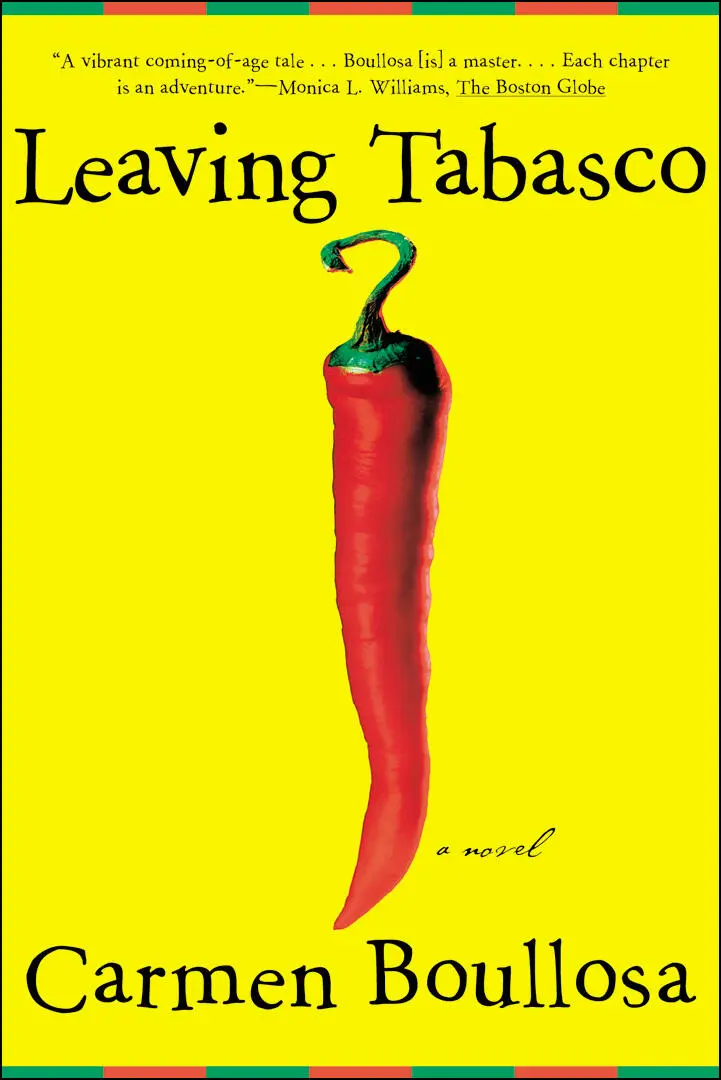
- Название:Leaving Tabasco
- Автор:
- Издательство:Grove Press
- Жанр:
- Год:2002
- ISBN:нет данных
- Рейтинг книги:4 / 5. Голосов: 1
-
Избранное:Добавить в избранное
- Отзывы:
-
Ваша оценка:
Leaving Tabasco: краткое содержание, описание и аннотация
Предлагаем к чтению аннотацию, описание, краткое содержание или предисловие (зависит от того, что написал сам автор книги «Leaving Tabasco»). Если вы не нашли необходимую информацию о книге — напишите в комментариях, мы постараемся отыскать её.
Leaving Tabasco — читать онлайн бесплатно полную книгу (весь текст) целиком
Ниже представлен текст книги, разбитый по страницам. Система сохранения места последней прочитанной страницы, позволяет с удобством читать онлайн бесплатно книгу «Leaving Tabasco», без необходимости каждый раз заново искать на чём Вы остановились. Поставьте закладку, и сможете в любой момент перейти на страницу, на которой закончили чтение.
Интервал:
Закладка:
On Monday I went to school at the usual time, overtired but punctual. All the students were talking about the behavior of the toads and nobody had any thought for the incinerated cow or the giant serpent, and the business of the bandstand came close to being taken for granted. All the talk was of the toads, wherever you went. On the patio one of the bigger girls said it was all the priest’s fault, because he was up to all kinds of filthy tricks with the nuns. I was a lot smaller than she was, but that didn’t stop me from arguing back. I told her it was a cheap lie from beginning to end, that Father Lima didn’t do anything dirty with the nuns, that I knew what I was talking about, and that her teeth would fall out for being such a liar.
She said I was just a kid and what did I know? “You don’t even know what filthy tricks are.”
“It’s a filthy trick when a man and a woman take off their clothes in a hammock and start making noises like pigs at the slaughterhouse and sucking and licking and pinching—”
All the girls started to laugh and I stopped my explanation. But they didn’t talk badly of the nuns again and they decided to blame the electric storm and its aftereffects, the giant serpent and the carbonized cow, on the craze for chewing bubble gum that had swept through the school the previous week.
By the time school was over, we were all convinced of this and there wasn’t a single student among us with bubble gum in her mouth. I felt curiously happy and victorious. The sisters had escaped the stain of calumny and the priest’s reputation was intact thanks to my stunning intervention. How had I managed to fool them so easily? I kept asking myself. I was sure that none of them had any idea what filthy tricks were, any more than I did, but my version, because of its outlandishness, struck them as convincing. I had returned evil with good, I told myself. And for a while I felt positively angelic, a creature of sweetness and light. When I got home, I observed that the cleaning girls had received reinforcements. A virtual army was at work scraping windows and walls. It didn’t consist of goofy girls but Indian women cleaners. I went down to the riverside and saw the same scene repeated at all the houses there. Where had they gotten so many Indians to do the cleaning? They’d brought them in from the farms, interrupting their work in the fields, at the cattle ranches, and on the coffee plantations. In the evening they came into the central patio to have supper out of an enormous cauldron of pozole which old Luz had specially made for them. It was one of the few nights that Grandma didn’t tell her tales. She and Dulce came into my room and bolted the door, and Dulce combed her hair in silence, while out under the sky the barefoot Indians sang hymns to the Virgin Mary, before curling up to sleep on the ground.
Songs, laments, solemn howlings, filled with drawn-out notes and syllables, transmitted an ancestral grief, recalling ancient hardships, much more ancient than the Virgin herself, appealing to her from their need for shelter, for a naked, melancholy kindness, so plaintive and so goodly that it stirred one’s fears.
When I awoke the next morning, there was no sign of the Indians. They had been taken away in trucks to their places of work, and those there was no room for had had to walk there. However, the Gypsy encampment had reappeared. On my way home from an errand, one of their women said to me, “Hey, you there, little girl.”
It was strictly forbidden to talk to the Gypsies, because, according to Grandma, they stole little children, hiding them on hooks under their broad skirts and taking them away to beg in distant countries, sometimes poking out their eyes if they weren’t pretty, and other times drugging them to sleep both day and night with their potions. And as well, they said, their women didn’t have a shred of decency, while all the men were thieves.
“You know why that cow got burned up on your ranch?” the Gypsy woman asked me, boldly, staring me in the eyes, though I’d no idea who gave her the right to talk to me that way.
“Because it got struck by lightning,” I replied with equal boldness.
“Come on! Don’t be stup—” she said, swallowing the final syllable.
“I’m not stupid. Don’t say I am. I saw it with my own eyes. Don’t try to fool me.”
“He got that way from eating mangoes.”
“You’re the one who’s stupid, Gypsy. What’s mangoes got to with being burned to a cinder?”
“It’s very simple. Do you really think that mangoes are eaten the whole world over? That cow, who knows where they brought it from—”
“It was a fine zebu. It could put up with all sorts of weather. They come from India.”
“I guarantee it comes from somewhere where they don’t eat mangoes. It tried one, it liked it — well, who doesn’t — then it had another, and then another, and then one more, till its guts caught fire, and in the end its flesh and its skin, till it was burned up from top to bottom, inside and outside. The same happens to blond little girls like you who eat too much from this country. Be careful, little girl, be careful. Do you want me to read your palm? Give me a coin and I’ll read your future. Give me your hand. I know how to see into the future.”
I gave the Gypsy my hand. She looked at it attentively. Then she closed it and said to me, looking into my eyes, “No, I can’t read it for you. I don’t like to take coins from the people who have your sort of luck. Don’t eat any more mangoes. I figure that one half of your heart has already turned yellow, and the other half is turning brown with the heat, that’s what I figure.”
14 Old Luz
The following Sunday, when old Luz awoke, she was bearing the stigmata of Christ. As if this were a mere nothing, she sat down in her wooden chair to grind up the recently roasted coffee, but found she couldn’t turn the handle of the mill because the wounds made by the nails prevented her, and she burst into tears. My grandmother found her crying and immediately sent for Dr. Camargo, who took one glance at her and sent for the priest. By this time Luz was levitating, her chair and all floating off the ground, and she kept insisting on clapping her hands so that she and I could sing together as usual, while my grandmother scolded her for all the blood she was splashing around the kitchen. In spite of her wounds and the harsh words, Luz’s face wore a radiant smile. “Don’t the wounds hurt?” I asked. Obviously they didn’t, and that proved they weren’t marks of illness but signs of Christ’s blessing. Her blouse was soaked in blood.
The priest pulled at his hair when he realized that this was one more Sunday he’d have to spend without saying Mass and enjoying the pleasures of the hammock. “This had to go happen on a Sunday,” he was saying to himself, but we caught his words. “This lovely miracle had to go happen on a goddam Sunday!” Old Luz felt a need to go pee and she landed her chair gently on the ground. Then with the help of my nanny, Dulce, she directed her feeble, faltering steps to the bathroom. She was longer in there than usual. She wasn’t coming out or answering our calls. When Dulce forced the door of the tiny windowless cubicle to see what was happening, she discovered that Luz wasn’t there. At the foot of the toilet bowl rested the old lady’s clothing, her shoes, her long gray skirt, the blouse, the underskirt, the knickers, and the blood stains that had drenched the shoes. That was all. Our dark-skinned Luz had dissolved in urine. But Dulce wasn’t giving up the search and called on everybody, the priest, the doctor, my grandmother, my mother, the three nuns, and even the neighbors, to help find the missing woman. They all peered into the cubicle, without any idea of what was going on, and saw there the clothing and the toilet bowl containing pee. Grandma and the doctor inspected it carefully, while the three nuns sang a dog-Latin hymn in praise of Jesus. The priest was muttering prayers, while the neighbors dashed out to spread the news around town. Old Luz couldn’t have concealed herself in a nook or cranny of the cubicle, because there weren’t any. It was impossible to believe that she had slipped away unnoticed from the cubicle. So they pulled the chain, gathered up her clothes, and the priest sent a message to ring the church bells to announce her death. While the bells pealed out, he headed off to the church, eager to say Mass. It had already struck nine o’clock and the church was packed with both Indian and white parishioners, on this rare occasion mixed together, for they’d been waiting there for two hours in the midst of all sorts of rumors, some of which included Luz and some of which didn’t. From the pulpit the priest explained how Luz had met her end, and how she had passed away in an odor of sanctity, omitting that it was an odor strongly tinged with urine.
Читать дальшеИнтервал:
Закладка:
Похожие книги на «Leaving Tabasco»
Представляем Вашему вниманию похожие книги на «Leaving Tabasco» списком для выбора. Мы отобрали схожую по названию и смыслу литературу в надежде предоставить читателям больше вариантов отыскать новые, интересные, ещё непрочитанные произведения.








Обсуждение, отзывы о книге «Leaving Tabasco» и просто собственные мнения читателей. Оставьте ваши комментарии, напишите, что Вы думаете о произведении, его смысле или главных героях. Укажите что конкретно понравилось, а что нет, и почему Вы так считаете.