Carmen Boullosa - Cleopatra Dismounts
Здесь есть возможность читать онлайн «Carmen Boullosa - Cleopatra Dismounts» весь текст электронной книги совершенно бесплатно (целиком полную версию без сокращений). В некоторых случаях можно слушать аудио, скачать через торрент в формате fb2 и присутствует краткое содержание. Год выпуска: 2004, Издательство: Grove Press, Жанр: Современная проза, на английском языке. Описание произведения, (предисловие) а так же отзывы посетителей доступны на портале библиотеки ЛибКат.
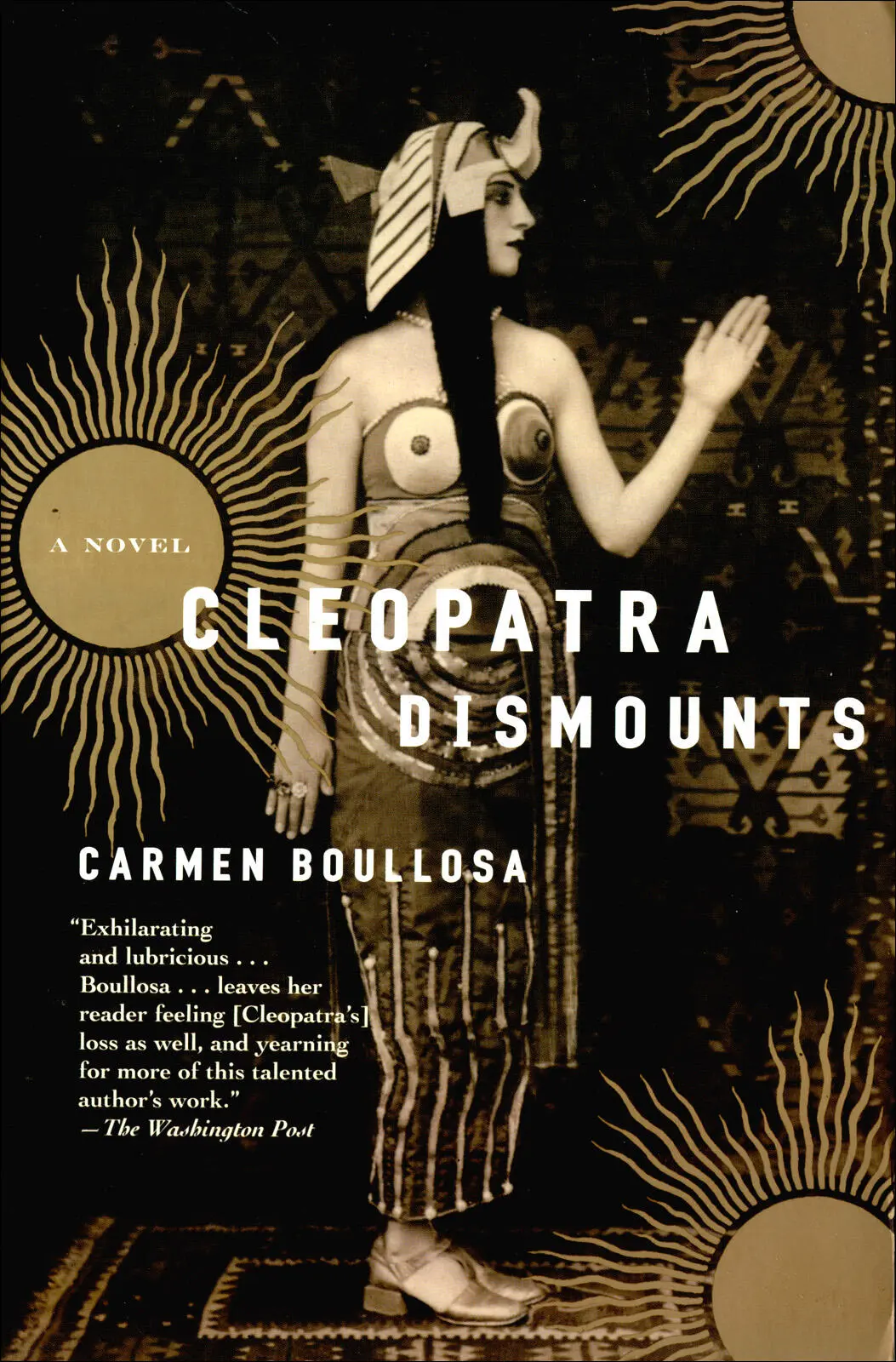
- Название:Cleopatra Dismounts
- Автор:
- Издательство:Grove Press
- Жанр:
- Год:2004
- ISBN:нет данных
- Рейтинг книги:3 / 5. Голосов: 1
-
Избранное:Добавить в избранное
- Отзывы:
-
Ваша оценка:
Cleopatra Dismounts: краткое содержание, описание и аннотация
Предлагаем к чтению аннотацию, описание, краткое содержание или предисловие (зависит от того, что написал сам автор книги «Cleopatra Dismounts»). Если вы не нашли необходимую информацию о книге — напишите в комментариях, мы постараемся отыскать её.
Through the intervention of Cleopatra's scribe and informer Diomedes, Boullosa creates two deliriously wild other lives for the young monarch — a girl escaping the intrigues of royal society to disguise herself and take up residence with a band of pirates; and the young queen who is carried across the sea on the back of a magical bull, to live among the Amazons.
Magical, multifaceted, and rippling with luminous imagination, Cleopatra Dismounts is a work that recalls Jeanette Winterson’s Sexing the Cherry and confirms Carmen Boullosa as an important international voice.
Cleopatra Dismounts — читать онлайн бесплатно полную книгу (весь текст) целиком
Ниже представлен текст книги, разбитый по страницам. Система сохранения места последней прочитанной страницы, позволяет с удобством читать онлайн бесплатно книгу «Cleopatra Dismounts», без необходимости каждый раз заново искать на чём Вы остановились. Поставьте закладку, и сможете в любой момент перейти на страницу, на которой закончили чтение.
Интервал:
Закладка:
Antony, neither you nor Caesar, nor anybody could have given me that One, for a mortal is nothing without the gods and the earth. The river loses its gleam, its generative powers, if the gods do not infuse it with life. The Nile is the gods because it contains them. Let us imagine the unimaginable: that the Nile became merely running water, that it lost its divine identity. Well, so what? It is impossible to imagine it but let us suppose that the giver of life losts its godly powers. Its dark waters would not even wet us. Its silt would be sterile sand. But the river knows nothing of such foolish arrogance. The river is the breath of the gods and does nothing to hide it. It runs full of life and it bestows it on us, because it is life itself. Hear this, Antony, though you hate me to speak of Caesar: His attachment to me made me haughty after I thought that, with him as my ally, I would receive obeisance from all the kingdoms of the world. Listen now to what I say of you: So great was my joy, so profound the intoxication you filled me with, that I loved you in the firm belief that we would one day encompass everything, that our love would contain the Nile, the air, the sea, the sun. Nothing, nobody, would be lacking. We were to be complete. We needed no tunic of Deianeira to ruin us! The bonds of love could have remained untangled and we would still have known defeat, for we were convinced that you and I together were One in the world’s despite, the One that outrivaled all beings mortal and divine!
So our ship sank all the deeper in the deepest of waters. Because we were happy, because we thought we were complete in the possession of our happiness, because you came back to me and abandoned me yet again! It meant nothing to us that the scant breath of Octavius blew on our sails and snapped the yardarm, and the sky darkened with rage, and the whole universe, including the Elysian Fields and the world of the dead, turned against us. The great battle between East and West, between the Tiber and the Nile, between Octavius and Antony and his Cleopatra — the conflict that poets will sing for centuries to come — none of that ever happened. We fled from Actium before Octavius could smash us down and postponed the final encounter. When he did come to face us, the issue was not fought over you or me, or over the oneness that we thought we were building piece by piece. Antony, neither of us listened to the truths of the gods. Because we were the river that thinks it owes nothing of its power to the divine, because we were a rootless tree, a sky overcast, the couple who believed they were self-sufficient — that was why!
It did not matter, Antony, that you were a successful general but an ineffectual king, that you were not adept in satisfying the wishes of others and were even incapable of perceiving your own, that you never knew what you wanted, that you were often a sundial buried in shadow. You were great when you had my Caesar to advise you, but you were not vanquished because you lost him. You were vanquished because of what I have been telling you, for loving me to excess, because I returned your love, convinced that we two made one, that we formed a perfect unity. We lost. We were our own defeat!
Betrayal
Everything, everything is the handiwork of Death.
— VirgilDiomedes the Informer
Cleopatra was short in stature but possessed an extraordinary physical beauty and grace in her movements, as agile and elegant as an animal or a nymph. Her manner of speech was quick and confident, and in order to fulfil my obligations as her scribe, I was forced to devise a form of shorthand that my assistants would know how to decipher. She had personally approved of my entering into her service when I was a mere youngster, but would not have done so had she had the foresight to see how much I would end up weighing. I tend toward obesity, the sole trait I share with the Ptolemies, and my body, though formerly obedient to my will, has never enjoyed either speed or agility or grace. Now, thanks to my weight and my advancing years, I am the prisoner of my own legs. I was not so at the time when the events of the story I plan to narrate took place. The hand with which I write now is appropriate to my weight. I am slow. I weigh every word as I go. Between one line and the next, I stumble over my own thoughts. It is incumbent upon me to confess to this characteristic, though it is nothing in my favor, but I will not trouble you with it again.
Cleopatra had this rapid way of speaking and told her stories with a liveliness that I, old and fat, cannot presume to imitate with either my hand or my head that now requires an effort to raise when I wish to see the stars twinkling far above. My weight stoops me the way Nature bends an animal, obliging it to peer down at the surface of the Earth. Only mankind has a face wholly to the front, but some of us, despite our humanity, have become animals in this respect.
The passing years have effaced much of what I remember of Cleopatra, but some things I can still recall without the least distortion, right down to the most trivial details. The one advantage of being torpid and heavy is that one proceeds more slowly; and at that pace, memory holds fast to certain things as if nothing could budge it, as if it were fixed, firmly rooted. But the words of Cleopatra were beaten down every time I tried to recount them. It happened so often that now they hide themselves from me, together with certain incidents to which I had been eyewitness, flying from me like birds that flee before the drums of rowdy men. My interrogators wore themselves out trying to convince me that I had not seen what I really saw. That what I knew to be the truth was actually falsehood. How many times did they come and ask me about her, only immediately to contest every statement I made, every phrase, every account of every act that I tried to affirm. For long years I had submitted myself to the authority of the truth with a dedication I now repeat here, but I started to weaken and make concessions, first with my words, then with my point of view, and finally even in my memory. But I will tell no more lies. I will fill in the gaps where terror caused me to forget. From my stylus will come nothing imagined.
Since I know I am soon to die, I cannot cling to the argument that Theodotus employed to advocate the treacherous beheading of Pompey: “The dead don’t bite.” Maybe they do not bite the living but I’m not certain they do not bite the other dead. I write now because I wish to repair my errors, but already I realize I have failed! The words I have attributed to Cleopatra do not convey the lively way she spoke. I falsify them by calling them hers. That alone should be enough to disqualify them, but there is a defect even more serious: they have been deliberately altered by the powers of Rome.
They pretend to describe the real Cleopatra; they even believe their own pretence, but they end up reinforcing the version created by Caesar Augustus. (Cleopatra always called him “Octavius.”) They focus on one aspect of her, representing her as a creature who saw life through eyes blurred by her feelings. An insulting straitjacket for a woman of her energy, complexity, and violence. Could the great Cleopatra have been merely a tear-stained creature, weeping for her sentimental misfortunes? She had been educated by sages, constantly surrounded by refined and worldly eunuchs, by prudent and intelligent maidens. From childhood onward, she had witnessed palace intrigues. She had shone as a governor, excelled as a cunning strategist, and managed her affairs with consummate skill. Could she be this weepy weakling? Not anywhere on this planet called Earth. Nowhere where a man is called a man, a woman, a woman; courtiers, courtiers; youths, youths; slaves, slaves; soldiers, soldiers. Nowhere in the world of Cleopatra. She was of another order entirely. And I intend to portray her as such — even as I flee for my life, on horseback for my legs no longer support me — as a woman born to command, with the glance of a queen; a woman of method, order, skilled in languages and in seeing through pretences. Get away from me, all Romanness, Rome and its Romans. Away, I say! Far from where my hand is writing. Away, I tell you.
Читать дальшеИнтервал:
Закладка:
Похожие книги на «Cleopatra Dismounts»
Представляем Вашему вниманию похожие книги на «Cleopatra Dismounts» списком для выбора. Мы отобрали схожую по названию и смыслу литературу в надежде предоставить читателям больше вариантов отыскать новые, интересные, ещё непрочитанные произведения.




Обсуждение, отзывы о книге «Cleopatra Dismounts» и просто собственные мнения читателей. Оставьте ваши комментарии, напишите, что Вы думаете о произведении, его смысле или главных героях. Укажите что конкретно понравилось, а что нет, и почему Вы так считаете.