Gabriel Blackwell - Madeleine E.
Здесь есть возможность читать онлайн «Gabriel Blackwell - Madeleine E.» весь текст электронной книги совершенно бесплатно (целиком полную версию без сокращений). В некоторых случаях можно слушать аудио, скачать через торрент в формате fb2 и присутствует краткое содержание. Год выпуска: 2016, Издательство: Outpost19, Жанр: Современная проза, на английском языке. Описание произведения, (предисловие) а так же отзывы посетителей доступны на портале библиотеки ЛибКат.
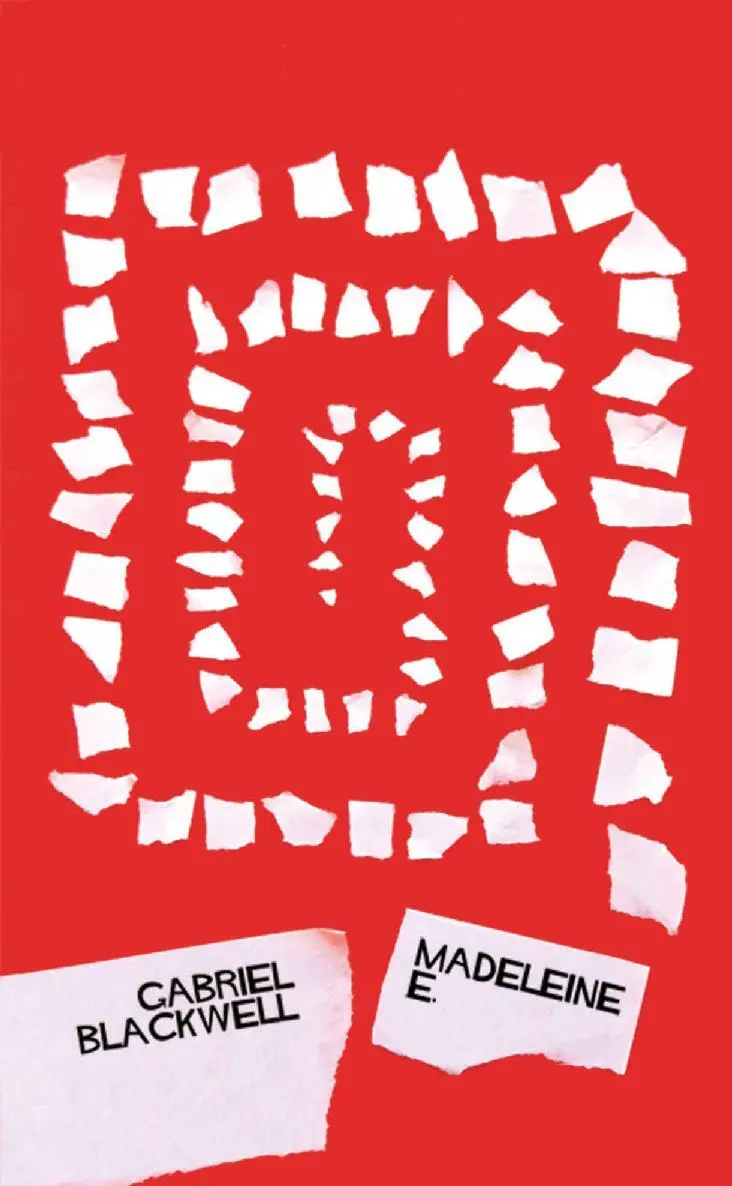
- Название:Madeleine E.
- Автор:
- Издательство:Outpost19
- Жанр:
- Год:2016
- ISBN:нет данных
- Рейтинг книги:4 / 5. Голосов: 1
-
Избранное:Добавить в избранное
- Отзывы:
-
Ваша оценка:
Madeleine E.: краткое содержание, описание и аннотация
Предлагаем к чтению аннотацию, описание, краткое содержание или предисловие (зависит от того, что написал сам автор книги «Madeleine E.»). Если вы не нашли необходимую информацию о книге — напишите в комментариях, мы постараемся отыскать её.
Madeleine E. — читать онлайн бесплатно полную книгу (весь текст) целиком
Ниже представлен текст книги, разбитый по страницам. Система сохранения места последней прочитанной страницы, позволяет с удобством читать онлайн бесплатно книгу «Madeleine E.», без необходимости каждый раз заново искать на чём Вы остановились. Поставьте закладку, и сможете в любой момент перейти на страницу, на которой закончили чтение.
Интервал:
Закладка:
[INT. Judy’s Hotel Room (NIGHT)]
…
Judy lives in the Empire Hotel, next to a restaurant (?) named — what else? — ”Twelfth Knight,” Twelfth Night being Shakespeare’s farce of identity, in which men fall in love with men who are not men and women fall in love with women who are not women.
…
In many countries, the traditional Twelfth Night celebration ends the winter festival that begins with Halloween. There is drinking and feasting. Children run through the streets knocking on doors and ringing bells to drive out evil spirits. The order of things is reversed: the king is treated as a peasant, and, from among the peasants the Lord of Misrule, who presides over the festivities, is chosen. In other countries, Twelfth Night begins Carnival, which involves the same reversal and many of the same traditions.
…
Judy: “I’ve been on blind dates before. Matter of fact, I’ve been picked up before.” By Elster? An allusion to (before) the beginning?
…
Better well hanged than ill wed.
(Soren Kierkegaard, Philosophical Fragments , via Shakespeare, Twelfth Night )
…
I’ve been understanding since I was seventeen.
(01:44:15)
…
Judy writes her note to Scottie left-handed, as though (for nine out of ten people) seen in a mirror.
…
While we are, I think, meant to assume that Judy is taking down all that she says in her voiceover, when she holds her letter up to tear it in half, we can see that she has only written two lines. It’s possible, I suppose, that there is more writing on the other side of the paper, but it isn’t visible to us, and it really doesn’t seem likely, given the wide margin of blank space we can see. What did she really write?
…
Scottie sees the same woman, a woman who is not Madeleine or Judy, at Ernie’s at 01:43:00 (gray suit) as at 01:31:00 (blue dress/brooch).
…
Green (as Edith Head, who designed two green outfits for Kim Novak, flatly observed) is the colour of death.
(Krohn, Hitchcock at Work )
…
Green is also the color of rebirth.
…
We met up with my wife’s friends on Market Street, barely two hours after we’d touched down. This trip was supposed to be a reconciliation, an apology — she held it all against me. I held it all against me, too. She chose San Francisco as a poke in my eye, I thought, but I felt I deserved a poke in the eye. I couldn’t be sure it was my fault, of course, but I thought it was probably my fault. And I was still afraid of this other man. I wanted to order in, stay in our hotel room, make up or at least talk. She made plans on the plane, before we’d even touched down, without telling me what they were. We’ll be late, she said. I didn’t know we were going out, I said. I was not in a position to refuse.
The two women who screamed when they saw my wife and I coming down the sidewalk were less friends than they were former co-workers. My wife’s happiness at seeing them was clearly forced. When she went in to give them a hug she looked directly at me, into my eyes. It was clear that the two women were there to help my wife make me feel worse about myself. I tried to make myself as invisible as I could for the rest of the afternoon, but then I was worried about this other man. It was awkward to be out clothes shopping with these three women who did not want to have anything to do with me, but I couldn’t risk just standing outside of the shops on the street. I had to stay close.
My wife explained to the two women that I had been working on a book about Vertigo . She called it “his little book.” The two women knew nothing about the movie. I’ve never seen it, they said, is it good? They pretended to be interested, but the moment I said anything about it, they ignored me and started talking to each other. We walked up towards Nob Hill, along Sutter. As we passed under the awning of the Hotel Vertigo, one of the women said, Isn’t that that movie you were just talking about? I didn’t have a chance to answer. She explained to my wife she couldn’t wear shorts like that , but she kind of wanted a pair anyway. I knew she wasn’t listening, so I didn’t tell her that the building that prompted her question had played an important role in the film. I didn’t tell her it had appeared there under a different name, its old name, the Empire. I didn’t tell her I had read that Hitchcock had begun planning the shooting of a movie in San Francisco during his first visit to the city, during that visit’s first hours, long before there was a story or a script to be shot there. He’d hardly needed a location scout during Vertigo ’s pre-production, I didn’t say. I didn’t tell the woman how strange it was that Hitchcock, so in love with San Francisco, set the two most important scenes in the movie he shot there ninety miles outside of it — really, nowhere near it, at San Juan Bautista. He might as well have filmed them in Sacramento, I didn’t say. Though I guess, I didn’t go on, that seemed a little less surprising when one considered that Hitchcock had a home — far and away his favorite home — in Scotts Valley, not far from San Juan Bautista. He spent more of his time in his home in Los Angeles, of course, I didn’t say. I didn’t mention that the other two important, bookended scenes in Vertigo took place at Ernie’s, one of Hitchcock’s favorite restaurants in San Francisco. It didn’t really matter. Ernie’s was no longer there and we were many blocks away from where it had been.
…
“Is this some kind of Gallup poll?” Judy, even as Judy Barton, must act a part, even after she has given up the part of Madeleine. She has, in accepting the part of Madeleine, agreed to play a part for the rest of her life, the part of Judy-who-was-never-also-Madeleine. Can there ever again be a “real” Judy?
…
Scottie is in every scene of Vertigo , with just two exceptions: when we cut to Midge in her car outside of his apartment, and in Judy’s hotel room, after he has left. But, in the case of the scene of Midge in her car, we know that Scottie is there, it’s just that he’s not visible because of where the camera is set up. Move just a couple of steps down the sidewalk and suddenly there he is, in the lighted window. In the Empire Hotel scene, however, not only has he left the shot, he has left the hotel, too. (Hasn’t he? Is he standing behind the door?) We have momentarily lost track of him, the first and only time in the film. Both Wood and Modleski tell us the movie is meant to be seen as subjective, as though from Scottie’s point of view, but, if that’s so, we have to wonder whose point of view this scene in Judy’s room represents. The effect of his absence, his altogether exceptional absence, is to turn this scene into a fantasy. One has to believe it’s his fantasy since he’s not in the frame, but it doesn’t matter whose fantasy it is if it is a fantasy — the scene is ultimately more about exposition than psychology. The letter, we may conclude, cannot be real.
…
A letter always arrives at its destination.
(Jacques Lacan, Seminar on The Purloined Letter)
…
Hitchcock wanted the letter in the film, at this particular moment in the film, even though many people close to him advised against it. Critics said it was a clunky way of explaining what was going on and asked why the audience would keep watching if they found out what had happened forty minutes before the movie actually ended. But holding something so large over the audience’s head was not suspense: that was mystery, and Hitchcock did not deal in mystery.
There is no such letter in Boileau and Narcejac’s novel, though it would be much more natural there — although the narrator of the novel is close to Flavierès (Scottie in the film), it isn’t Flavierès, it is a third person narrator not bound to what Flavierès knows; it can tell us what Flavierès can only suspect. In fact, Flavierès’s certainty is the only thing the reader has to go on in believing that Renée (Judy in the film) is Madeleine — she will not admit it until the end of the novel, and by that point we can’t be sure her confession isn’t made out of exasperation with Flavierès’s insistence that she is Madeleine, out of a kind of fatalistic resignation or folie à deux . Indeed, because it is a book and the story is told in words only — Boileau and Narcejac do not have the luxury of having the same actress play both parts — it seems much less likely that Renée is Madeleine than that Judy is Madeleine. We cannot see to believe. We must trust in Flavierès’s words, and we know him to be unreliable. By the end, he will have strangled this woman, whoever she is, to death; how can we possibly trust him?
Читать дальшеИнтервал:
Закладка:
Похожие книги на «Madeleine E.»
Представляем Вашему вниманию похожие книги на «Madeleine E.» списком для выбора. Мы отобрали схожую по названию и смыслу литературу в надежде предоставить читателям больше вариантов отыскать новые, интересные, ещё непрочитанные произведения.






Обсуждение, отзывы о книге «Madeleine E.» и просто собственные мнения читателей. Оставьте ваши комментарии, напишите, что Вы думаете о произведении, его смысле или главных героях. Укажите что конкретно понравилось, а что нет, и почему Вы так считаете.