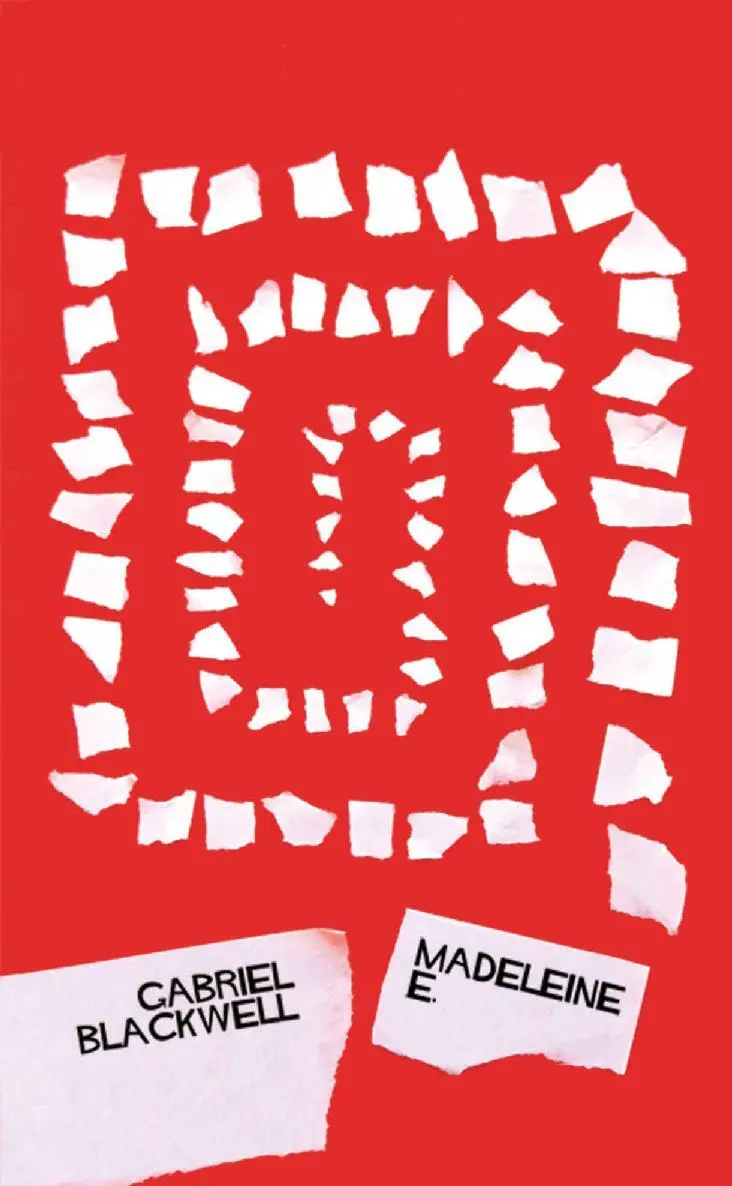
Gabriel Blackwell - Madeleine E.
Здесь есть возможность читать онлайн «Gabriel Blackwell - Madeleine E.» весь текст электронной книги совершенно бесплатно (целиком полную версию без сокращений). В некоторых случаях можно слушать аудио, скачать через торрент в формате fb2 и присутствует краткое содержание. Год выпуска: 2016, Издательство: Outpost19, Жанр: Современная проза, на английском языке. Описание произведения, (предисловие) а так же отзывы посетителей доступны на портале библиотеки ЛибКат.
- Название:Madeleine E.
- Автор:
- Издательство:Outpost19
- Жанр:
- Год:2016
- ISBN:нет данных
- Рейтинг книги:4 / 5. Голосов: 1
-
Избранное:Добавить в избранное
- Отзывы:
-
Ваша оценка:
Madeleine E.: краткое содержание, описание и аннотация
Предлагаем к чтению аннотацию, описание, краткое содержание или предисловие (зависит от того, что написал сам автор книги «Madeleine E.»). Если вы не нашли необходимую информацию о книге — напишите в комментариях, мы постараемся отыскать её.
Madeleine E. — читать онлайн бесплатно полную книгу (весь текст) целиком
Ниже представлен текст книги, разбитый по страницам. Система сохранения места последней прочитанной страницы, позволяет с удобством читать онлайн бесплатно книгу «Madeleine E.», без необходимости каждый раз заново искать на чём Вы остановились. Поставьте закладку, и сможете в любой момент перейти на страницу, на которой закончили чтение.
Интервал:
Закладка:
…
In Scottie’s fantasy of Judy’s memory, Elster has to cover Judy’s mouth to keep her from screaming.
…
I believe in my conscience I intercept many a thought which heaven intended for another man.
(Laurence Sterne, The Life and Opinions of Tristram Shandy, Gentleman )
…
And at the base of Coit Tower, while my wife and her friends stopped in the shade to discuss their plans for the night, while I looked at my phone to try to figure out which way to go to get back to our hotel, I looked up and the man was simply standing there, looking not at me but through me, into the tower, where my wife and her friends were standing, and I reached out as though to push him away, and he brushed past me. He had been no heavier than the fog that had come in that morning and then dissipated. I felt almost as though, if I had kept my arm extended, it would have passed right through him.
…
Anyone would distrust a person who said, “My companions and I are illusions; we are a new kind of photograph.”
(Bioy Casares, Morel )
…
The more you disguise yourself, the more you look like you.
(Saramago, The Double )
…
It seems, at first, simple: Judy writes the letter to explain everything to Scottie. This letter, then, far from being a mystery, is trying to dissolve one. But it is not as simple as it seems, because why write a letter? Judy has promised to meet Scottie again; she could just as easily explain everything at that meeting. Though it would be difficult and hurtful, still, to share this secret might well, with time, bring them closer together — how much more intimate to say it (as she does to us, the audience) than to write it. And so the letter, the fact that Judy writes these words she ought to speak, seems to indicate a distance Judy wants to maintain.
A letter must be delivered ; unlike speech, which depends upon time, a letter transcends time but must move through space to do so. When two people cannot be together in the same place to speak to one another, they write, and an intermediary (the post office, typically) delivers their words. What then is the nature of a letter hand-delivered by the person who has written it? Such a letter typically contains words that cannot be spoken aloud, words that cannot bear the pressures of being heard. Such a letter declares unrequited love; such a letter breaks off a relationship; such a letter announces the death of a loved one or the reasons for a suicide. Which of these is it for Judy? All are equally possible once we have accepted that she loves Scottie but he loves only Madeleine, and that to break off her relationship with this man who, now that he has found her, will never leave her alone, means to leave San Francisco, and that to leave San Francisco and this man means also to leave Judy Barton, to become yet another person, to live yet another life. She tears up this letter because she decides she cannot bear to once again look in the mirror and not see herself; because she has decided she cannot bear to repeat some strange name over and over again until she responds to it as she would her own, until she can give that name on command; because she has decided that, though it will mean being Madeleine again, through being Madeleine again, she might finally be able to be Judy. She might be able to be only Judy.
…
And yet if one calls the New York Medical Examiner’s Office to learn its own estimate of how many people might have jumped [on 9/11], one does not get an answer but an admonition: “We don’t like to say they jumped. They didn’t jump. Nobody jumped. They were forced out, or blown out.” And if one Googles the words “how many jumped on 9/11,” one falls into some blogger’s trap, slugged “Go Away, No Jumpers Here,” where the bait is one’s own need to know.
(Tom Junod, “The Falling Man”)
…
All of the stories of doubles and doppelgangers I’ve read involve a confrontation between the two doubles, and they all end with the death of one of those doubles. Edgar Allan Poe’s “William Wilson” and its echo, H. H. Ewers’s “The Student of Prague,” both end with that confrontation and what may be interpreted as either the murder of the double or a suicide, as did their progenitor, E. T. A. Hoffmann’s “The Doubles.” The confrontation in José Saramago’s novel The Double does not lead to murder or suicide, but precipitates an accident that ends one double’s life. Hoffmann’s long novel The Devil’s Elixir features many murders of the story’s double, all apparently botched. Fyodor Dostoevsky’s The Double: A Petersburg Poem , too, features many confrontations, and a death. I mention this because this story, the one I seem to be telling, is not one of those stories.
I had a feeling this wasn’t the last time I was going to see this man, but I decided it would be the last time I took any notice of him. It seemed as though, when he had passed through my arms like so much mist, he had also passed through my consciousness. He had lost his hold on me. He was just one of many people in San Francisco at that moment, a stranger to me, as were all of the others. He was nothing more to me than they were. He was living a life that had, briefly, coincided with mine, at least in space, but in that respect he was no more exceptional than millions of other people. I felt freed of something.
And that was when he grabbed my wife’s arm and went into the tower. It sounds melodramatic, or silly, but it happened. I did not imagine it. When I woke my wife the next morning with breakfast I had brought up from the restaurant of the hotel across the street (our hotel’s restaurant was only open for dinner), and which I accompanied with a small bunch of pink roses I bought from a vendor I saw down the block, I had already decided I wouldn’t ask what had happened, where she had been. I had written her a love note that was also an apology for my behavior of the last few months. She refused to read it — why couldn’t I just tell her what it said? — but eventually she saw I was sincere and she put the note away, still unread, in her bag. She kissed me. I told her I had decided to give up the book I was writing. She looked relieved. I told her I was going to look for a job when we got back to Portland, first thing, that our life was going to return to normal. I think I meant it. But how could I not wonder what had happened? How could I not ask? The rest of my life, I would have this thing hanging over me.
…
[INT. Ransohoff’s (DAY)]
…
Edith Head: “He explained. that the simple gray suit and plain hairstyle were very important, and represented the character’s view of herself in the first half of the film. The character would go through a psychological change in the second half of the film, and would then wear more colorful clothes to reflect the change. Even in a brief conversation, Hitch could communicate complex ideas. He was telling me that women have more than one tendency, a multiplicity of tastes, which can be clouded by the way they view themselves at any particular moment.”
…
Believe me, there lies in such outward things, more consequence than is usually ascribed to them. Surely you will not misunderstand, or suspect me of levity, when I remind you of the effect produced by dress on an actor. On assuming the costume of any character, he experiences in himself a corresponding change of feelings.
(Hoffmann, The Devil’s Elixir )
…
The quickness of the hand deceives the eye: speed, says Hitch, is preoccupation, and. the rapidity of the transitions keeps the audience so preoccupied that they are always cheerfully, breathlessly, one step behind.
(Taylor, Hitch )
Читать дальшеИнтервал:
Закладка:
Похожие книги на «Madeleine E.»
Представляем Вашему вниманию похожие книги на «Madeleine E.» списком для выбора. Мы отобрали схожую по названию и смыслу литературу в надежде предоставить читателям больше вариантов отыскать новые, интересные, ещё непрочитанные произведения.









Обсуждение, отзывы о книге «Madeleine E.» и просто собственные мнения читателей. Оставьте ваши комментарии, напишите, что Вы думаете о произведении, его смысле или главных героях. Укажите что конкретно понравилось, а что нет, и почему Вы так считаете.