Gabriel Blackwell - Madeleine E.
Здесь есть возможность читать онлайн «Gabriel Blackwell - Madeleine E.» весь текст электронной книги совершенно бесплатно (целиком полную версию без сокращений). В некоторых случаях можно слушать аудио, скачать через торрент в формате fb2 и присутствует краткое содержание. Год выпуска: 2016, Издательство: Outpost19, Жанр: Современная проза, на английском языке. Описание произведения, (предисловие) а так же отзывы посетителей доступны на портале библиотеки ЛибКат.
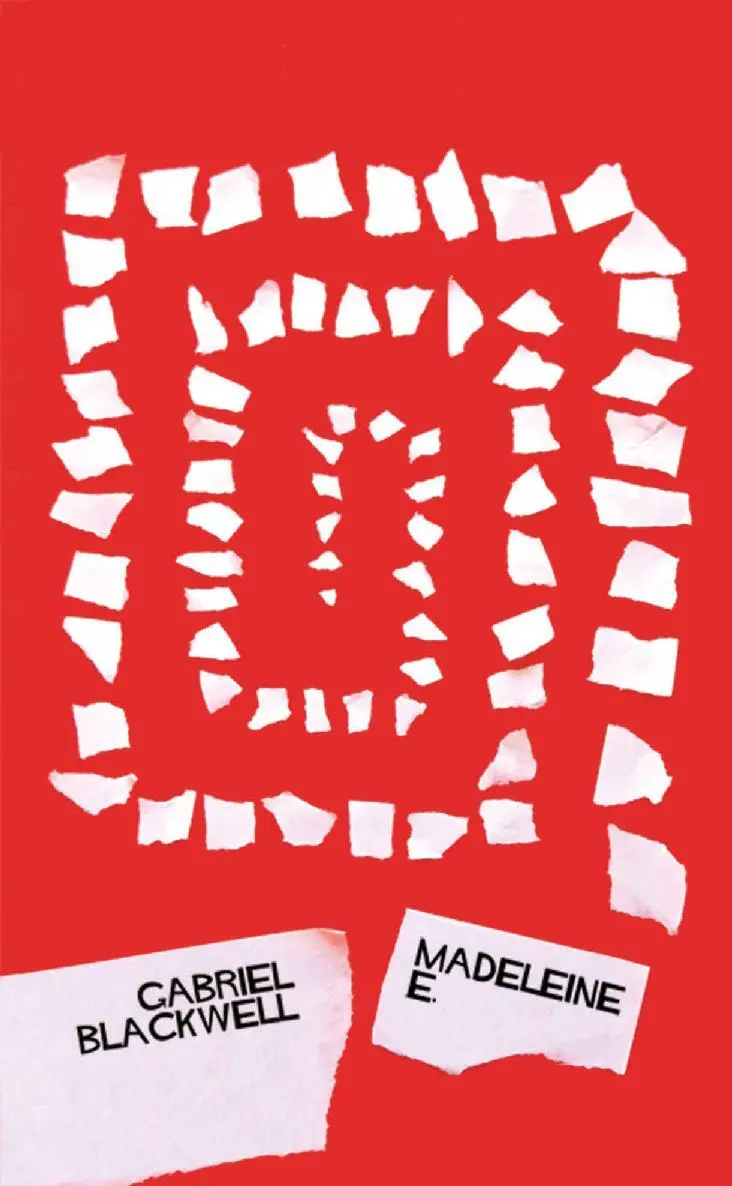
- Название:Madeleine E.
- Автор:
- Издательство:Outpost19
- Жанр:
- Год:2016
- ISBN:нет данных
- Рейтинг книги:4 / 5. Голосов: 1
-
Избранное:Добавить в избранное
- Отзывы:
-
Ваша оценка:
Madeleine E.: краткое содержание, описание и аннотация
Предлагаем к чтению аннотацию, описание, краткое содержание или предисловие (зависит от того, что написал сам автор книги «Madeleine E.»). Если вы не нашли необходимую информацию о книге — напишите в комментариях, мы постараемся отыскать её.
Madeleine E. — читать онлайн бесплатно полную книгу (весь текст) целиком
Ниже представлен текст книги, разбитый по страницам. Система сохранения места последней прочитанной страницы, позволяет с удобством читать онлайн бесплатно книгу «Madeleine E.», без необходимости каждый раз заново искать на чём Вы остановились. Поставьте закладку, и сможете в любой момент перейти на страницу, на которой закончили чтение.
Интервал:
Закладка:
…
My agent wanted the book done. In order to finish it, I needed to go to San Francisco. Hitchcock had seen San Francisco and thought, “I must make a movie here.” He rejected Maxwell Anderson’s script because it would not have accommodated many of the images Hitchcock had conceived on that first visit. Even though the majority of the filming had taken place on a soundstage in Los Angeles, there was something about the city that was vital to the production. Now, there was something about it that was vital to my book.
My girlfriend objected that I had lived in San Francisco for years. Did I really need to go back now, less than a week after we had moved in together? She had just found out she was pregnant. We needed to save money, be careful. I invited her to come with me. I told her it would be good. I needed a subject, a foreground for my research; without her there, I would not be able to see the scenes I was writing as I needed to see them. Alone, the city was the city, an environment to be navigated; with her there, it would become a setting , a place where things happened. She wasn’t convinced. I told her to imagine a canvas without any paint on it, or paint without a canvas. This is what I remember saying, those words, though the analogy is obviously flawed. She was not my subject, Vertigo was. Thinking about it now, I realize what I was saying was I needed a medium to work in. This is another way of saying that I would be lying if I said I didn’t know where things began to go wrong. I needed her there. It wouldn’t work otherwise.
…
The characteristic subject of [Hitchcock’s] art, often taken to be suspense, is more accurately anxiety.
(Taylor, Hitch )
…
One does not create by adding, but by taking away. To develop is another matter. (Not to spread out.)
(Bresson, Notes )
…
How much time passes between “Madeleine’s” faked death (Madeleine’s real death) and Judy’s unmasking? It takes minutes onscreen, but we’re meant to believe that. months have gone by? Later, we’re told it has been a year since San Juan Bautista, long enough for Midge to give up hope in Scottie, and for Scottie to begin to recover some equilibrium. How long does that take? For some people, it can take years. For some people, there is no healing some wounds.
…
We are in fact by this time [immediately following Madeleine’s supposed suicide] so thoroughly identified with Scottie that we share his shock, and the resulting sense of bewildered desolation, in the most direct way, just as we share his sense of helplessness, even of responsibility. We are stunned, the bottom is knocked out of the world, we cannot at all see where the film is going, what possible sequel this event can have: all is chaos.
(Wood, Hitchcock’s Films )
…
The body is imaginary, and we bow to the tyranny of a phantom. Love is a privileged perception, the most total and lucid not only of the unreality of the world but of our own unreality: not only do we traverse a realm of shadows; we ourselves are shadows.
(Octavio Paz, Alternating Current )
…
[EXT. Podesta Baldocchi (LATE AFTERNOON)]
…
“SOMEWHERE. SOMEHOW he’d loved her and let her slip through his fingers. He had seen her die . And now here she was looking into his eyes again. ”
Tagline for Vertigo ad
…
When a fantasy object, something imagined, an object from inner space, enters our ordinary reality, the texture of reality is twisted, distorted. This is how desire inscribes itself into reality, by distorting it.
(Zizek, The Pervert’s Guide to Cinema )
…
Two persons, looking each other in the eye, see not their eyes but their looks.
(Bresson, Notes )
…
There are multiple doppelgangers for Judy: not only Madeleine (played by Novak’s stunt double), but also the woman Scottie mistakes for Madeleine (a third actress), the assistant at Ransohoff’s (platinum blonde, and apparently the same size), and the actress that plays Carlotta in the dream sequence. Do any of these women get a screen credit?
…
Judy, walking with her friends or coworkers, stops outside of Podesta Baldocchi. Where were they going? To Podesta Baldocchi? She doesn’t live above it. She doesn’t go in to buy flowers. None of her friends do, either. She comes to a stop just in front of Scottie, standing in front of an assortment of arrangements they’ve both seen multiple times, in “Portrait of Carlotta.” It’s meant to look like an accident, but how can it be?
…
Once set down on paper, each fragment of memory. becomes, in fact, inaccessible to me. This probably doesn’t mean that the record of memory, located under my skull, in the neurons, has disappeared, but everything happens as if a transference had occurred, something in the nature of a translation, with the result that ever since, the words composing the black lines of my transcription interpose themselves between the record of memory and myself, and in the long run completely supplant it.
Simultaneously, my recollections grow dull. To conceptualize this fact, I use the image of evaporation, of ink drying; or else water on a pebble from the sea, the sun leaving behind its dulling mark, the salt film. The recollection’s emotion has disappeared. Occasionally, if what I have written in explanation satisfies me (later, on rereading), a second induced emotion, whose origin is the lines themselves in their minute, black succession, their visible thinness, procures for me a semblance of a simulacrum of the original emotion, now grown remote, unapproachable. But this emotion does not recur, even in lesser form.
(Jacques Roubaud, The Great Fire of London )
…
He who defines personal identity as the private possession of some depository of memories is mistaken. Memory is no more than the noun by which we imply that among the innumerable possible states of consciousness, many occur again in an imprecise way.
(Borges, “The Nothingness of Personality”)
…
When I type an open quotation mark (“) into the search bar at the top right of my computer’s web browser, the browser, anticipating what I will type next, immediately suggests “judy barton,” followed by “gabriel blackwell.” Though this is the result of my own (past) actions, I can’t help but be struck by it.
…
It would all be much too complicated and unproductive to go into, since all we really care about on the outside is our hero on the run, not where he is running from and what, if anything, he is running to. The chase itself is the point.
(Taylor, Hitch )
…
In life someone may just go mad. suddenly giving way under a strain. But will that be acceptable in a dramatization of these same facts?
(Taylor, Hitch )
…
Hitch’s letter to Maxwell Anderson, Dec. 4:
You have to realize one very important fact. Here is a woman who has been an accessory to a murder, she has let herself revert back physically to her original color and style. And yet, she allows a man to recreate her in the image of the dead woman. Here, as you will see, she is taking a terrible risk. After all, she is a woman virtually in hiding. When she renews her association with the ex-detective she would love to pursue their old relationship in her current physical appearance, but naturally, he will have none of this. It is only as Madeleine he wants her. So, you see, Max, the woman must be desperately in love with him to allow him to do this. And this she tells him at the end of the story.
You can see what a chance she is taking because as Renee [the Judy character’s name at this point in the screenwriting process, the name given that character in Boileau and Narcejac’s novel], she is safe both within her identification and being able to stand up to any probe into her background. Because remember that she was Renee before she was turned into a blonde, and was dressed as nearly as possible like Gavin’s wife. So again, Max, you see the woman falling in love with him is of the utmost importance to justify her behavior in section two.
Читать дальшеИнтервал:
Закладка:
Похожие книги на «Madeleine E.»
Представляем Вашему вниманию похожие книги на «Madeleine E.» списком для выбора. Мы отобрали схожую по названию и смыслу литературу в надежде предоставить читателям больше вариантов отыскать новые, интересные, ещё непрочитанные произведения.





Обсуждение, отзывы о книге «Madeleine E.» и просто собственные мнения читателей. Оставьте ваши комментарии, напишите, что Вы думаете о произведении, его смысле или главных героях. Укажите что конкретно понравилось, а что нет, и почему Вы так считаете.