Giannina Braschi - Yo-Yo Boing!
Здесь есть возможность читать онлайн «Giannina Braschi - Yo-Yo Boing!» весь текст электронной книги совершенно бесплатно (целиком полную версию без сокращений). В некоторых случаях можно слушать аудио, скачать через торрент в формате fb2 и присутствует краткое содержание. Год выпуска: 2011, Издательство: AmazonCrossing, Жанр: Современная проза, на английском языке. Описание произведения, (предисловие) а так же отзывы посетителей доступны на портале библиотеки ЛибКат.
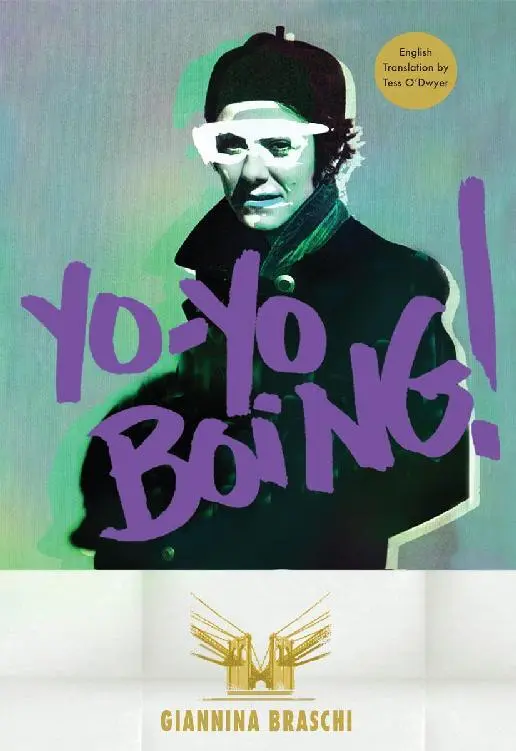
- Название:Yo-Yo Boing!
- Автор:
- Издательство:AmazonCrossing
- Жанр:
- Год:2011
- ISBN:нет данных
- Рейтинг книги:5 / 5. Голосов: 1
-
Избранное:Добавить в избранное
- Отзывы:
-
Ваша оценка:
Yo-Yo Boing!: краткое содержание, описание и аннотация
Предлагаем к чтению аннотацию, описание, краткое содержание или предисловие (зависит от того, что написал сам автор книги «Yo-Yo Boing!»). Если вы не нашли необходимую информацию о книге — напишите в комментариях, мы постараемся отыскать её.
Yo-Yo Boing! — читать онлайн бесплатно полную книгу (весь текст) целиком
Ниже представлен текст книги, разбитый по страницам. Система сохранения места последней прочитанной страницы, позволяет с удобством читать онлайн бесплатно книгу «Yo-Yo Boing!», без необходимости каждый раз заново искать на чём Вы остановились. Поставьте закладку, и сможете в любой момент перейти на страницу, на которой закончили чтение.
Интервал:
Закладка:
— Hey! Heeey-ho! — she thumbed over her shoulder— Follow the music. Listen.
But when she pointed at you, you dropped the guitar and ran backstage. The crowds were screaming for her to sing without you.
— What happened? — she asked. We were fantastic.
— You were fantastic —I said. I loved when you gave the heys and the ho’s. You were the only one who understood. I must say, however, that when you sang to the audience, you turned your back to her as if she were your back-up musician. Wait here, I’ll talk to her backstage.
— What a lack of respect —you muttered. Yelling vulgarities.
— They loved her, and she loved you.
— Sorry seven times.
— You can ask me to say sorry seven times, fourteen times. But a woman you don’t even know, a woman who could make your career.
— Seven times —you insisted— on her knees.
But I knew you would accept her apology. She came backstage and embraced you.
— Excuse me, I didn’t turn my back on you. And if I did, it’s because I was feeling the music on my back, and I wanted to confront it face to face. Back to back. Front to back, back to front, inside. It was an injection of vitality, a shot of ho’s.
— How was that hey-ho?
— Heeey-ho! — she sang to you, took your hand and together you walked on stage. The fans stood up, whistling and screaming.
— Success. Success —I called my father— Full house .
— You sang? — he asked quietly.
— No.
— Did you play an instrument?
— No.
— Were you on stage?
— No.
— So what success is it for you? Skedaddle. Skedaddle before it is too late.
— What is he saying? — you yelped in the background— That I wasn’t a hit? Tell him who sang with me! A full house, tell him. Skedaddle? He should go skedaddle himself.
— I thought you said she wasn’t there —he said.
— I can’t skedaddle. People who skedaddle don’t win grants.
— What grants are you winning? Listen, I don’t want to tell you what to do, honey, but if I were you, I’d skedaddle, skedaddle as soon as I could.
— Exactly. That’s what you are, the buffer between the creator and the public. And to think I nearly blew it, running off the set. If it weren’t for you, the music wouldn’t have reached the people. Of course, I can’t forget about the celebrity who carried the melody that had no melody, because it was amorphous, and gave it a form of expression that the masses could understand. And you, backstage, talking to her, talking to me, you were the success. But there’s just one latch that doesn’t click. I swear, I would have not run off the stage. I would have invited her on stage to sing with me. Or I would have joined her in the audience so she would not hog the spotlight.
— Unabashed narcissism. It’s not you. It’s Tess. She doesn’t know who she is. The singer is her arrested libido telling her to turn her back on you, the composer. But the composer is her other self. She is all the characters in her dream. That’s why you don’t identify with the composer. Because it’s her personality. She is so defensive that she even guards herself against success, sabotaging herself under the pretext of dignity because she has no confidence in her creative power. Even a simple gesture — the singer turning to face the audience — makes her feel weak. It’s her weakness because you make her weak, and that’s why she disguises her weakness with your face. And the singer, who has an accessible voice of her own, seeks liberation from you. But her third ego — the only one she accepts and she recognizes as herself — is the mending one — that’s why it has her face. At the end, the voice of her father, the voice of her conscience, tells her: Escape from the only self that you dare to recognize as yourself. Develop your own voice. Why do you have to be her stage-hand and sell yourself short? Skedaddle.
— Don’t listen to her. You made it all possible.
— But you didn’t write the music. Skedaddle. You didn’t sing it either. Skedaddle. The audience applauded the composer and the singer, but nobody clapped for you. And she says you’re the buffer, but you weren’t the buffer. The singer was the buffer. Skedaddle.
— But you were the power behind the throne.
— Do you want to be behind the throne or on it?
— You are a star either way.
— Don’t patronize her. Her self-esteem is low enough. Always sacrificing. You want to be a translator? Being a translator is a noble business if you’re Baudelaire translating Poe. But you still have to write Flowers of Evil . Or are you expecting her to write all your poems for you? Your name will always be in a smaller font. Why should you sacrifice? I see how much you have inside. Don’t let your hunger eat you up. She takes your friendship for granted. You don’t envy her, you don’t feel jealousy, you don’t feel anything dark inside your heart, when you see that she’s shining because you are her cheerleader with twinkling eyes. You clap, they clap. If I had you, I’d have Leo Castelli by now. I need a Tess.
— Go ahead and take her.
— I could not exploit her like you do. I would encourage her to finish her PhD. Find her own voice. She is your emotional crutch. If you don’t write, you blame her, you spill your coffee, you blame her, you bite your tongue, you blame her. Poor thing, she’s too young to know any better.
— I wonder why she thinks you’re so easy.
— Don’t step in her snare. You’re attacking me to defend yourself.
— You think that if you had a Tess you would have a show at the Whitney. You think Van Gogh was Van Gogh because he had Theo. Theo was Theo because he had Van Gogh.
— You need to do some soul searching. Don’t let yourself be swayed by her every need, cater to your own needs. Establish a reputation with people who can pay you. Octavio Paz, García Márquez. Build a career. Why be a knight errant? Nobody can squeak a peep because you draw your sword to defend her. But artists need to feel frustration in order to create beauty. Unrecognized, she strives, pampered she dies. If you raise ravens, they’ll take your eyes out. And believe me. She’ll leave you blind.
— I’m not a raven. I have no eyes. I’m blind, deaf, and dumb.
— Harmless as a fly. Helpless as a crab claw. You’ve snapped at plenty of people — so skip your innocent poet routine — no one believes it anymore — you’re ambitious. But poetry, poetry has always been the art of the underground. It sees in the dark. And creates at twilight. Beyond twilight, it loses its sight. To shine a light is to bare her stitches. No one wants to see the history of its wounds — the myth is what matters — obscurity and transcendence.
— No wonder — I thought. A black cat had crossed my path. I was on my way to Iris Pagán’s house for a reading that night. There she told me that a dead man was hanging on my neck.
— Rub a raw steak all over your naked body.
— Bloody?
— You can’t avoid it.
— A dead man on me?
— No good comes of him. He rides hunchback.
— I don’t feel him.
But the cadaver started to trigger my imagination. I couldn’t sleep a wink that night. I told you about it.
— Put a bloody piece in a sack with twenty-five cents and chuck it.
— Where?
— On the train tracks.
After bathing with the raw meat that gave me swirly golden hives and rashes on my back, we head straight for Penn Station.
Читать дальшеИнтервал:
Закладка:
Похожие книги на «Yo-Yo Boing!»
Представляем Вашему вниманию похожие книги на «Yo-Yo Boing!» списком для выбора. Мы отобрали схожую по названию и смыслу литературу в надежде предоставить читателям больше вариантов отыскать новые, интересные, ещё непрочитанные произведения.





Обсуждение, отзывы о книге «Yo-Yo Boing!» и просто собственные мнения читателей. Оставьте ваши комментарии, напишите, что Вы думаете о произведении, его смысле или главных героях. Укажите что конкретно понравилось, а что нет, и почему Вы так считаете.