Giannina Braschi - Yo-Yo Boing!
Здесь есть возможность читать онлайн «Giannina Braschi - Yo-Yo Boing!» весь текст электронной книги совершенно бесплатно (целиком полную версию без сокращений). В некоторых случаях можно слушать аудио, скачать через торрент в формате fb2 и присутствует краткое содержание. Год выпуска: 2011, Издательство: AmazonCrossing, Жанр: Современная проза, на английском языке. Описание произведения, (предисловие) а так же отзывы посетителей доступны на портале библиотеки ЛибКат.
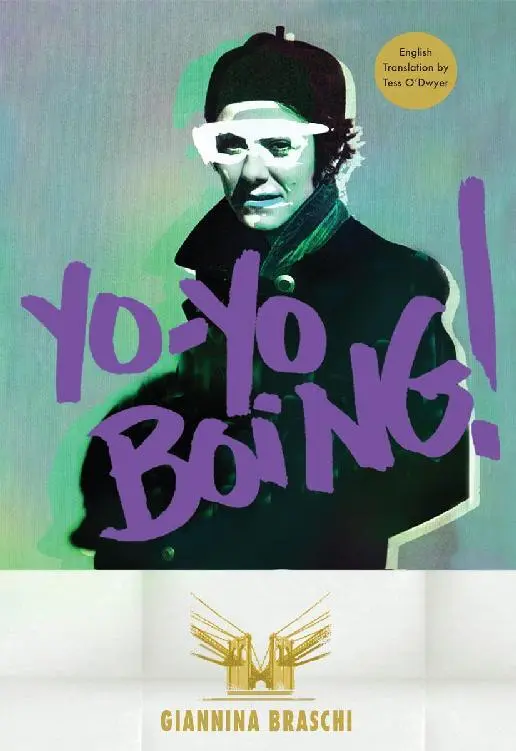
- Название:Yo-Yo Boing!
- Автор:
- Издательство:AmazonCrossing
- Жанр:
- Год:2011
- ISBN:нет данных
- Рейтинг книги:5 / 5. Голосов: 1
-
Избранное:Добавить в избранное
- Отзывы:
-
Ваша оценка:
Yo-Yo Boing!: краткое содержание, описание и аннотация
Предлагаем к чтению аннотацию, описание, краткое содержание или предисловие (зависит от того, что написал сам автор книги «Yo-Yo Boing!»). Если вы не нашли необходимую информацию о книге — напишите в комментариях, мы постараемся отыскать её.
Yo-Yo Boing! — читать онлайн бесплатно полную книгу (весь текст) целиком
Ниже представлен текст книги, разбитый по страницам. Система сохранения места последней прочитанной страницы, позволяет с удобством читать онлайн бесплатно книгу «Yo-Yo Boing!», без необходимости каждый раз заново искать на чём Вы остановились. Поставьте закладку, и сможете в любой момент перейти на страницу, на которой закончили чтение.
Интервал:
Закладка:
— The Boy. The Boy.
— What’s with the boy?
— Don’t wax theoretical. Sign your exam: The Boy. That will do it. The Boy gets an A no matter what you write. Don’t sign your name. The Boy is unforgettable. I’ll be sure to write The Boy a letter of recommendation for Yale.
Then the bell rang, and the students got up. I didn’t dare get up. I signaled you to check the back of my skirt to see if it was stained because the Kotex had ridden up my butt.
— Does it show? It feels like a bun up my butt.
— No, it’s okay.
But I knew it showed. Just then the bell rang, and we all sat back down. Then a three-year-old boy with a naughty face hopped on my lap and grabbed hold of my breasts, making me three years old again, three naughty years old, three worldly years old. And whichever way I looked, there was his little face of wonder in front of me, and he was milking my breasts, guanábanas, for all that I had inside, and all that I ever knew was in his little hands, and he wouldn’t stop squeezing and staring and grinning relentlessly like a ventriloquist’s dummy, until I entered his world. There were crags and cliffs, and I was climbing a mountain, following the barefoot boy straight up the path. His mother was calling from below that it was naptime. I recognized her voice. It was Lourdes, my cousin Eduardo’s wife.
— Lourdes —I asked— remember me?
She looked at me the way Dulcinea did the time I left her in the kitchen without food. Three weeks went by and you forgot all about her. The truth is I didn’t dare to face her for fear she might be dead. And one day, I said:
— What about Dulcinea?
We went to the kitchen to see if she was dead. No longer was she a Scottish terrier. Her coat was orange and knotted, and her tail was long and hairy like a collie. How could it be that she was still alive and fat with so much hair around her eyes that she hardly saw what was going on around her, but she recognized me, and she looked me square in the eye, letting me know she was so lonely, so hungry, she had been eating books, eating empires of pain.
— Hey, dyke —I said— what brings you here?
— I had to leave Eduardo because I was starving for affection. We weren’t having sex, and I wanted a baby.
I followed the boy down the mountain and rushed to greet Lourdes.
— It’s naptime —she said to her son.
— And what brings you here? — she asked me.
— I’m reading Darío. I know his work inside-out, but I’m researching this article because I forgot the date 1898 and the meaning of Modernism. You’re Parnassian, aren’t you?
— Actually, I’m a lesbian. Son —she said to the boy— it’s naptime.
Then she spread her legs, and when she spread them, the boy stuck his head inside her uterus.
— Doesn’t it hurt? — I asked her.
The boy pulled his head out and said to me:
— Nah, it doesn’t hurt her. Me neither. See how my face is all wrinkled, I’m a shar-pei puppy, my skin is all wrinkled, but not from suffering, experience, or maturity — they’re tender caresses of the womb — and I bet you wish you had a mama like mine so you could tuck your sleepy head inside her and pull it out refreshed. Look at me, outside in Conservatory Park — snuggling inside my mama — even with my eyes open the sun doesn’t bother me — it’s like nursing but even better because I don’t even have to suck her tits — I just stick my head in and pull it out — like a sunflower — it’s a sunflower of tenderness — nobody gets more tenderness than me — and it’s hard to know if I should grow up or keep mushing up like a ball of clay — it took a lot of squishing and squashing to squoosh back inside once I learned to talk and walk and return to the womb.
He scrunched his face back inside. And that was the last I heard of him until I woke up.
— It was your duende.
— Well, he certainly wanted to possess me. He knew I was bleeding. He caught the smell of blood and was fascinated by it, like dogs that recognize better than men when a woman is bleeding. They immediately start sniffing the crotch, getting high, inhaling blood, death, life, sex. Menstruation was my first experience with mortality. When I used to play tennis with my friends, our conversations were based on this fact of life.
— Did it come?
— Nope, not yet.
— We’ll all get it, sooner or later.
My grandmother and her friend Elvira Matienzo used to read the obituaries together every morning, browsing for the names of their friends. I guess they awaited the news of death the same way we awaited the first drop of blood.
— I like: “Today I woke up happy.”
— Give me a pen so I can put it back.
— No, send me more fragments. And your curriculum vitae. So they won’t say I’m only publishing it because we’re friends. That Olmo-Olmo’s got a big mouth.
— Forget Olmo-Olmo. Leave him alone. He’s all washed up.
— I practically bore him. He is my intellectual son. But I’m sick and tired of his stinginess. Get this, he stole five computers, I asked him for one, and he gives me none. I gave him everything. Him, zip. With friends like that, who needs enemies.
— He told me:
— What’s a rich woman like you doing teaching three courses? You shouldn’t have to teach.
Can you believe I fell for it? I actually felt rich and dropped the courses. The next thing I know, he signed up to teach my courses. And now I don’t have a pot to piss in.
— That’s the sophist for you. You can’t trust a word he says.
— What a great country!
— Why did you say that?
— Why not? The greatness of a country is created by its poets. If a country has great poets, it’s a great country. You can tell if a country is rich if its poetry is rich. And why not merge the wealth of Martí, Darío, Neruda, and Vallejo with the wealth of Whitman and Dickinson.
— Because of the Eliots and Pounds who are racists and fascists.
— Yes, but Neruda hated Americans. We have to start tearing down the walls dividing our two Americas. And we — you and I — have to be the spokesmen because we’re bilingual.
— You may be bilingual, but I’m loyal to Neruda and Vallejo.
— So am I. Neruda was an ambassador.
— We can’t be ambassadors because we don’t have a country. Because Puerto Rico is not a country with any power in the world, I won’t be considered a great poet. Spain created great poets with its empire and made them known around the world through its empire. Great poetry has always stemmed from the economic prosperity of a people. That is why we have Quevedo and Góngora.
— What about Julia de Burgos and Palés Matos?
— They perpetuate our oppression — stuck, delayed in the eternal traffic jam of la guaracha . We want our liberty.
— And you think that liberty is going to liberate us?
— It’s going to free us from our inferiority complex. Because if we were already free we wouldn’t have the excuse that we’re not free because you, American, denied and deprived us of liberty.
— It’s so juvenile to point the finger. It’s your fault I’m not free. It’s your fault I can’t finish the book. It’s your fault I’m stuck. Stop blaming. The one who blames is to blame. For not accepting his own guilt. I’m to blame. It’s my fault. If I’m not free, it’s my fault. That’s how a people begins to liberate itself. We have an obligation as poets to speak words of truth, even if politicians turn them into putty in their filthy hands and point the finger at us for ridding reality of the blame. If I’m not a great poet, I’m not going to blame my country because it’s a colony. No, it’s my own fault. And I wash my hands like Pontius Pilate. There. I’ve washed away the guilt.
Читать дальшеИнтервал:
Закладка:
Похожие книги на «Yo-Yo Boing!»
Представляем Вашему вниманию похожие книги на «Yo-Yo Boing!» списком для выбора. Мы отобрали схожую по названию и смыслу литературу в надежде предоставить читателям больше вариантов отыскать новые, интересные, ещё непрочитанные произведения.







Обсуждение, отзывы о книге «Yo-Yo Boing!» и просто собственные мнения читателей. Оставьте ваши комментарии, напишите, что Вы думаете о произведении, его смысле или главных героях. Укажите что конкретно понравилось, а что нет, и почему Вы так считаете.