Stephen Dixon - Late Stories
Здесь есть возможность читать онлайн «Stephen Dixon - Late Stories» весь текст электронной книги совершенно бесплатно (целиком полную версию без сокращений). В некоторых случаях можно слушать аудио, скачать через торрент в формате fb2 и присутствует краткое содержание. Год выпуска: 2016, Издательство: TRNSFR, Жанр: Современная проза, на английском языке. Описание произведения, (предисловие) а так же отзывы посетителей доступны на портале библиотеки ЛибКат.
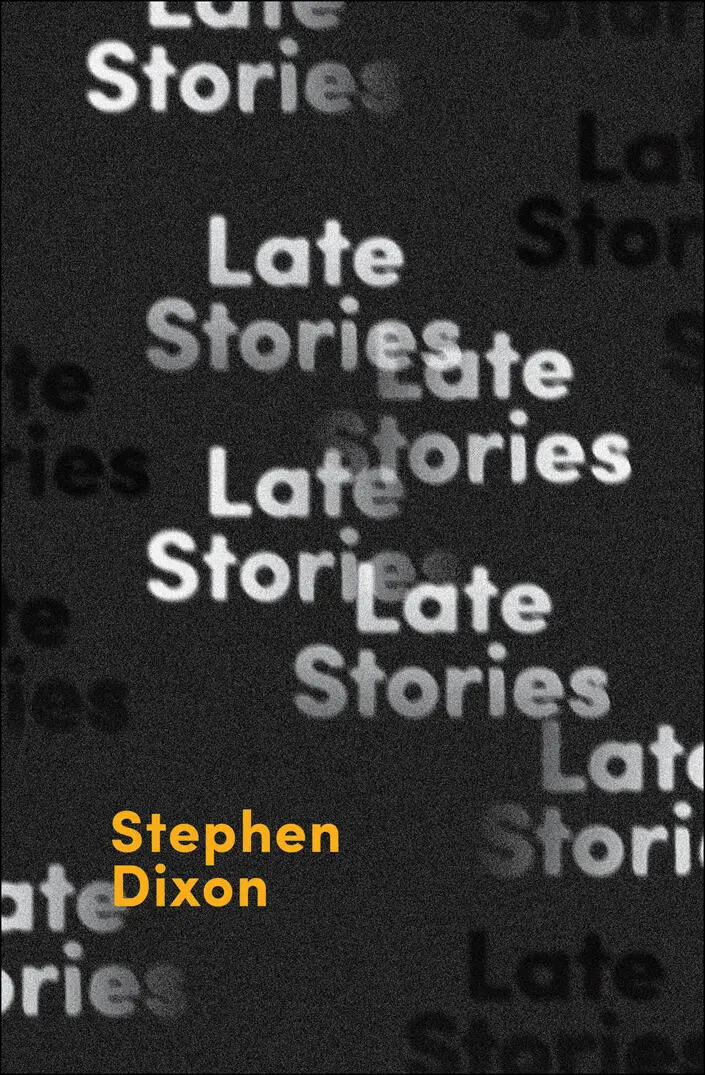
- Название:Late Stories
- Автор:
- Издательство:TRNSFR
- Жанр:
- Год:2016
- ISBN:нет данных
- Рейтинг книги:5 / 5. Голосов: 1
-
Избранное:Добавить в избранное
- Отзывы:
-
Ваша оценка:
Late Stories: краткое содержание, описание и аннотация
Предлагаем к чтению аннотацию, описание, краткое содержание или предисловие (зависит от того, что написал сам автор книги «Late Stories»). Если вы не нашли необходимую информацию о книге — напишите в комментариях, мы постараемся отыскать её.
detail the excursions of an aging narrator navigating the amorphous landscape of grief in a series of tender and often waggishly elliptical digressions.
Described by Jonathan Lethem as "one of the great secret masters" of contemporary American literature, Stephen Dixon is at the height of his form in these uncanny and virtuoso fictions.
With
, master stylist Dixon returns with a collection exploring the elision of memory and reality in the wake of loss.
Late Stories — читать онлайн бесплатно полную книгу (весь текст) целиком
Ниже представлен текст книги, разбитый по страницам. Система сохранения места последней прочитанной страницы, позволяет с удобством читать онлайн бесплатно книгу «Late Stories», без необходимости каждый раз заново искать на чём Вы остановились. Поставьте закладку, и сможете в любой момент перейти на страницу, на которой закончили чтение.
Интервал:
Закладка:
Just What is Not
They’re having lunch in a restaurant, their third time in a month, and he asks her what she’s been reading. She gives the titles of two books, “both of which I don’t think you’d like or even want to be seen with. They’re almost escape fiction, which for the past week I’ve needed to escape to because of all my work. But they’re light and easy to follow and with no big words to look up and they also help me to get through my own writing, when I have time for it. I don’t have to stop to understand another writer’s complicated entanglements of plot and profundities of thought. What have you been reading?” and he says “Anna Dostoevsky’s Reminiscences . Also, Joseph Frank’s biography of Dostoevsky. The abridged and condensed edition, as the jacket flap copy says, down to around nine hundred and seventy pages from what I think was around three thousand pages in four to five volumes. But I can’t part from one chapter in both books, rereading them over and over again because I love that particular time in their lives so much: how Feodor Mikhailovich and Anna Grigoryevna got engaged. Can I tell you it? It’s not too late?” She says “I have to pick up the kids in half an hour, but it’s only ten minutes away. So if you can give me the condensed-abridged version, I think we’ll make it.” “Anna was twenty and Feodor was forty-five or — six. He’d hired her — this was in Saint Petersburg, 1866—as a stenographer for his new novel, a short one, The Gambler . He’d dictate it and she’d write it down in shorthand and later at home transcribe it in longhand and next day he’d go over it. I think I have that right. No typewriters, then. You see, if he didn’t get it done in a month and turn it in to this very unscrupulous publisher he had a contract with, he could lose the rights to all his past books and maybe Crime and Punishment too, which he’d put aside for The Gambler and was being published serially and to great success in a magazine. Not his own: Time . Did you know he and his older brother Mikhail published a magazine called Time ?” “No,” she says, “but go on. All this other stuff is interesting, but we haven’t that much time.” “They completed it in a month and turned it in. During that time he’d become more and more enchanted with her — in love, really — but didn’t think she’d be interested in marrying an old and sick man. You have to understand that nothing happened between them yet. So, in one of their many tea breaks — they took them between hour-long sessions of dictation — he said to her, and I’ve read this part so often I can almost quote their exact words—‘I have three possible paths to take.’ That’s Dostoevsky talking. ‘One is to go to the East — Jerusalem and Constantinople — and stay there, possible forever. The second is to go aboard to play roulette — a game that mesmerizes me,’ he says. ‘And the third is to marry again’—he had a very sad first marriage, and his wife died—‘and seek joy and happiness in family life. You’re a smart girl,’ he said. ‘Which do you think I should choose?’ She said ‘Marriage and family happiness is what you need.’ Then he said ‘Should I try to find a wife, should she be an intelligent or kind one?’ and Anna said ‘Intelligent.’ I forget her reason, and I don’t know why she didn’t say both. But Dostoevsky said he’d prefer a kind one ‘so that she’ll take pity on me and love me.’ After they completed their work on The Gambler , he asked her to stay on and help him with Crime and Punishment . And during one of their tea breaks from this book, he said he has an idea for a new novel after Crime and Punishment in which the psychology of a young girl plays a crucial part. ‘I’m having difficulty working out the ending,’ Dostoevsky told her, ‘and again I need your advice. In this novel, a man — an author — meets a girl roughly your age. She’s gentle, wise, kind, bubbling with life. The author fails in love with her and becomes tormented whether she could ever possibly respond to his ardent feelings. ‘Would you,’ he said, ‘consider it psychologically plausible for such an exuberant girl to fall in love with a much older man — one my age,’ he said, ‘and with all my physical ailments?’ Anna said ‘If she’s really in love with him, she will. She’ll be happy and regret nothing.’ ‘Imagine,’ he said, ‘the artist is me — that I’ve confessed my love for you and I’m asking you to be my wife. What would your answer be?’ and she said ‘I would answer that I love you and will love you all my life.’ And that’s how they got engaged.” He starts crying. “I’m sorry, but this happens almost every time I read this passage in both Anna’s and Joseph Frank’s books. I find it to be one of the most touching stories I’ve ever read. But what do you think of it? Am I being silly?” and she says “It’s a beautiful story. And if you said to me what he said to Anna, I’d probably say the same thing she did. No, I definitely would.” “You’re not fooling with me, are you? I couldn’t take it,” and she says “Absolutely not.” “Then I’ve said it to you,” he says, “and will say it again as many times as you want. Oh, my sweetheart, my darling Ruth. You can’t believe how happy this makes me and how happy I’ll be for the rest of my life,” and he moves his chair closer to hers, leans across the table and kisses her on the mouth for the first time.
He goes to a reading his former department invited him to. There’ll be drinks and dinner at the faculty club after, which he’s looking forward to a lot more than he is to the reading. He can’t stand readings and hopes this one will be short. He’s sitting in the auditorium with about thirty other people, waiting for the reader to be introduced, when someone kisses the top of his head. He turns around; it’s Ruth, smiling at him. “Wow,” he says, “what a surprise, seeing you. And what was that thing on the head for?” “That thing was to show how I feel about you,” she says. “And how did I know you’d be here? Fiction reading? You a fiction writer? I guessed. I bet you never thought I could be so calculating. And you haven’t said if you’re glad to see me.” “Glad? After what you said and did? Yes. Very. Very. Couldn’t be gladder. Here, come around and sit beside me, unless you’re with someone.” She leaves the row she’s been standing in, excuses herself past two people at the end of his row and sits beside him and takes his hand and presses it to her cheek. He’s about to say something to her when the chairwoman of the department taps the podium mike a few times, says into it “Can you all hear me in the back?” Someone in the back yells “You’re good.” She thanks everyone for braving the elements on this cold and blustery night and starts to introduce the reader. He whispers to Ruth “I was about to say I’ve been invited to dinner after with the writer, but I’m not going to go to it now.” “No,” she says, “go, and see if you can get me to come with you as your date. They’ll do anything for you. It’ll be fun and, as usual, I’m starved.”
He bumps into Whitney in Whole Foods. “You look like you’re in a rush,” he says, “but don’t go anywhere yet. Freya, my older daughter’s here with me somewhere. I want you to see her after so many years.” “Haven’t got time,” she says. “Got to meet Harold. But we have to get together. We can’t keep relying on running into each other at these places. Lunch? This Friday? Twelve-fifteen? An odd hour, but it fits in perfectly between my Pilates class and picking up Hannah at school on an early day. New restaurant I love. I’ll email you where, and it’ll be my treat.” “Oh, no,” he says. “Always on me.” “Don’t argue with me,” she says. “I’ve been working out with weights and can’t be pushed around as easily as I once was.” She writes down his email address. “Now, big hug,” she says, and hugs him and goes to the checkout area with two containers of prepared foods. She’s a good friend of Ruth’s. Or used to be and probably still is. They were grad students together in his fiction-writing class, or maybe she was a couple of years ahead of Ruth and they became friends when Whitney stayed on a few years to teach expository writing to freshmen. She emails him the directions to the restaurant from his house. They meet, talk about their children, her husband—“Still like two lovebirds,” she says. “We got lucky.” Their writing—“I’m back at it after an eight-year hiatus,” she says. “You, I know, never stop.” The fiction writers who graduated with her when it was still a one-year program—“Most have given up,” she says. “Larry Myers became a lawyer and is already a partner in a high-toned firm, and Nancy Burnett is a college dean.” “I always forget their names once they graduate, unless they publish books that get reviews in the Times or they stayed in Baltimore and I keep bumping into them. You still in touch with Emma and Ruth, two whom I remember.” “Just Ruth. You know she’s getting a divorce.” “I do,” he says. “We’ve met a few times. She’s also, I think, dating someone in Raleigh, since she drives down there every other weekend. I didn’t ask why.” “That’s over with. It was just casual. I suppose not worth the trip anymore, though he used to come up to see her every other weekend. The guy she really has a crush on, which you must know by now — stop pretending — is our own Philip Seidel.” “Come on; what are you talking?” he says. “She’s given no signs of it. And to be completely honest with you, though please don’t repeat it to her — I don’t want to make her feel uncomfortable and stop her from having lunch with me again — it’s me who has a crush on her. Imagine; my age and with someone so much younger. It’s stupid. Though it’s also nice to know I can feel that way about someone again, but that it can never work out has made me miserable.” “She thinks you think she’s too ditzy, or frantic’s more like it — even scatterbrained sometimes and silly. You should try going through a rancorous divorce one time, in addition to everything else she’s doing.” “No, no,” he says. “I don’t think any of that about her. I think she’s wonderful, capable, smart, the rest of it — everything good. I only have the best feelings for her and I know what she’s going through.” “Tell her. I’m sure she’d like to hear it. You can even mention the crush you have on her. I know her and I know it won’t unsettle her.” “Maybe when I get home I can call her and tell her a little bit of it,” and she says “What’s wrong with now? You don’t have your cell phone with you? — because believe me, now would be a good time to call.” “I never leave the house with it unless I’m driving to Maine.” “Then use mine.” She hands him her cell phone — his is about ten years older than hers and was his wife’s — tells him how to use it and says if he wants, she’ll absent herself for ten minutes or however long he needs. He says “Not necessary. And I forgot her number — I’ve only spoken with her on the phone twice — and she probably won’t be home.” “Then she’ll have her phone with her. Her number’s the oh-four, six-seven one on the phone number scroll.” He goes outside and calls. At the end of it he says “This is too too good to be true. Let me pinch myself again. There, I did it, and it still seems real. See you tonight. I’ll bring a good bottle of wine — a great one: Chateâuneuf-du-Pape, my favorite — and a beautiful plant to remember this call and which you can replant in your garden. Now, how do I end this talk?” and she says “If you mean turn off Whitney’s cell phone, which I can see you’re using by the telephone number that came up, just snap it shut.”
Читать дальшеИнтервал:
Закладка:
Похожие книги на «Late Stories»
Представляем Вашему вниманию похожие книги на «Late Stories» списком для выбора. Мы отобрали схожую по названию и смыслу литературу в надежде предоставить читателям больше вариантов отыскать новые, интересные, ещё непрочитанные произведения.


Обсуждение, отзывы о книге «Late Stories» и просто собственные мнения читателей. Оставьте ваши комментарии, напишите, что Вы думаете о произведении, его смысле или главных героях. Укажите что конкретно понравилось, а что нет, и почему Вы так считаете.