Stephen Dixon - Late Stories
Здесь есть возможность читать онлайн «Stephen Dixon - Late Stories» весь текст электронной книги совершенно бесплатно (целиком полную версию без сокращений). В некоторых случаях можно слушать аудио, скачать через торрент в формате fb2 и присутствует краткое содержание. Год выпуска: 2016, Издательство: TRNSFR, Жанр: Современная проза, на английском языке. Описание произведения, (предисловие) а так же отзывы посетителей доступны на портале библиотеки ЛибКат.
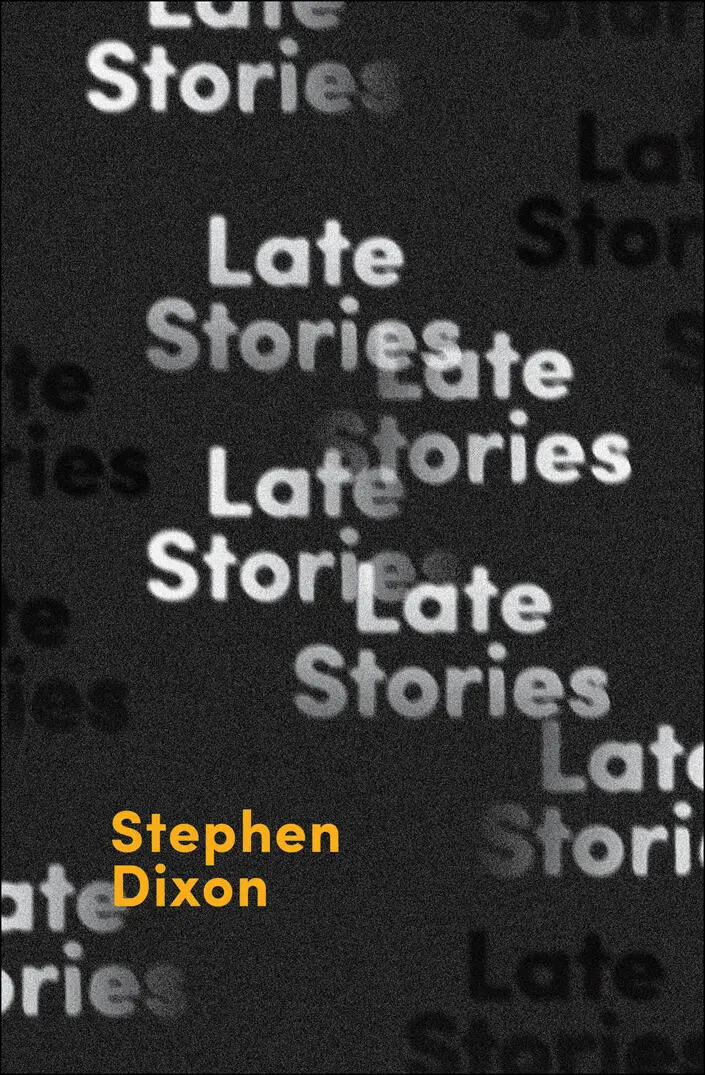
- Название:Late Stories
- Автор:
- Издательство:TRNSFR
- Жанр:
- Год:2016
- ISBN:нет данных
- Рейтинг книги:5 / 5. Голосов: 1
-
Избранное:Добавить в избранное
- Отзывы:
-
Ваша оценка:
Late Stories: краткое содержание, описание и аннотация
Предлагаем к чтению аннотацию, описание, краткое содержание или предисловие (зависит от того, что написал сам автор книги «Late Stories»). Если вы не нашли необходимую информацию о книге — напишите в комментариях, мы постараемся отыскать её.
detail the excursions of an aging narrator navigating the amorphous landscape of grief in a series of tender and often waggishly elliptical digressions.
Described by Jonathan Lethem as "one of the great secret masters" of contemporary American literature, Stephen Dixon is at the height of his form in these uncanny and virtuoso fictions.
With
, master stylist Dixon returns with a collection exploring the elision of memory and reality in the wake of loss.
Late Stories — читать онлайн бесплатно полную книгу (весь текст) целиком
Ниже представлен текст книги, разбитый по страницам. Система сохранения места последней прочитанной страницы, позволяет с удобством читать онлайн бесплатно книгу «Late Stories», без необходимости каждый раз заново искать на чём Вы остановились. Поставьте закладку, и сможете в любой момент перейти на страницу, на которой закончили чтение.
Интервал:
Закладка:
The Dream and the Photograph
He puts down the newspaper, brings the glass he’s been drinking out of into the kitchen and washes it and puts it upside down in the dishrack. He makes sure the door’s locked and turns off the kitchen light. He’s about to go to bed. It’s a little past nine, around the time he almost always goes to bed, but he needs a book to read there. He finished a book this afternoon while he was having lunch and doesn’t know what he wants to read next. He sees Sebald’s The Rings of Saturn lying flat, cover up, on a bookshelf in the living room. He read it about ten years ago, remembers liking it. He’s liked all Sebald’s novels, Austerlitz the most, but that one he loaned to someone, he forgets whom, and never got it back. So maybe he’d like reading Saturn again, something he doesn’t do that much — reread a book — or just start it in bed and if he doesn’t think he’ll want to read any more of it, put it back on the shelf or in the bookcase with the other Sebald books tomorrow and look for another book to read. Or he can drive to his favorite bookshop in Baltimore, only a few miles from his house, and look for a book there. He’s done that a number of times at this shop, scanned the titles on the fiction shelves starting at “A” and a couple of times at “Z” till he found a book he wanted to read or at least start.
He opens the Sebald book to read the first page or two and a photograph drops out of it to the floor. “Damn,” he says, “what the fuck’s going on?” because so many things he grabs or even touches these days fall to the floor, forcing him to bend down and sometimes to get on one knee to pick up. He bends down and picks it up. The back of it says “6/07.” So it was taken in June, six years ago to the month. The photograph has several people in it, all facing the camera. He, Abby, two of his colleagues at school, one standing beside his wife, his arm around her waist. Also the two administrative assistants of his department at the time, and three women he doesn’t recognize. They must work in the Rare Books and Special Collections unit of the school’s library, because that’s the room the photograph was taken in. The occasion was the first day of an exhibit, timed to coincide with his retirement from teaching at the school after twenty-six years, of his original typescripts and first editions of most of his books and photographs of him doing several things related to his writing — sitting at his typewriter at home, reading to a small audience at his favorite bookshop in Baltimore, dressed in a tux at an awards ceremony in New York when he was a finalist for a prestigious literary prize, Abby standing next to him, holding on to her walker, and so on. The exhibit was up for two months. Sometime later, he forgets where he bumped into her, he asked the librarian (she must be one of the three women he doesn’t recognize in the photo) in charge of the exhibit and collecting his finished typescripts and working manuscripts and letters and such — even the unrepairable manual typewriter he must have written a dozen of his books on and which was also behind a display case in the exhibit — how many people came to it. “The usual,” she said, “or maybe a bit less, as it was summer and few students and faculty were around. Nine or ten? Maybe five more who didn’t sign in or were in the room for other reasons but stopped to look.” In the photograph Abby’s in her wheelchair and he’s behind her, hands tightly gripping the handles of the chair, which he always did when he stood behind it, afraid it’d roll away. She looks as if she’s trying to smile but can’t quite get it out. That doesn’t sound right. She was forcing herself to smile. Didn’t want to spoil the photograph — everyone else in it smiling as if they meant it — by looking how she really felt. That doesn’t get it either. So what is it? Photograph was taken a year and a half before she died of pneumonia. She was very sick the previous year, twice almost died of pneumonia. She was still weak when the photograph was taken. Who took it? Probably someone else who worked in Special Collections, or a professional photographer hired by the library so it could publicize the event in its newsletter and on its web page. She hadn’t had the tracheotomy done on her yet — that was a half year later. He knows she never would have consented to be photographed with the inner cannula, was it? — the trach tube, or just “trach”—sticking out of her neck. She doesn’t look that weak, though. Her face is full and there’s some color in her cheeks. Her hair is unkempt. Maybe it was hot and humid that day — Baltimore can get like that in June — so the sticky weather could have done that to her hair — it had plenty of times before — and they might not have had the time or any place to brush it once they got to the library, and brushing her hair was something he usually did for her by then. He puts the photograph back in the book, makes sure the porch door is locked, shuts off the living room light, and brings the book with him to his bedroom. Doesn’t read much of it. Two pages; less. Keeps pulling the photograph out and looking at it. Why does she look the way she does in the photograph — sad, really; dejected? Because she’s in a wheelchair and everyone else is standing. Because she’s sick and weak and they’re all healthy and strong. Because she had to be pushed there in the wheelchair — by this time, she couldn’t even move it a few feet on her own — while everyone else in the photograph is able to walk and run and so on. In other words: they get around on their own while she’s dependent on other people. Because she’ll probably be dead in a year or two, the way she’s going, and half the people in the photograph will probably be going to her funeral or memorial or whatever they’ll go to for her. Because she probably needs to go to the toilet, or will soon — it’s been more than two hours since she last went — and she’ll have to be wheeled there and lifted on and off the toilet seat and have her pad changed. He doesn’t remember doing any of that, but he probably did and all of it so she wouldn’t wet herself on their way home, or if she did, she’d have a dry pad on. Because she could already be wet and is uncomfortable and doesn’t want to say anything in front of all these people or she just doesn’t want to pull him away from this room right now. Because she didn’t want to come to the exhibit but did because he urged her to. It won’t be the same if she’s not there, he told her. “They’re making it into such a big deal,” he said, or something like it, “that there’s going to be a photographer there and I want you to be in the photos with me.” Because sometimes she just wants to die and she has a look that gives the impression that’s what she’s thinking and maybe some of the other things. “I hate being photographed,” she might be saying to herself while the photographer’s photographing the entire group. “I look so awful and sick and weak and ugly and my hair’s a mess, while before I got sick I was pretty and had an attractive figure because I wasn’t squashed into a wheelchair most of the day and I always took care of my hair myself.” He puts the book on the night table, places the photograph on it, and turns off the light.
He has a dream a few hours later. Had two or three dreams, without waking up from them, before he had this one, but this is the only one he remembers. He turns on the night table light, gets out of bed and goes to the bathroom, pees, sits on the bed, his feet on the floor, and gets the notebook he’s been writing his dreams in the last four years off the night table and starts to write. “7/2/13. Dream of Abby in the hospital. She’s sitting on the bed, not in it, her feet almost reaching the floor. She looks good: healthy, pretty; she seems happy. Her face is rosy, her hair’s brushed back into a ponytail. She looks to be around 40. It’s her last day in the hospital. Tomorrow she’s coming home. We have a son, who seems to be around 3 years old. He’s blond, as Abby was when I first met her, and also blond like Randolph, the son of the woman I lived with in California from ’65 to ’68. I was the boy’s surrogate father for 3 years. Randolph, 2½ when I moved into his mother’s house, even called me ‘Daddy.’ I say to Abby ‘I have to go.’ She says ‘You’re leaving me with a hysterical child?’ The boy’s been screaming on and off for the last minute. We ask him ‘What is it? What’s wrong, little guy?’ but he continues to scream, his eyes squeezed closed. I say to Abby over the boy’s screams ‘You’re all right now. You can take care of him. But I’m already late for my appointment.’ ‘Take him with you then,’ and I say ‘You know I can’t,’ and I leave the room. The boy follows me, still screaming hysterically. ‘My son,’ I think. ‘My poor son. Then I think ‘What about this tactic? Maybe it’ll work, because nothing else has.’ I say to him ‘You like tomatoes, don’t you?’ He stops screaming long enough to nod. ‘Well, if I give you a few cherry tomatoes, will you stay with your mother and not make a big fuss anymore?’ He nods again and this time doesn’t resume screaming. I empty a few cherry tomatoes out of a bag into his hand. He eats one, smiles, and eats another. He seems fine now. ‘Here, have some more,’ I say. ‘You deserve it. You’re a great kid. I always thought that.’ I go back into Abby’s room. She’s still sitting off the bed. I say ‘I got him to stop screaming. I can leave him with you now, can’t I? He won’t scream again.’ She says ‘You can. But how’d you do it?’ ‘All it took were tomatoes,’ I say. ‘Cherry tomatoes. Not the big beefsteak kind. He seems to like the cherry ones best. Here, want some? Why not take the whole bag?’ and I give her it. ‘No, thanks,’ she says, giving it back. ‘You’ve done enough for me.’ I kiss her, say ‘See you later,’ and leave the room. ‘Damn,’ I say. ‘I should have kissed the boy too. But he won’t mind that I didn’t. And given him the bag of tomatoes. There weren’t that many left, and what am I going to do with them?’ I walk to the elevator. Elevator comes and the doors open. Nobody’s inside it. ‘See,’ I say, as the doors close. ‘When you use your brains, you get things done. Don’t you feel good now? But really feel good at helping her out rather than deserting her? I do, I really do. This is how I should act from now on. Helpful. Quick-thinking. Imaginative. If only I could,’” and the dream ended.
Читать дальшеИнтервал:
Закладка:
Похожие книги на «Late Stories»
Представляем Вашему вниманию похожие книги на «Late Stories» списком для выбора. Мы отобрали схожую по названию и смыслу литературу в надежде предоставить читателям больше вариантов отыскать новые, интересные, ещё непрочитанные произведения.








Обсуждение, отзывы о книге «Late Stories» и просто собственные мнения читателей. Оставьте ваши комментарии, напишите, что Вы думаете о произведении, его смысле или главных героях. Укажите что конкретно понравилось, а что нет, и почему Вы так считаете.