J.G. Ballard - Cocaine Nights
Здесь есть возможность читать онлайн «J.G. Ballard - Cocaine Nights» — ознакомительный отрывок электронной книги совершенно бесплатно, а после прочтения отрывка купить полную версию. В некоторых случаях можно слушать аудио, скачать через торрент в формате fb2 и присутствует краткое содержание. Жанр: Современная проза, на английском языке. Описание произведения, (предисловие) а так же отзывы посетителей доступны на портале библиотеки ЛибКат.
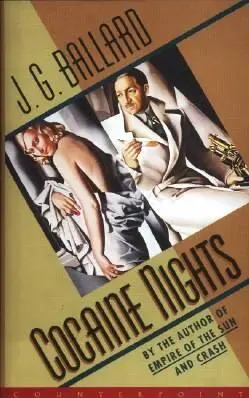
- Название:Cocaine Nights
- Автор:
- Жанр:
- Год:неизвестен
- ISBN:нет данных
- Рейтинг книги:5 / 5. Голосов: 1
-
Избранное:Добавить в избранное
- Отзывы:
-
Ваша оценка:
Cocaine Nights: краткое содержание, описание и аннотация
Предлагаем к чтению аннотацию, описание, краткое содержание или предисловие (зависит от того, что написал сам автор книги «Cocaine Nights»). Если вы не нашли необходимую информацию о книге — напишите в комментариях, мы постараемся отыскать её.
Outward appearances suggest the wholesale adoption of a new ethos of high-spirited, well-controlled collective exuberance. But there’s the matter of the fire: The house and household of an aged, wealthy industrialist has gone up in flames, claiming five lives, while virtually the entire town stood and watched. There’s the matter of the petty crime, the burglaries, muggings, and auto thefts which have begun to nibble away at the edges of Estrella Del Mar’s security despite the guardhouses and surveillance cameras. There’s the matter of the new, flourishing trade in drugs and pornography. And there’s the matter of Frank Prentice, who sits in Marbella jail awaiting trial for arson and five counts of murder, and who, despite being clearly innocent, has happily confessed.
It is up to Charles Prentice, Frank’s brother, to peel away the onionlike layers of denial and deceit which hide the rather ugly truth about this seaside idyll, its residents, and the horrific crime which brought him here. But as is usually the case in a J.G. Ballard book, the truth comes with a price tag attached, and likely without any easing of discomfort for his principal characters.
Cocaine Nights marks a partial return on Ballard’s part to the provocative, highly-successful mid-career methodology employed in novels such as Crash and High Rise: after establishing himself as a science fiction guru in the 1960s, Ballard stylistically shifted gears towards an unnerving, futuristic variant on social realism in the 1970s. Both Crash and High Rise were what-if novels, posing questions as to what the likely results would be if our collective fascination with such things as speed, violence, status, power, and sex were carried just a little bit further: How insane, how brutal could our world become if we really cut loose?
Cocaine Nights asks a question better suited to the ’90s, the age of gated communities and infrared home security systems: Does absolute security guarantee isolation and cultural death? Conversely, is a measure of crime an essential ingredient in a vibrant, living, properly functioning social system? Is it true, as a character asserts, that “Crime and creativity go together, always have done,” and that “total security is a disease of deprivation”? Suffice to say that the answers presented in Nights will be anathema to moral absolutists; the world of Ballard’s fiction, like life in the hyperkinetic, relativistic 1990s, abounds with uncomfortable grey areas.
On the surface, Cocaine Nights is a whodunit and a race against time, but as it proceeds – and as preconceived conceptions of good and evil begin to dissolve – it evolves into a thoughtful, faintly frightening look at under-examined aspects of 1990s western society. As is his wont, Ballard confronts his readers with some faintly outlandish hypotheses unlikely to be embraced by many, but which nonetheless serve to provoke both thought and a bit of paranoia; it’s a method that Ballard has developed and refined on his own, and as usual, it propels his novel along marvellously.
Cocaine Nights doesn’t have either the broad sweep or brute impact of the landmark Crash, but it retains enough social relevance and low-key creepiness to more than satisfy Ballardphiles. As is often the case in Ballard’s alternate reality, it’s a given that his most appealing, human characters turn out to be the most twisted, and that even the most normal of events turn out to be governed by a perverse, malformed logic; that this logic turns out to be grounded in sound sociological and psychological principles is its most horrific feature.
David B. Livingstone
Cocaine Nights — читать онлайн ознакомительный отрывок
Ниже представлен текст книги, разбитый по страницам. Система сохранения места последней прочитанной страницы, позволяет с удобством читать онлайн бесплатно книгу «Cocaine Nights», без необходимости каждый раз заново искать на чём Вы остановились. Поставьте закладку, и сможете в любой момент перейти на страницу, на которой закончили чтение.
Интервал:
Закладка:
'Poor man…' Paula held my arm, eyes avoiding the debris of charred timbers around us, and tried to smile at the chauffeur. 'Do you think he's all right here?'
'I hope so. It looks as if he's waiting for the Hollingers to return. Inspector, what do you know about the psychology of chauffeurs…?'
But Cabrera was pointing to the flight of steps that led to the housekeeper's quarters above the garage. A wrought-iron gate beside the entry door opened on to the blighted hillside where the lemon orchard had once flourished. Cabrera sprinted up the steps and stood by the gate.
'Dr Hamilton, Mr Prentice… you will notice the gate from the orchard. We can now imagine the situation on the evening of 15 June. By seven o'clock the party is well in progress, with all the guests on the terrace beside the pool. As Dr Hamilton will remember, the Hollingers appear on the top-floor veranda and propose the toast to your Queen. Everyone is looking up at the Hollingers, glasses raised to Her Majesty, and no one notices the arsonist when he opens the orchard gate.'
Cabrera skipped down the staircase and stepped past us to the kitchen entrance. He took a set of keys from his pocket and unlocked the door. I appreciated his tactful use of the term 'arsonist', though I suspected that the tour was designed to rid me of my faith in Frank's innocence.
'Inspector, Frank was mingling with the other guests on the terrace. Why would he leave the party and hide in the orchard? Dozens of people talked to him by the pool.'
Cabrera nodded his sympathy at this. 'Exactly, Mr Prentice. But no one remembers speaking to him after six-forty-five. Did you, Dr Hamilton?'
'No – I was with David Hennessy and some friends. I didn't really see Frank at all.' She turned away and stared at the gleaming Bentley, pressing the faded bruise on her mouth as if willing it to return. 'Perhaps he didn't go to the party?'
Cabrera firmly dismissed this. 'Many witnesses spoke to him, but none after six-forty-five. Remember, the arsonist needed to park his incendiary materials close at hand. No one would notice a guest walking up the steps to the orchard. Once there, he collects his bombs-three bottles filled with ether and gasoline that he buried the previous day in a shallow excavation twenty metres from the gate. As the Queen's toast begins he sets off to enter the house. The nearest and most convenient door is this one into the kitchen.'
I nodded at all this, but asked: 'What about the housekeeper? Surely she would have seen him?'
'No. The housekeeper and her husband were by the terrace, helping the temporary staff to serve the canapés and champagne. They were raising their glasses to Her Majesty and saw nothing.'
Cabrera pushed back the door and beckoned us into the kitchen. A brick-built annexe to the main house, it was the only part of the structure undamaged. Saucepans hung from the walls, and the shelves were crowded with spices, herbs and bottles of olive oil. But the yeasty stench of sodden carpets and the acrid odour of charred fabrics filled the room. Pools of water lay on the floor, soaking a walkway of wooden boards laid down by the police investigators.
Cabrera waited until we found our footing and then continued. 'So: the arsonist enters the empty kitchen and seals the door. The house is now closed off from the outside world. The Hollingers preferred their guests not to enter their home, and all the doors on to the terrace were locked. In fact, the guests were completely segregated from their hosts – an English tradition, I assume. Now, let us follow the arsonist when he leaves the kitchen…'
Cabrera led the way into the pantry, a large room that occupied a section of the annexe. A refrigerator, washing-machine and spin-drier stood on the concrete floor, surrounded by pools of water. Beside a deep-freezer cabinet an inspection door opened into a head-high chamber that contained the central heating and air-conditioning system. Cabrera stepped through the inspection door and pointed to the partly dismantled unit, a furnace-sized structure that resembled a large turbine.
'The intake manifold draws air from a pipe on the kitchen roof. The air is filtered and humidified, then either cooled during the summer or heated during the winter, and finally pumped to the rooms around the house. The arsonist switches off the system-for the few minutes he needs no one will notice. He removes the cowling of the humidifier, drains off the water and refills the reservoir with his gasoline and ether mixture. All is now set for a huge and cruel explosion Cabrera ushered us through the service corridor that led into the mansion. We stood in the spacious hall, looking at ourselves in the foam-smeared mirrors, visitors to a marine grotto. The staircase rose a dozen steps, then divided beneath a large baronial fireplace that dominated the hall. Tags of scorched cloth lay in the iron grate, and the ashes had been carefully sifted by the police investigators.
Watching me closely, Cabrera continued: 'Everything is ready. The guests are busy with their party outside, eager to drink the last of the champagne. The Hollingers, their niece Anne, the Swedish maid and the secretary, Mr Sansom, have retired to their rooms to escape the noise. The arsonist takes his remaining bottle of gasoline and ether and soaks a small carpet he has laid in the fireplace. The flames leap swiftly from his match or lighter. He then returns to the pantry. As the fire on the staircase begins to rage he switches on the air-conditioning system…'
Cabrera paused, waiting as Paula gripped my arm to steady herself, knuckles between her teeth.
'It's terrible to imagine. Within seconds the gasoline mixture is driven through the ventilation ducts. Ignited by the flames on the staircase, the rooms of the upper floor turn into an inferno. No one escapes, even though there are emergency steps that lead down to the terrace from a door on the landing. Mr Hollinger's film library, in a room next to his study, adds to the blaze. The house is a furnace, and everyone inside it perishes in a matter of minutes.'
I felt Paula stumble against me, and put an arm around her trembling shoulders. She had begun to cry to herself, and her tears stained the lapel of my cotton jacket. She seemed about to collapse, but rallied herself and murmured: 'Good God, who could do such a thing?'
'Certainly not Frank, Inspector.' Still supporting Paula, I spoke as calmly as I could to Cabrera. 'This dismantling of the air-conditioning system and turning it into an incendiary weapon – Frank could barely change a light-bulb. Whoever carried out this attack had the skills you find only in people trained as military saboteurs.'
'Perhaps, Mr Prentice…' Cabrera watched Paula with obvious concern, and offered her his handkerchief. 'But skills can be learned, especially dangerous ones. Let us continue our tour.'
The staircase was strewn with charred timbers and ceiling plaster, but the police investigators had cleared a narrow ascent. Cabrera climbed the steps, hands holding the scorched banisters, feet sinking in the sodden carpet. The oak panelling around the fireplace had turned to charcoal, but here and there the outlines of a heraldic shield had been preserved.
We paused on the landing, surrounded by blackened walls, the open sky above our heads. The bedroom doors had burned down to their locks and hinges, and through the empty frames we could see into the gutted rooms with their incinerated furniture. The forensic team had laid a catwalk of planks along the exposed joists, and Cabrera stepped warily towards the first of the bedrooms.
I helped Paula along the rocking timber and steadied her against the doorway. In the centre of the room were the remains of a four-poster bed. Around it stood the carbonized ghosts of a desk, dressing-table and a large oak wardrobe in the Spanish style. A line of framed photographs stood on the stone mantelpiece. Some of the glass had melted in the heat, but one frame, surprisingly intact, showed a florid-faced man in a dinner jacket, standing at a lectern inscribed with the legend: 'Beverly Wilshire Hotel'.
Читать дальшеИнтервал:
Закладка:
Похожие книги на «Cocaine Nights»
Представляем Вашему вниманию похожие книги на «Cocaine Nights» списком для выбора. Мы отобрали схожую по названию и смыслу литературу в надежде предоставить читателям больше вариантов отыскать новые, интересные, ещё непрочитанные произведения.






Обсуждение, отзывы о книге «Cocaine Nights» и просто собственные мнения читателей. Оставьте ваши комментарии, напишите, что Вы думаете о произведении, его смысле или главных героях. Укажите что конкретно понравилось, а что нет, и почему Вы так считаете.