Kenzaburo Oe - Somersault
Здесь есть возможность читать онлайн «Kenzaburo Oe - Somersault» весь текст электронной книги совершенно бесплатно (целиком полную версию без сокращений). В некоторых случаях можно слушать аудио, скачать через торрент в формате fb2 и присутствует краткое содержание. Жанр: Современная проза, на английском языке. Описание произведения, (предисловие) а так же отзывы посетителей доступны на портале библиотеки ЛибКат.
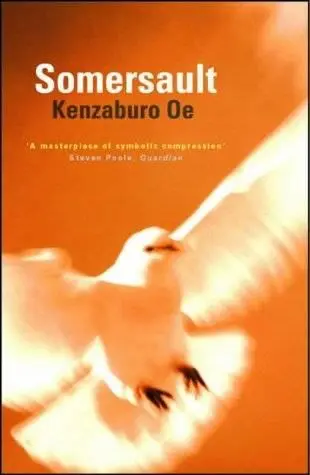
- Название:Somersault
- Автор:
- Жанр:
- Год:неизвестен
- ISBN:нет данных
- Рейтинг книги:4 / 5. Голосов: 1
-
Избранное:Добавить в избранное
- Отзывы:
-
Ваша оценка:
Somersault: краткое содержание, описание и аннотация
Предлагаем к чтению аннотацию, описание, краткое содержание или предисловие (зависит от того, что написал сам автор книги «Somersault»). Если вы не нашли необходимую информацию о книге — напишите в комментариях, мы постараемся отыскать её.
From Publishers Weekly
Nobelist Oe's giant new novel is inspired by the Aum Shinrikyo cult, which released sarin gas in Tokyo 's subway system in 1995. Ten years before the novel begins, Patron and Guide, the elderly leaders of Oe's fictional cult, discover, to their horror, that a militant faction of the organization is planning to seize a nuclear power plant. They dissolve the cult very publicly, on TV, in an act known as the Somersault. Ten years later, Patron decides to restart the fragmented movement, after the militant wing kidnaps and murders Guide, moving the headquarters of the church from Tokyo to the country town of Shikoku. Patron's idea is that he is really a fool Christ; in the end, however, he can't escape his followers' more violent expectations. Oe divides the story between Patron and his inner circle, which consists of his public relations man, Ogi, who is not a believer; his secretary, Dancer, an assertive, desirable young woman; his chauffeur, Ikuo; and Ikuo's lover, Kizu, who replaces Guide as co-leader of the cult. Kizu is a middle-aged artist, troubled by the reoccurrence of colon cancer. Like a Thomas Mann character, he discovers homoerotic passion in the throes of illness. Oe's Dostoyevskian themes should fill his story with thunder, but the pace is slow, and Patron doesn't have the depth of a Myshkin or a Karamazov-he seems anything but charismatic. It is Kizu and Ikuo's story that rises above room temperature, Kizu's sharp, painterly intelligence contrasting with Ikuo's rather sinister ardor. Oe has attempted to create a sprawling masterpiece, but American readers might decide there's more sprawl than masterpiece here.
Somersault — читать онлайн бесплатно полную книгу (весь текст) целиком
Ниже представлен текст книги, разбитый по страницам. Система сохранения места последней прочитанной страницы, позволяет с удобством читать онлайн бесплатно книгу «Somersault», без необходимости каждый раз заново искать на чём Вы остановились. Поставьте закладку, и сможете в любой момент перейти на страницу, на которой закончили чтение.
Интервал:
Закладка:
"I went to med school because of my mother. The last four generations in my family had studied at Tekijuku, and as far as my mother was concerned if I didn't go there I could forget about the future. If you look at my name it's all too clear-my given name is written with the same character as the tekj in Tekijuku. My mother's father was a bureaucrat in the Ministry of Health and Welfare, and it was my mother who really wanted to marry my father, who was a doctor.
"I was born in Boston, where my father had been sent as a research assistant, and I lived there until I was four. So I was one of the first 'returnee children,' as we now call them. Back in Japan I suffered through all kinds of bullying. I liked languages and wanted to study literature, but when I told my mother this she exploded. Naturally she brought up all our ancestors who had studied at Tekijuku. 'It doesn't matter what language you're talk- ing about,' she said, 'Chinese, Dutch, whatever-the only reason people should study them is to use them as tools with which to make a contribution to society. But making a career out of languages is a waste. Name one of the six hundred students at school who've made foreign languages into a useful career!'
"So there it was: I entered medical school. After graduating and finish- ing my internship I ran smack dab into a brick wall. The word doomed would be appropriate. I couldn't touch people's bodies anymore. Usually when you say people's bodies you mean people other than yourself. But unless I used a cloth or paper to come between me and my own skin I couldn't even touch myself, if you can imagine. Thin latex gloves were out because there's no re- sistance and it feels even more like real skin.
"After a while it wasn't just touching people that disturbed me, but also talking with them, and I became painfully conscious of other people's gazes. Being a doctor was out of the question-or even being a patient. I wrapped my hands in bandages, wore tinted goggles, and stayed shut up in a Japanese-style room. And my mother, who'd managed to have her son follow in the footsteps of his illustrious ancestors and graduate from medi- cal school, stayed by me day and night, lamenting what I'd become. Who could stand that? Ha ha!"
A glint in his eyes, Dr. Koga laughed heartily, his sturdy teeth shining.
3
Before long Kizu began to notice that Dr. Koga's expression and force- ful way of speaking was attracting other listeners. The businessman across the aisle had removed his headphones and was leaning toward them, while the napping woman, too, had woken up and was gazing in their direction.
The people in front and behind them weren't visible, but the two men in suits diagonally across from them to the right, rather than trying to ignore Dr. Koga's penetrating voice, had turned around with evident curiosity.
Eventually Dr. Koga realized what was going on. Coming to a conve- nient break in the conversation, he stopped, returned briefly to his seat, and brought back a small booklet. The booklet had a bright resin-coated cover and a title in a foreign language Kizu couldn't read. Dr. Koga opened the book to a spot he'd marked with a colored card, and there was the heading "The Untouchable Body" and his own name.
"Since it doesn't seem appropriate to continue to talk about it here," he said, "why don't you read this? We can talk more after you grasp what an awful fix I was in. We compiled this booklet after the persecution by the authorities had calmed down and we'd rebuilt the organization. We edited this as a collection of all our testimonies of faith. The shock we got at the child- ish-looking pictures those young people drew spurred on all the members of the workshop to try to organize their thoughts and write them down."
"What does the title mean? It looks like German," Kizu said, before letting his gaze drop again to the pages of the booklet.
"It says Andern hat ergeholfen. I'm not sure where this expression comes from," Dr. Koga explained, "but in English it means He saved others. It expresses the feelings of some of my younger colleagues who, even after the Somersault, continued to believe in Patron."
"I'd always imagined it was just as the media reported," Kizu said, "namely, that after the Somersault the former radical faction detested Patron and Guide as traitors and that Guide's death was their act of revenge. I was sure Patron was next on their hit list, which made me worry when I saw how happily Patron accepted all of you back into the fold. But from your perspec- tive Patron was more a tragic figure, wasn't he?"
Dr. Koga squinted as if smoke from a campfire had wafted up in his face. Without a word, he stood up and traded places with Ikuo.
Feeling as though Ikuo was blocking out the other people in the train for him, Kizu eagerly read the booklet to find out what came next in Dr. Koga's story.
From morning to night, my mother mumbled some strange things. The words were directed at me, but in such a low voice I couldn't catch them.
Her words leaked out like a faucet that won't stop dripping.
When my mother could still speak clearly to me, she often quoted two poems: "I, who sleep without awakening from the world of dreams, which I clearly see to be insubstantial-am I really human?" And "When you realize that your state in the world and your mind are not in accord, then truly you will understand."
At the time I was sure my mother couldn't be quoting from classical poetry and only later realized my mistake. For her, after all, Japanese poetry was anathema, for all her ancestors who'd studied at Tekijuku viewed scholars of the classics as their sworn enemy. So I was convinced that these two poems were something she'd conjured up herself as a kind of parody of classical learning. She muttered these words over and over, never explaining what the poems meant, but her mutterings themselves had a kind of dramatic presence, and I knew they expressed a powerful idea that had taken hold of her.
"Even if I could see this world, filled with disappointment, in my dreams, that's the way it is, so why should I be surprised-continuing to sleep, that's the kind of person I'd become." And "Once I realize that my body doesn't do what my mind wants it to, then I will understand well this world, and people, and everything." This is how I interpreted the poems.
Since I was suffering because I was unable to control my own body, I found the second poem particularly unnerving. Even though I felt this deep down, though, I had my doubts about whether this would lead me to a generosity of spirit when it came to other people.
Once, and only once, when she happened to be in a good mood, I asked my mother about this mind-body question. "Your body and your mind are alienated from each other," she said. "The mind is powerless to con- trol your body. I learned this from you. Something is fundamentally wrong with a world that compels someone to live with a mind and body like that. Now I know the world is evil and sinful. This is the wisdom these poets extol," she said.
Returning to the first poem, she went on to say that, knowing how awful and disappointing this world is, she wasn't surprised anymore to wake up and find reality as cold as the cruel dreams she had while sleep- ing. In short, though she couldn't put it into words, she was appealing to me to escape the world with her.
Though she was putting her fate in my hands, I couldn't murder my mother. And I couldn't kill myself either. The reason was quite simple: my phobia about touching bodies, even my own.
Before long this total despair made my mother desperate, and she com- mitted suicide with some poison she'd gotten from a doctor relative be- fore she was married. She took advantage of a short spell of time during which I slept-as I lay sleeping shut up in my room as always all day long, my days and nights like a line of white and black Go stones.
Читать дальшеИнтервал:
Закладка:
Похожие книги на «Somersault»
Представляем Вашему вниманию похожие книги на «Somersault» списком для выбора. Мы отобрали схожую по названию и смыслу литературу в надежде предоставить читателям больше вариантов отыскать новые, интересные, ещё непрочитанные произведения.





Обсуждение, отзывы о книге «Somersault» и просто собственные мнения читателей. Оставьте ваши комментарии, напишите, что Вы думаете о произведении, его смысле или главных героях. Укажите что конкретно понравилось, а что нет, и почему Вы так считаете.