Kenzaburo Oe - Somersault
Здесь есть возможность читать онлайн «Kenzaburo Oe - Somersault» весь текст электронной книги совершенно бесплатно (целиком полную версию без сокращений). В некоторых случаях можно слушать аудио, скачать через торрент в формате fb2 и присутствует краткое содержание. Жанр: Современная проза, на английском языке. Описание произведения, (предисловие) а так же отзывы посетителей доступны на портале библиотеки ЛибКат.
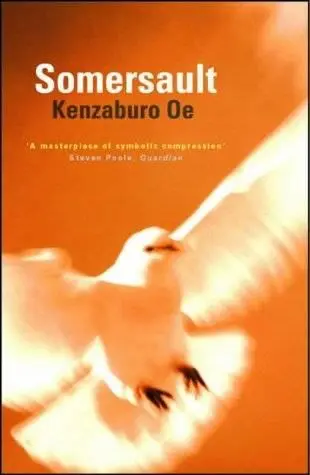
- Название:Somersault
- Автор:
- Жанр:
- Год:неизвестен
- ISBN:нет данных
- Рейтинг книги:4 / 5. Голосов: 1
-
Избранное:Добавить в избранное
- Отзывы:
-
Ваша оценка:
Somersault: краткое содержание, описание и аннотация
Предлагаем к чтению аннотацию, описание, краткое содержание или предисловие (зависит от того, что написал сам автор книги «Somersault»). Если вы не нашли необходимую информацию о книге — напишите в комментариях, мы постараемся отыскать её.
From Publishers Weekly
Nobelist Oe's giant new novel is inspired by the Aum Shinrikyo cult, which released sarin gas in Tokyo 's subway system in 1995. Ten years before the novel begins, Patron and Guide, the elderly leaders of Oe's fictional cult, discover, to their horror, that a militant faction of the organization is planning to seize a nuclear power plant. They dissolve the cult very publicly, on TV, in an act known as the Somersault. Ten years later, Patron decides to restart the fragmented movement, after the militant wing kidnaps and murders Guide, moving the headquarters of the church from Tokyo to the country town of Shikoku. Patron's idea is that he is really a fool Christ; in the end, however, he can't escape his followers' more violent expectations. Oe divides the story between Patron and his inner circle, which consists of his public relations man, Ogi, who is not a believer; his secretary, Dancer, an assertive, desirable young woman; his chauffeur, Ikuo; and Ikuo's lover, Kizu, who replaces Guide as co-leader of the cult. Kizu is a middle-aged artist, troubled by the reoccurrence of colon cancer. Like a Thomas Mann character, he discovers homoerotic passion in the throes of illness. Oe's Dostoyevskian themes should fill his story with thunder, but the pace is slow, and Patron doesn't have the depth of a Myshkin or a Karamazov-he seems anything but charismatic. It is Kizu and Ikuo's story that rises above room temperature, Kizu's sharp, painterly intelligence contrasting with Ikuo's rather sinister ardor. Oe has attempted to create a sprawling masterpiece, but American readers might decide there's more sprawl than masterpiece here.
Somersault — читать онлайн бесплатно полную книгу (весь текст) целиком
Ниже представлен текст книги, разбитый по страницам. Система сохранения места последней прочитанной страницы, позволяет с удобством читать онлайн бесплатно книгу «Somersault», без необходимости каждый раз заново искать на чём Вы остановились. Поставьте закладку, и сможете в любой момент перейти на страницу, на которой закончили чтение.
Интервал:
Закладка:
When Ikuo reminded him that the train trip alone would take six hours, Kizu was surprised not by the length but by how short it was. fust to get from his college town in New Jersey up to Boston sometimes took just as long, if you had a bad connection. But Kizu was a bit on edge, worrying about all the time he'd be spending together with Dr. Koga, whom he barely knew. Aware of this, Ikuo bought two sets of Green Car luxury tickets for seats apart from each other. Kizu and Dr. Koga would each have window seats, with Ikuo sitting beside Kizu and the former Izu researcher beside Dr. Koga.
Most of their luggage was being sent by rented truck, so Kizu and Dr. Koga were able to travel light, with one bag each. For their part, their seat mates had taken on the task of transporting the vacuum tube amplifier that Patron had been using for years and the video equipment of Ms. Asuka, who would be joining them in Shikoku sometime later.
While Kizu searched for the right train car, Ikuo and a man in his mid- thirties were at the front of the platform loading two crates as large as the steamer trunks foreigners travel with. By the time Kizu boarded, the two crates were already stowed aboard. Ikuo introduced the older man as Mr. Hanawa. The latter merely bowed his head in greeting and sat down, leaving the window seat open for Dr. Koga, who had yet to appear, and began reading a book in a foreign language with all sorts of formulas in it.
Three minutes before the train was to pull out of the station, Dr. Koga appeared at the front entrance of the car and strode toward them with the same firm steps he'd shown at the memorial service. Four or five rows ahead of Kizu, Dr. Koga came to a halt where Mr. Hanawa was reading and, hunt- ing cap still on his head, greeted him enthusiastically and swung his bag onto the overhead rack. He removed his duffel coat, which was made of the same deerskin pattern as his cap, and, now in a blue long-sleeve shirt, settled down in the window seat. As Kizu watched him from behind, he worried that, like any city dweller concerned about the weather in the kind of backwoods area they were headed, perhaps Dr. Koga had brought an overly heavy coat.
Kizu was impressed by the no-nonsense way Dr. Koga didn't try to lo- cate his other traveling companions in the flurry just before the train was to leave. Just before he put his suitcase in the overhead rack, Dr. Koga had taken out a thick book that he was now engrossed in; Mr. Hanawa didn't speak to him, and neither did Ikuo stand up to walk over and say hello. Even so, it was clear that Ikuo and Mr. Hanawa were attentive to their duties as escorts.
It had been a long time since Kizu had felt so at ease in the midst of people he didn't know and he settled back, giving himself up to the motion of the train.
Even after they left the cities surrounding Tokyo, the hills and valleys were filled with houses, and in the rare patches of greenery, bulldozers were busily scraping away the last vestiges of nature. In America one would never find such uniform scenery like this. Kizu was surprised to see, on the slope of one mountain, a row of twenty identical houses. The scenery was moving by at a faster clip than he remembered. He spied some tall buildings crowded together beside a river in a valley between two steep mountain slopes and sus- pected they were in a region of hot springs, though he wondered whether there really was a hot springs so near to Tokyo. Meanwhile, after passing through a short tunnel they went through the city of Atami. The Bullet train lived up to its name.
Mount Fuji suddenly appeared, like a raised dark-gray plane, and three lines of leftover snow on it flowed by as streaks of dull white. After this, mountains and forests appeared only sporadically between the towns. Kizu had always had a mental image of train travel in Japan as express trains run- ning past rice fields and mountain forests, and all the towns made him feel a bit uncomfortable. He turned to Ikuo beside him and grumbled out a com- plaint.
"One of my colleagues at the institute traveled in Japan and told me the whole country's nothing but cities and suburbs. I told him to try taking a long- distance train. 'You'll see some pastoral scenery, real Japanese hills and fields; once you change to a local line it'll be even more like that,' I insisted. But look at this-it's all houses or roads or construction sites for new subdivisions. And we've been traveling for an hour at least."
"On Hokkaido, though," Ikuo said, "all you'll see from the train is mountains and fields. I'm sure that once we cross the Seto Bridge and start into Shikoku there'll be a lot more natural scenery."
"You mean until then it's all like this? I was looking forward to chat- ting with Dr. Koga while we enjoyed looking out at the mountains or the sea.
Japan's certainly not what I expected."
"Now that you've given up on the scenery," Ikuo said, in a rare joking way, "maybe it's about time to start talking with Dr. Koga? It's a long trip, and I suppose he felt in no hurry to come over."
"Maybe he's holding back on my account. We're all going to be one big happy family from now on, so I suppose it's high time I changed and stopped being so standoffish."
The relaxed feelings the trip had engendered in Kizu brought on this remark, but Ikuo's response was blunt. "You got that right. I think you will have to change," he said. "I'll switch seats with Dr. Koga. The scenery won't be rural for quite some time."
2
Ikuo took Dr. Koga's seat, while the doctor strode over to where Kizu was sitting. Under thick eyebrows a smile much younger than his years sparkled in his deep-set eyes; he sat down and without any real greeting launched into the topic of Kizu's physical condition.
"The doctor you consulted in Tokyo was a year or so behind me in medical school. When things got out of hand during the student movement period he transferred to a university in California. He's a man who knows how to get ahead, I'll give him that. When you look at how efficiently he handles things like getting me to take over your case, you'll see I'm no match for him.
"The place where we'll be living is an hour and a half from the Red Cross Hospital in Matsuyama-provided the traffic's light. Some areas in the Tokyo area are even farther from a decent hospital, so I wouldn't worry if I were you. I will do whatever's necessary."
Kizu didn't expect to hear anything more at this point from the doctor who'd be caring for him. He nodded, relaxed by Dr. Koga's smile.
"We'll be together from now on so there's no need to rush, but I do have some questions I'd like to ask, if that's all right?" Dr. Koga looked ready to stand up and leave if Kizu hesitated.
"Yes, I'd like that," Kizu said. "The reason I haven't come over to talk with you is that I've been looking out the window, waiting impatiently for us to get someplace where there aren't any more buildings or roads. Now that I think about it, though, it's silly to imagine they'd build a bullet train through remote mountains and valleys."
Dr. Koga settled back down in his seat and gazed out the window. He seemed to speak only when he wanted to discuss the business at hand, which Kizu found refeshing.
"Did your doctor explain the symptoms of your disease to you clearly?"
Dr. Koga asked. "Typically, that only happens when an immediate operation is indicated, at which point the patient gets pretty busy, with little time to consider the situation carefully. When you were given the prognosis, though, you didn't have an operation-you didn't have any proper treatment, either.
Instead, you've done what most patients don't get a chance to do-think deeply about your condition. I'd like to ask you, not out of simple curiosity but as a physician: Has this prognosis brought about any psychological change?"
Читать дальшеИнтервал:
Закладка:
Похожие книги на «Somersault»
Представляем Вашему вниманию похожие книги на «Somersault» списком для выбора. Мы отобрали схожую по названию и смыслу литературу в надежде предоставить читателям больше вариантов отыскать новые, интересные, ещё непрочитанные произведения.





Обсуждение, отзывы о книге «Somersault» и просто собственные мнения читателей. Оставьте ваши комментарии, напишите, что Вы думаете о произведении, его смысле или главных героях. Укажите что конкретно понравилось, а что нет, и почему Вы так считаете.