Kenzaburo Oe - Somersault
Здесь есть возможность читать онлайн «Kenzaburo Oe - Somersault» весь текст электронной книги совершенно бесплатно (целиком полную версию без сокращений). В некоторых случаях можно слушать аудио, скачать через торрент в формате fb2 и присутствует краткое содержание. Жанр: Современная проза, на английском языке. Описание произведения, (предисловие) а так же отзывы посетителей доступны на портале библиотеки ЛибКат.
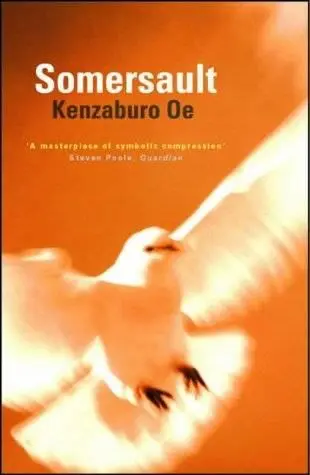
- Название:Somersault
- Автор:
- Жанр:
- Год:неизвестен
- ISBN:нет данных
- Рейтинг книги:4 / 5. Голосов: 1
-
Избранное:Добавить в избранное
- Отзывы:
-
Ваша оценка:
Somersault: краткое содержание, описание и аннотация
Предлагаем к чтению аннотацию, описание, краткое содержание или предисловие (зависит от того, что написал сам автор книги «Somersault»). Если вы не нашли необходимую информацию о книге — напишите в комментариях, мы постараемся отыскать её.
From Publishers Weekly
Nobelist Oe's giant new novel is inspired by the Aum Shinrikyo cult, which released sarin gas in Tokyo 's subway system in 1995. Ten years before the novel begins, Patron and Guide, the elderly leaders of Oe's fictional cult, discover, to their horror, that a militant faction of the organization is planning to seize a nuclear power plant. They dissolve the cult very publicly, on TV, in an act known as the Somersault. Ten years later, Patron decides to restart the fragmented movement, after the militant wing kidnaps and murders Guide, moving the headquarters of the church from Tokyo to the country town of Shikoku. Patron's idea is that he is really a fool Christ; in the end, however, he can't escape his followers' more violent expectations. Oe divides the story between Patron and his inner circle, which consists of his public relations man, Ogi, who is not a believer; his secretary, Dancer, an assertive, desirable young woman; his chauffeur, Ikuo; and Ikuo's lover, Kizu, who replaces Guide as co-leader of the cult. Kizu is a middle-aged artist, troubled by the reoccurrence of colon cancer. Like a Thomas Mann character, he discovers homoerotic passion in the throes of illness. Oe's Dostoyevskian themes should fill his story with thunder, but the pace is slow, and Patron doesn't have the depth of a Myshkin or a Karamazov-he seems anything but charismatic. It is Kizu and Ikuo's story that rises above room temperature, Kizu's sharp, painterly intelligence contrasting with Ikuo's rather sinister ardor. Oe has attempted to create a sprawling masterpiece, but American readers might decide there's more sprawl than masterpiece here.
Somersault — читать онлайн бесплатно полную книгу (весь текст) целиком
Ниже представлен текст книги, разбитый по страницам. Система сохранения места последней прочитанной страницы, позволяет с удобством читать онлайн бесплатно книгу «Somersault», без необходимости каждый раз заново искать на чём Вы остановились. Поставьте закладку, и сможете в любой момент перейти на страницу, на которой закончили чтение.
Интервал:
Закладка:
They exchanged a firm handshake, something Kizu experienced rarely in Japan, and said goodbye, and Kizu strolled off toward the Ginza subway station-also something he hadn't done in a while-pleasantly anticipating his new art school. The children he'd teach probably had never seen such paints, and when he went through the names of the colors with them this simple process would be a real education about the world around them. The countryside they'd be moving to was near the central mountain range in Shikoku, and as the children looked at the changing seasons in the forest, giving the name of a particular color to what they saw and then reproducing the scene on paper, their awareness of the forest that surrounded them would be transformed. They'd come to know and grasp the world in a way they'd never experienced before.
Kizu realized that his life as an art instructor, which had begun in a high school in the countryside near a forest, was now about to end in a similar way, opening an art class in a place surrounded by a deep forest, albeit a place he'd yet to lay eyes on. He was deeply moved that his life was coming full circle.
Together with a strangely calm sense of fulfillment, he found himself in high spirits as he accepted the fact that he was about to be thrust into a life that promised some startling twists and turns. As long as cancer didn't floor him, he knew he could make it.
Kizu's subway car passed one of the stations that had been attacked with sarin gas.
6
With the scheduled move to the buildings in the forests of Shikoku fast approaching, the one urgent personal matter that Kizu had to solve was the question of finding a replacement in Shikoku for the doctor who had taken on the responsibility of overseeing his own self-centered way of dealing with his cancer. This was Kizu's one concern about leaving Tokyo for good. Com- pletely at a loss as to what he should do, he went again to the clinic in Akasaka.
Kizu hadn't mentioned it before, but now he told his doctor how he had no intention of returning to his university in the United States, and would be moving to the forests of Shikoku as a member of a church; the doctor seemed surprised to hear this but didn't ask any questions. He seemed to be weigh- ing the connection between the new signs of cancer and Kizu's dramatic lifestyle changes. Done with that, he questioned Kizu in detail about practi- cal matters such as the distance between this village in the woods and the nearest city hospital, the conditions of the nearest clinic, and so on. But Kizu hadn't gathered any such information. Hard put to reply, he told him there would be one doctor, a Dr. Koga, among the followers, who'd all be living a communal life. "I'm not sure if he's still practicing," Kizu added, "but he's fairly well known."
"Kanau Koga?" said his doctor. "He is indeed a well-known clinician.
Of course he's still practicing medicine. If he's going to quit his practice and move, it'll be a blow to whatever hospital he's been working for. You're very lucky to have him with you."
Surprised, Kizu listened as the doctor ardently talked on, his face with his rimless glasses looking down as Kizu watched him.
"I once read in the papers that Dr. Koga was involved with a religious group," the doctor said; though not looking in Kizu's direction, his reactions were precise. "But wasn't that a long time ago? We don't belong to the same academic society, but he was just a year ahead of me in university and I've known him ever since. Even now I hear news about him, but nothing about any religious group."
The doctor's next words showed he'd given this some thought and was trying to express his interest.
"That must be a very interesting religious group to make Dr. Koga quit his post in a Tokyo hospital and go live in a commune in the woods. And here you are too, participating despite your cancer."
"My case is different from Dr. Koga's," Kizu said hurriedly. "At any rate, this will be the last job of my life. Besides, I'm sort of a lukewarm par- ticipant-I don't even know much about the doctrines of the church."
"I'm not about to ask anything personal about the church," the doctor said, and looked down again as before, "but being with Dr. Koga is a definite plus for you. I haven't received the medical records yet from the hospital in New Jersey-we'll take care of that later-but for now I'll collect all the records I do have and hand them over to Dr. Koga. I'll write a letter to him, too, outlining the plan we discussed for administering morphine."
The thought suddenly came to Kizu that if he were to choose an adviser for Ikuo after his death this doctor would make a fine choice, and he realized he'd never considered who he could trust to be Ikuo's counselor after he was gone, a sure sign that he was trying to avoid thinking about his approaching inevitable demise.
The doctor half turned away from Kizu, who was sitting on a stool, and began writing a letter at his plain desk. After gathering together the docu- merits he'd mentioned-Kizu's health record he'd brought from America, plus copies of the charts of his last examination-the doctor was no doubt writing a letter to Dr. Koga. This straightforward way of taking care of busi- ness forced Kizu to reflect on his own vague attitude toward life despite the short time left to him.
The doctor put the letter inside a plain business envelope printed with the name of the clinic and passed this, along with a larger envelope of medi- cal records, over to Kizu.
"You tend to downplay the value of things you do, but I'm very inter- ested to see people like you and Dr. Koga working on a joint project. It's quite refreshing, since intellectuals of your caliber in Japan very rarely do joint work outside their own fields."
"I don't know Dr. Koga very well," Kizu said, "but I know that through the events of ten years ago, and even now, he's a fanatically confident follower.
But as I said, I'm lukewarm about this idea. The only reason I'm moving to Shikoku is because the young man I like is going there. I can't believe it my- self sometimes that I'm doing such a bizarre thing in my condition."
"No, I'm sure you gave it a lot of thought before you decided."
The doctor smiled for the first time that day-albeit a weak smile- and saw Kizu out. Afterward, as Kizu was waiting in line one floor below to pay his bill, the doctor passed right by him on his way to the staff bathroom, his face looking unexpectedly old and worried.
16: THE CLINICIAN
1
Ikuo delivered the letter and records to Dr. Koga's clinic right away.
Kizu had wanted to go over to say hello personally, but Dr. Koga was busy tying up loose ends before their move to Shikoku. Ikuo relayed a message from the doctor that he couldn't spare the time right now and would see Kizu later; holding out hope because he'd said later, Ikuo took it upon himself to see that things proceeded in that direction.
Dr. Koga had been raised in an area behind the Tokyo University Hos- pital, where his father worked, and the only traveling he'd ever done before now was plane trips to academic conferences in the Kansai region, Kyushu, and points in between. The village they were heading to in Shikoku had a clinic but no regular doctor; since he would be taking charge of the facilities, Dr. Koga had already gone there once to consult about the clinic. Since that trip was by plane, from Haneda airport to Matsuyama, when it came time to move to Shikoku he said he hoped they could make the whole trip by train.
After many years in America, and knowing he wouldn't have another chance to travel by train across Japan, Kizu also thought it would be nice to see scenery different from that in which he'd been raised as he journeyed to the site of his final abode. Ikuo picked up on this idea and arranged for Dr. Koga and Kizu to travel by train, accompanied by himself and a former member of the Izu Research Institute. They were to leave Tokyo a little before 11 A.M. on the Nozomi bullet train. Something over three hours later, they would arrive in Okayama, where they'd change to the Shiokaze; from there they'd cross over to Shikoku on the Seto Bridge and take the Yosan Line, arriving in Matsuyama after 5 P.M. At the JR train station in Matsuyama they'd meet up with Patron, who was traveling by plane, and the church members coming by minivan, and then everyone would head by car to the forest.
Читать дальшеИнтервал:
Закладка:
Похожие книги на «Somersault»
Представляем Вашему вниманию похожие книги на «Somersault» списком для выбора. Мы отобрали схожую по названию и смыслу литературу в надежде предоставить читателям больше вариантов отыскать новые, интересные, ещё непрочитанные произведения.





Обсуждение, отзывы о книге «Somersault» и просто собственные мнения читателей. Оставьте ваши комментарии, напишите, что Вы думаете о произведении, его смысле или главных героях. Укажите что конкретно понравилось, а что нет, и почему Вы так считаете.